
EdgeCortix expands from inference to physical AI and has introduced Raiden, a scalable AI chiplet architecture targeting robotics, autonomous systems, aerospace, and high-performance edge computing. The platform combines up to four compute dies with shared software, configurable power, and high-speed connectivity. Its flagship Raiden-X4 targets 3.36 PFLOPS of FP4 compute, 256 GB of memory, and 6.4 Tb/s of chip-to-chip connectivity. Early customer commitments from Kawasaki Heavy Industries and Unigen indicate commercial interest ahead of sampling in 2027 and planned volume production later that year.
EdgeCortix, a Japanese fabless semiconductor company specializing in energy-efficient AI processing, introduced Raiden on September 24, 2026. The chiplet platform extends the company’s accelerator technology into higher-performance systems for physical AI, where autonomous machines must interpret sensor information, execute AI models, make decisions, and interact with their environments.
The architecture addresses an increasingly important problem in edge computing. Advanced AI applications require substantial computational throughput, memory capacity, data movement, and predictable execution times. Robotics, autonomous vehicles, industrial automation, and aerospace systems also impose constraints on power consumption, cooling, physical dimensions, and system reliability.
EdgeCortix developed Raiden around a common architecture that scales from one compute die to four. The company calls this segment the thick edge, systems that operate near physical equipment and sensors while supporting computational workloads that previously required substantial server infrastructure.
Raiden extends EdgeCortix’s DNA-X accelerator architecture and MERA software environment across three configurations: Raiden-X1, Raiden-X2, and Raiden-X4.
The company has secured initial design wins and expects to begin customer sampling in early 2027.
One architecture supports three performance configurations
Raiden’s modular architecture allows system designers to select one, two, or four compute dies according to application requirements. Each configuration uses the same underlying accelerator technology and software environment.
The single-die X1 targets applications requiring localized AI processing within constrained power and space envelopes. The two-die X2 expands available computational resources, while the four-die X4 targets larger models, concurrent workloads, and high-performance edge infrastructure.
EdgeCortix has not yet published complete performance and deployment specifications for X1 and X2. The company plans to introduce those details during subsequent phases of the launch.
For silicon teams and system integrators, the common architecture offers a potential advantage in platform development. A single software environment can support multiple product configurations, reducing the engineering work associated with deploying applications across different hardware performance classes.
The approach also gives OEMs a migration path as AI models become larger and application requirements evolve.
Raiden-X4 combines four compute dies
Raiden-X4 represents the flagship configuration. It integrates four DNA-X compute dies into a coordinated AI processing system with high-speed die-to-die communication.
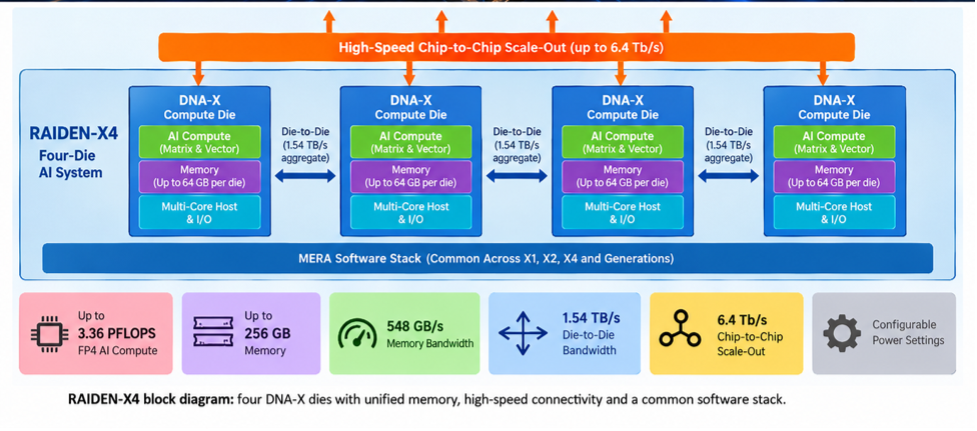
Figure 1. Raiden-X4 integrates four compute dies with high-speed interconnects and memory.
EdgeCortix specifies up to 3.36 PFLOPS of FP4 AI compute, 256 GB of memory, and 548 GB/s of memory bandwidth. The architecture also provides up to 1.54 TB/s of aggregate die-to-die bandwidth and 6.4 Tb/s of chip-to-chip connectivity.
The company includes integrated multicore host processing on each die and configurable power settings to support different system requirements.
These specifications describe architectural targets. EdgeCortix has not provided independently verified application benchmarks, sustained performance measurements, or detailed power-consumption figures in its announcement.
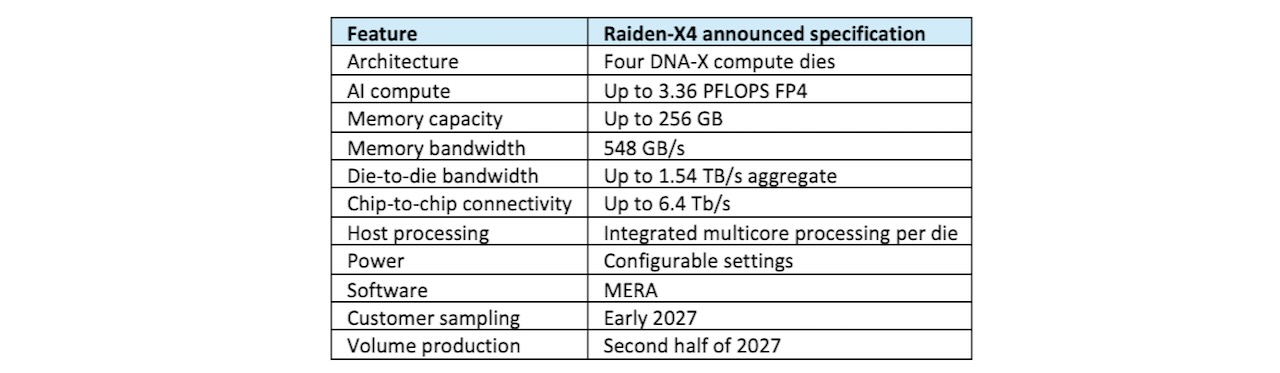
Table 1. EdgeCortix’s announced Raiden-X4 architectural capabilities and production schedule.
The compute specification indicates substantial low-precision arithmetic capability. Actual performance will depend on model architecture, numerical formats, memory behavior, compiler efficiency, and utilization across the four dies.
FP4 throughput provides a useful architectural indicator, although real-world inference performance also depends on support for other numerical formats, including those required for model accuracy and intermediate calculations.
Memory and interconnect determine system scalability
Raiden’s architecture addresses the relationship between compute throughput and data movement. Physical AI applications often process multiple sensor streams while executing perception models, planning algorithms, and control functions.
Memory capacity determines how many models and intermediate datasets a system can retain locally. Memory bandwidth influences how quickly the accelerator can supply data to its compute engines.
The announced 256 GB capacity gives Raiden-X4 room for larger models and concurrent applications. Its 548 GB/s memory bandwidth establishes an important performance constraint that developers must consider alongside the advertised FP4 compute capability.
The 1.54 TB/s aggregate die-to-die bandwidth supports communication among the four compute dies. EdgeCortix also provides up to 6.4 Tb/s of chip-to-chip connectivity for systems requiring additional scale.
System architects will need detailed information about memory topology, interconnect latency, coherence, workload partitioning, and communication overhead to evaluate the architecture fully.
DNA-X adds programmable matrix and vector processing
Raiden introduces an updated DNA-X architecture with microcode-programmable matrix and vector engines.
The design extends EdgeCortix’s runtime-reconfigurable processing approach, allowing the accelerator to address a broader range of computational operations associated with physical AI.
These workloads include neural-network inference, perception processing, reasoning functions, and application-specific calculations. The architecture aims to coordinate these activities within a common processing environment.
For ISVs, programmable execution resources can expand the range of algorithms that run efficiently on specialized silicon. Their practical value depends on instruction support, compiler optimization, scheduling, and software accessibility.
EdgeCortix uses MERA as its common software development and deployment stack. The company says MERA supports both its existing Sakura-II products and the new Raiden family.
This continuity could help developers transfer existing applications and models while reducing the cost of maintaining separate software implementations.
Customer commitments support commercial development
EdgeCortix has identified Kawasaki Heavy Industries and Unigen as early customers.
Kawasaki selected Raiden-based solutions for multiple aerospace and defense programs. These applications require reliable computing platforms capable of supporting evolving AI workloads over extended product lifecycles.
Unigen plans to develop Raiden-based server platforms, expanding its existing collaboration with EdgeCortix. The companies currently work together on Sakura-II modules and server systems.
The two engagements demonstrate different deployment requirements. Aerospace systems emphasize constrained operating environments, reliability, and long-term support. Edge servers emphasize throughput, scalability, serviceability, and infrastructure integration.
For CIOs and IT organizations, Raiden’s commercial relevance will depend on system availability, supported software frameworks, application performance, power efficiency, and lifecycle costs.
Production plans establish the next milestones
EdgeCortix expects to begin customer sampling in early 2027 and plans volume production during the second half of that year.
The company has opened its Raiden Early Access Program to qualified customers and ecosystem partners. Participants can engage during development and receive priority consideration for samples.
The schedule gives EdgeCortix a relatively short interval between initial sampling and planned volume manufacturing. Successful execution will require silicon validation, software maturity, packaging qualification, and reliable production capacity.
The announced customer programs provide an initial commercial foundation. Broader adoption will depend on demonstrated performance across physical AI workloads and the company’s ability to deliver complete, supported computing platforms.
Raiden represents a substantial expansion of EdgeCortix’s product strategy. Its combination of scalable chiplets, programmable AI acceleration, integrated host processing, and common software addresses the growing computational requirements of intelligent machines and distributed AI infrastructure.
What do we think?
EdgeCortix was founded in July 2019 by Dr. Sakyasingha Dasgupta in Tokyo, Japan, and raised more than $110 million. The company has developed a coherent architectural strategy for physical AI. Raiden combines scalable compute, substantial memory capacity, high-speed interconnects, and software continuity across multiple configurations. The early customer commitments strengthen its commercial prospects. However, power efficiency, memory utilization, application performance, and software maturity remain unverified. Production silicon and customer benchmarks will determine the architecture’s competitive position in edge AI markets.
Inflection point. Raiden suggests a potential inflection point in the evolution of physical AI computing. Its chiplet architecture illustrates how semiconductor developers can extend specialized AI acceleration into systems that combine perception, reasoning, and real-time control. The common hardware and software platform could simplify deployment across different performance classes. If EdgeCortix delivers its announced capabilities and production schedule, Raiden may accelerate adoption of larger AI models in autonomous machines, industrial systems, aerospace applications, and distributed edge infrastructure.
The addition of the Raiden-X4 increases the number of AI processors to 341 in our AI processor management information system tracker, offered by 155 active suppliers.
WHATYA THINK, INTERESTING ENOUGH TO SHARE WITH YOUR FRIENDS? WE’VE GOT MORE.