
The Steam Machine is a console-PC hybrid built around a custom AMD RDNA 3 GPU with 28 compute units and a 6-core/12-thread Zen 5 CPU. With 16 GB DDR5, 8 GB VRAM, and storage options from 51 2GB to 2 TB plus microSD, it targets 4K/60 via FSR upscaling and the RX 7600 class. Connectivity includes HDMI 2.0, DP 1.4, USB-A/C, gigabit Ethernet, Wi-Fi 6E, and Bluetooth 5.3. Performance slots place it between Xbox Series S and X; medium-settings 4K is feasible, but 8 GB VRAM and RDNA 3 limit ray tracing in practice.

(Source: Valve, Steam)
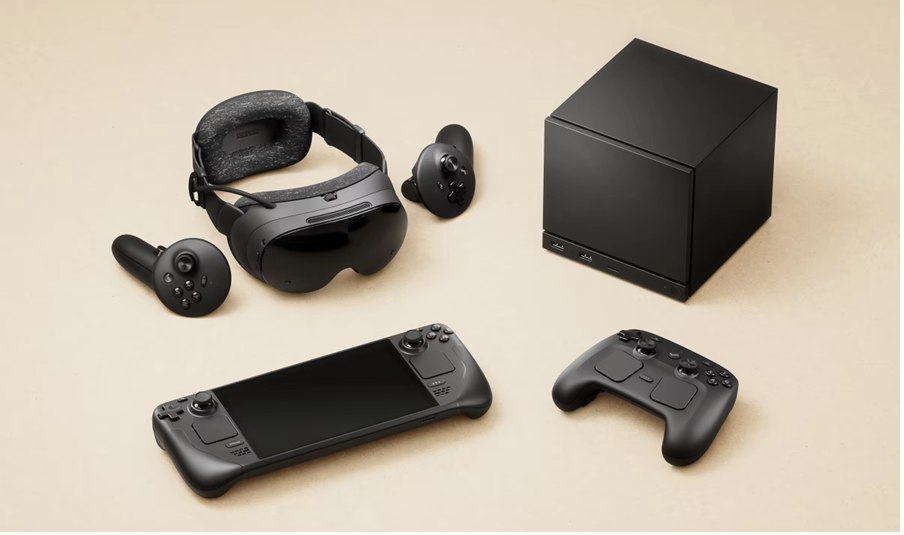
Valve’s renewed push into dedicated hardware marks a key milestone in the company’s long effort to expand SteamOS beyond handheld devices into living rooms and immersive computing environments. After years of speculation, the organization unveiled a unified lineup that includes a compact console-style PC, a standalone VR headset, and an improved controller ecosystem. Collectively, these devices aim to create a seamless computing platform across traditional screens, portable devices, and virtual environments, with SteamOS and Proton serving as the foundational software layer. Valve says it is six times more powerful than its Steam Deck.
The Steam Machine is Valve’s latest effort to create a ready-to-use living room PC. The company previously tried a similar idea in the mid-2010s through collaborations with outside manufacturers, but those systems never gained widespread support due to limited Linux game compatibility and inconsistent hardware designs. The release of the Steam Deck in 2022 changed that situation by showing that SteamOS could run a large library of Windows games via Proton, often with competitive performance. The handheld’s success set expectations that Valve would come back with a more powerful system for the living room, and the company has now made that plan official.
The new Steam Machine is a compact, cube-shaped system designed to function very much like a console. Its enclosure measures only a few inches on each side, with an internal power supply and a front panel that can be replaced or customized. Valve has shown prototypes made from different materials, although official accessory plans are still unconfirmed. Inside, the system uses a custom AMD processor that combines a Zen-based CPU with a 28-compute-unit RDNA 3 GPU. The graphics component operates within a modest power budget and includes 8 GB of video memory, placing it in a performance range similar to AMD’s Radeon RX 7600 or its mobile equivalents. Valve considers this design to be a practical balance between capability, thermal performance, and component cost. The system pairs the GPU with a six-core, 12-thread CPU, 16 GB of DDR5 RAM, and either 512 GB or 2 TB of NVMe storage, with room for a user-replaceable 2280 SSD. All other components, including the CPU and GPU, are soldered and not upgradable by the user.
The device’s thermal design emphasizes sustained performance within a compact chassis. A sizable internal heatsink occupies most of the internal space, directing air from the front and bottom ports to a rear exhaust. Valve states that the system maintains low noise levels even during continuous gaming sessions. The port layout features both front and rear USB ports, DisplayPort, HDMI, Ethernet, and a microSD slot designed for quick transfer of files from Steam Deck storage. Wireless connectivity includes Wi-Fi 6E and Bluetooth 5.3.
Valve asserts that, when paired with AMD’s FSR upscaling, the Steam Machine is capable of running the entire Steam catalog at 4K resolution and 60 fps. Demonstrations of titles such as Cyberpunk 2077 suggest that upscaled rendering from lower internal resolutions can produce stable frame rates, although visually demanding games with advanced lighting models still require reductions in quality settings. Benchmarks from hands-on sessions indicate that some titles perform well at 4K with appropriate settings, while others, particularly those built on Unreal Engine 5, show variable frame rates unless resolution or quality presets are reduced. The system’s reliance on HDMI 2.0 and DisplayPort 1.4 also fixes its output to 60 Hz at 4K, which limits high-refresh scenarios. Valve acknowledges these constraints and emphasizes that SteamOS optimizations and Proton’s translation efficiency narrow the gap between the Steam Machine and higher-spec Windows systems despite the hardware’s modest GPU configuration.
(Source: Valve, Steam)
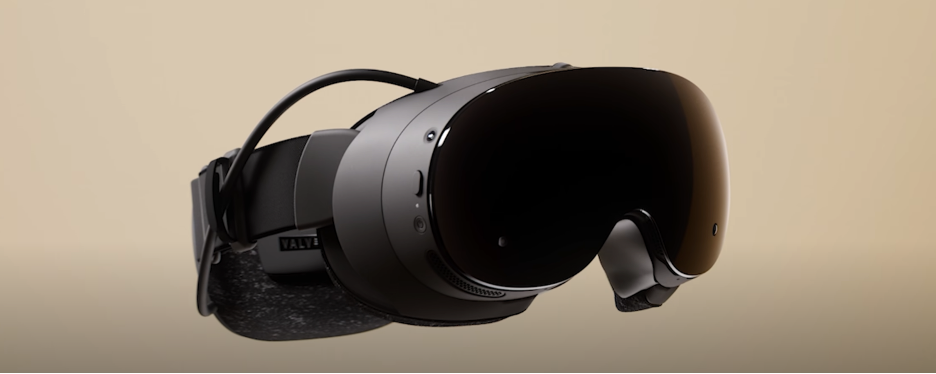
Alongside the Steam Machine, Valve introduced the Steam Frame, a stand-alone VR headset designed to work either independently or connected to a PC. The device features an Arm-based Snapdragon processor with 16 GB of LPDDR5X memory and up to 1 TB of UFS storage, plus support for external microSD expansion. Its display system uses compact pancake lenses to deliver a resolution of 2,160 × 2,160 pixels per eye, running at refresh rates between 72 and 144 Hz with a maximum field of view of approximately 110 degrees. Tracking is managed through outward-facing cameras for positional data and internal cameras for eye tracking and foveated rendering. Valve states that any Steam Deck–compatible Linux software can run on the headset, with x86 applications translated via a software layer. The company has started distributing development kits, enabling studios to evaluate performance and add native support.
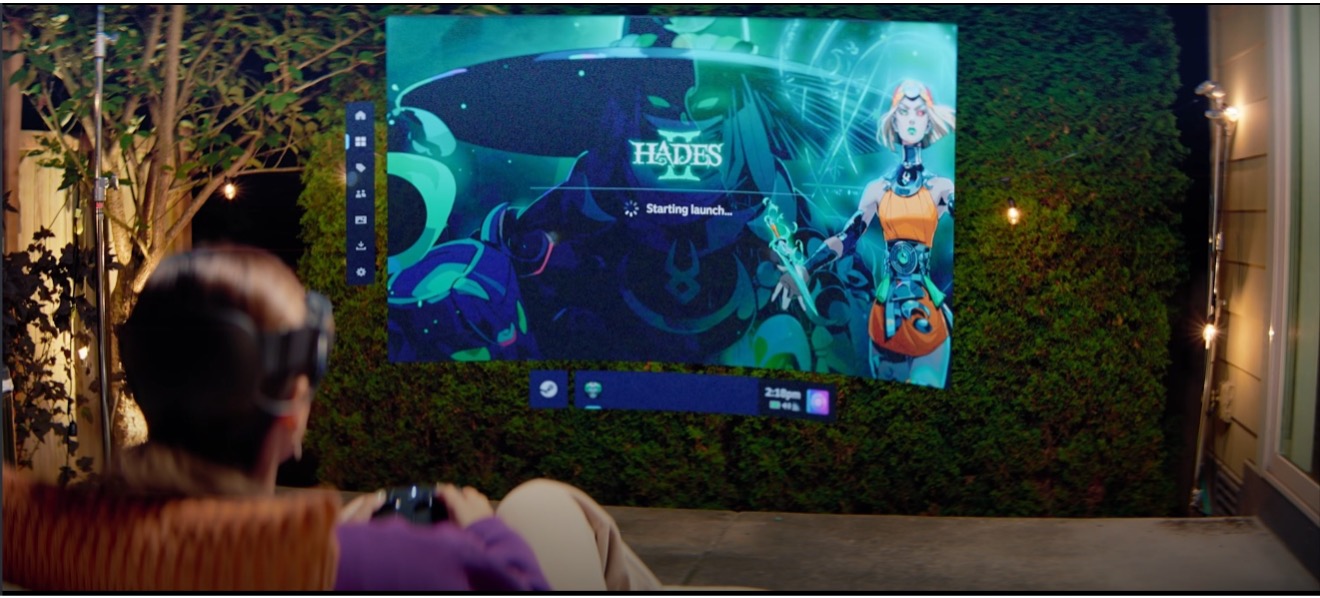
VR in your back yard. (Source: Valve, Steam)
To support these systems, Valve introduced new motion controllers for VR, along with a redesigned Steam Controller. The VR controllers have a shape similar to existing stand-alone headsets but feature a full button set, a directional pad, finger-tracking sensors, and haptic actuators. Each device uses a replaceable AA battery. The Steam Controller 2 drops the experimental layout of its predecessor and adopts a more traditional shape with trackpads modeled after those on the Steam Deck. The analog sticks use magnetic sensing to prevent drift, and the controller supports gyro input via touch sensors. It connects through USB or Bluetooth and can pair with a magnetic puck that serves as a wireless dongle and charging stand. Built-in support in the Steam Machine allows the controller to turn on the system remotely.
Valve’s main goal is to unify SteamOS as a seamless platform across various devices. The company is broadening its verification program to show that games marked as Steam Deck Verified will also display compatibility with the Steam Machine, while a different label will be used for the Steam Frame. This method follows the same approach used for the handheld, where compatibility badges greatly influence user expectations and developer optimization efforts.

A game on Steam’s console. (Source: Valve, Steam)
During demonstrations, Valve indicated that Steam Deck usage patterns informed the development of the new hardware. A notable portion of handheld users connected their devices to televisions through docking stations but experienced performance limitations due to the Steam Deck’s power constraints at high resolutions. The Steam Machine is intended to address that use case directly by providing a small, quiet system capable of running most contemporary games at living room resolutions without the variability associated with handheld hardware.
(Source: Valve, Steam)
Market conditions around component pricing remain uncertain, and Valve has not revealed final prices for any of the new systems. The company only states that the Steam Machine will be priced competitively compared to similarly configured PCs. Its final cost will determine how directly it competes with current consoles and whether it is mainly adopted by new entrants to PC gaming or by existing Steam users looking for a fixed, console-style device. Regardless of its eventual market position, Valve’s announcements show a clear effort to build a hardware ecosystem that covers handheld, desktop, and immersive environments under a unified operating system and software catalog.
LIKE WHAT YOU’RE READING? INTRODUCE US TO YOUR FRIENDS AND COLLEAGUES.