
At CES, Swave Photonics demonstrated tangible progress on its long-running ambition: true holographic displays suitable for near-eye applications. The company showed a dynamic holographic modulator operating live for the first time, alongside growing evidence that its technology and business are moving out of the lab and toward early commercialization.
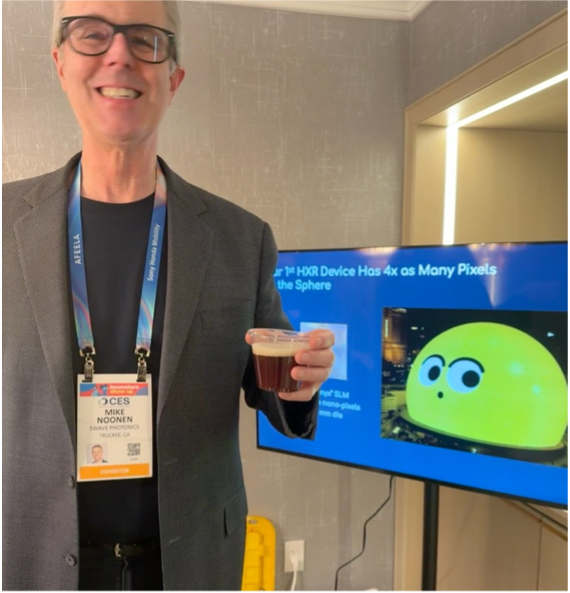
Swave CEO Mike Noonen celebrates shipping development kits, at CES 2026. (Source: JPR)
The CES Swave demo centered on a dynamic holographic display modulator, shown publicly for the first time in an active state. You’ll have to take our word for that because the company wasn’t up for photography, citing ongoing work ahead of Photonics West as the reason the CES demo wasn’t what they wanted to promote.
The device is a pixelated spatial light modulator divided into four logical quadrants, with a total of 256 million pixels. Its sub-wavelength pixel pitch (below 300 nm) directly determines diffraction angle and, therefore, field of view, enabling a demonstrated 160-degree field of view at blue wavelength, which Swave described as the limiting case.
The modulator was illuminated by red, green, and blue lasers, each incident from a different direction. This approach enables full-color holographic images without color filters, relying instead on holographic reconstruction. An optical relay fed the output into a camera used as a proxy for the human eye.
A key element of the demo was dynamic depth and focus control. The system alternated focus between distant content across the room and near content at roughly 20–25 cm, demonstrating two discrete depth planes while allowing for continuous depth placement within that range. Unlike earlier static demonstrations, this system was fully dynamic, supporting animated objects and conceptual AR-style UI overlays, with content appearing at contextually appropriate depths—for example, messages at arm’s length and navigation cues farther out.
Real-time hologram generation was handled using a Swave-designed FPGA-based compute processor, positioned explicitly as a development path toward an eventual ASIC. The pipeline is centered on Fourier transform (FT)-based hologram synthesis, combined with proprietary steps for image placement and noise reduction. Longer term, Swave plans to co-package the compute engine and modulator using a high-speed interconnect, eliminating today’s bulky development cabling.
The demo also addressed laser speckle, a persistent issue in laser-based displays. Swave described a proprietary illumination-based technique that introduces spatial and temporal diversity to significantly reduce speckle—importantly, without relying on mitigation approaches that are incompatible with AR glasses form factors.
Swave pointed to ongoing work on holographic optical element (HOE) combiners, aimed at integrating the technology into a more glasses-like form factor. An early combiner-based demo is expected in the near term.
From demo to development kits
Our conversation with Swave CEO Mike Noonen highlighted growing commercial traction.
On the business momentum behind the technology, Noonen didn’t hesitate: “People are beating down our doors to get the development kits they’ve ordered. We’ve started sampling to very early customers. We have about a dozen and a half dev kits. I see four have been delivered, and the balance will go out over the next month or so.”
Despite interest from multiple industries, Noonen was clear about where Swave is concentrating its effort. “Mostly, AR is our primary focus,” he said, referring to glasses-based AR. “We also already have engagements with automakers buying development kits for heads-up displays and longer-term engagements for mixed-reality gaming.”
“We’re maniacally focused on AR,” Noonen explained. “Everything we do is a pipe cleaner for heads-up displays. It’s the same optical path with different eye-box and illumination parameters, but the same fundamentals.”
One of the recurring themes in the conversation was that Swave is not positioning itself as a narrow optics supplier. The company is building a full platform spanning display, compute, and system architecture. “The architecture is meant to be extensible and based on the same unit-cell nanopixel,” Noonen said.
That extensibility shows up most clearly in Swave’s stance on waveguides, a dominant but contentious element in today’s AR designs. “Since we don’t require an eye-replicating waveguide, that opens up degrees of freedom from a form-factor and implementation standpoint,” he said. “It’s liberating.”
Avoiding waveguides isn’t just a technical preference, it’s a strategic one. “They’d cost more, weigh more, decrease efficiency, and limit creativity,” Noonen said. “Eye-replicating waveguides are a band-aid to get legacy display technology to do something it was never meant to do.” Instead, Swave has committed to nanopixel-scale holography, an approach many believed was impractical. “Yet here we are,” said Noonen.
Under the hood, Swave’s CES demo relied on FPGA-based compute, but Noonen framed that as a stepping stone rather than an endpoint. Rather than pushing everything onto a general-purpose processor, Swave uses a tightly focused math engine.
“Think of it as a math co-processor. It’s essentially an inverse FFT that does this really well,” Noonen explained. “Then you can have a lightweight MCU or a full application processor. Basically, we take something in and do the inverse FFT to get the image we want when we drive our quarter-billion nanopixels.”
What do we think?
We’ve been following Swave for some time, and CES reinforced a consistent pattern: The company keeps moving forward. The demo showed real technical progress: dynamic operation, wide field of view, depth control. Development kits are shipping, customers are engaged, and the investor base is clearly strategic.
That doesn’t mean the hardest part is behind them. Reaching the market, especially in AR, will open an entirely different fight around manufacturing, cost, power, and ecosystem fit. But Swave now looks increasingly likely to reach that market, rather than stall short of it.
LIKE WHAT YOU SAW HERE? SHARE THE EXPERIENCE, TELL YOUR FRIENDS.