
Google TPUs are becoming a market product. This is a structural shift in AI infrastructure. Compute is moving from single-vendor dependence toward a multi-supplier model, where companies evaluate multiple architectures based on cost, performance, and supply resilience. Systems built by Google, once limited to internal use, are now deployed externally at scale, supported by custom silicon partners such as Broadcom. Adoption by organizations including Meta and Anthropic indicates that alternative AI hardware platforms are no longer experimental but are entering production consideration across multiple industries.
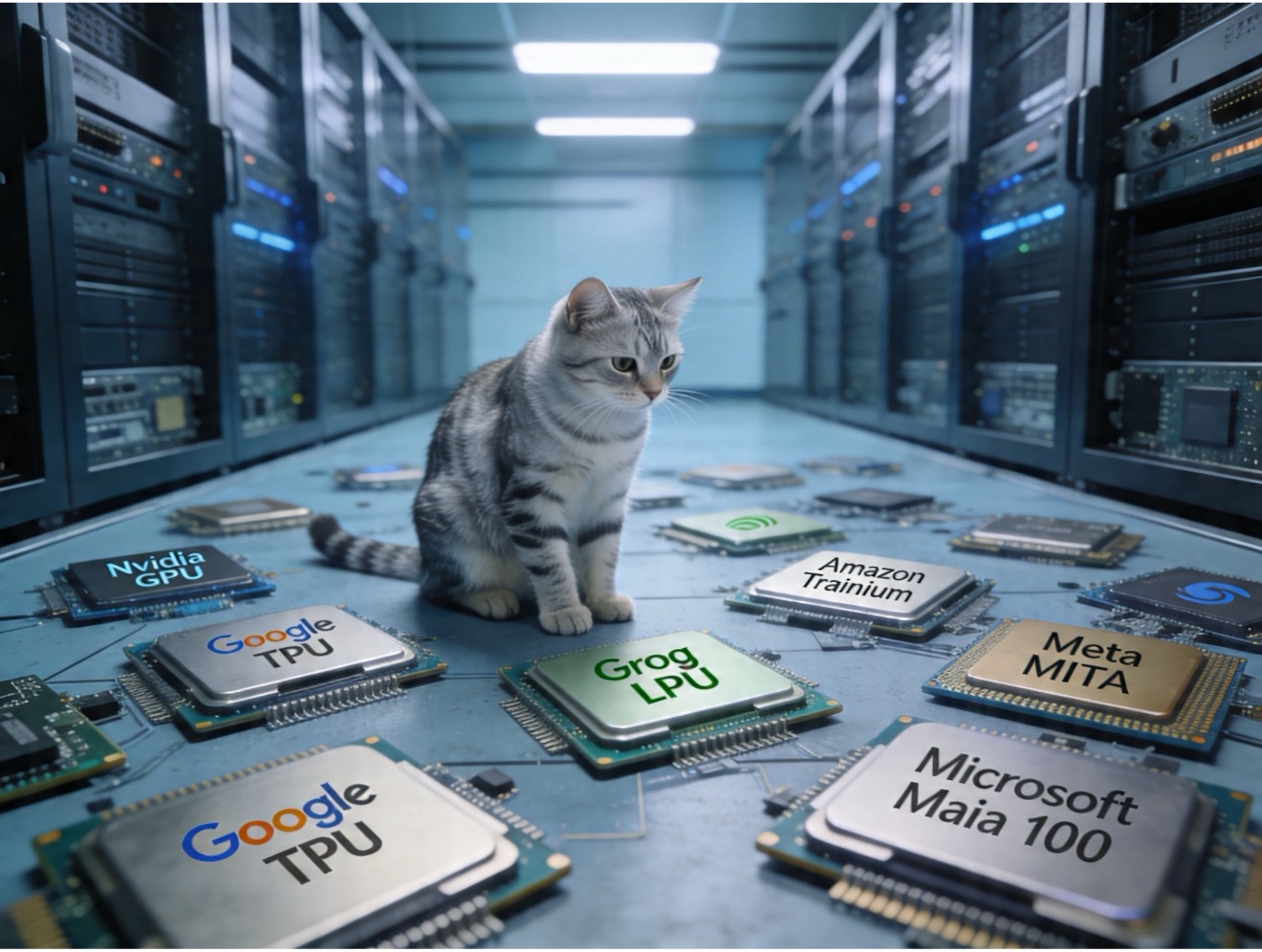
This is where the hype usually outruns reality: TPUs are not simply “better than Nvidia GPUs.” They win in specific situations and lose in others, and the distinction is rooted in architectural intent. Systems based on Google TPUs are designed as application-specific accelerators optimized for large-scale linear algebra, particularly transformer workloads, while Nvidia GPUs remain general-purpose parallel processors adaptable to a broad range of models and workflows. This divergence defines the competitive landscape: tightly integrated, workload-specific systems versus flexible, widely supported compute platforms.
Google’s repositioning of TPUs reflects a transition from internal infrastructure to externally consumable systems. Earlier limitations—tooling constraints, TensorFlow dependence, and workflow friction—restricted adoption despite availability through Google Cloud. That environment has changed. TPUs now support PyTorch more directly and are packaged as production-ready systems combining compute, networking, and software. Architectures such as TPU v5e and newer TPU7-class platforms emphasize scaling across thousands of chips, with per-chip power typically in the ~200–300 W range on 5 nm–class process nodes. Rather than maximizing single-chip performance, these systems rely on compiler-managed execution and high-bandwidth interconnects to deliver efficiency at scale. Google does not disclose transistor counts or die sizes, reflecting a focus on system-level throughput and energy efficiency.
Adoption patterns reinforce this shift. Anthropic has secured access to TPU capacity at a scale that reflects infrastructure planning rather than experimentation, including earlier access approaching 1 million chips and multi-gigawatt expansion plans. The company has also diversified across TPUs, AWS Trainium, and Nvidia GPUs, indicating a deliberate multi-sourcing strategy. Meta’s engagement adds a second signal. Historically reliant on Nvidia GPUs and internal silicon, Meta is testing TPU systems for both training and inference, introducing an additional compute pillar. Other participants extend this beyond hyperscalers: Citadel Securities has highlighted performance advantages in certain latency-sensitive workloads, while G42 is exploring TPUs as part of national-scale AI infrastructure. Together, these examples indicate that TPU demand now spans AI labs, financial services, and sovereign deployments.
Custom silicon partners play a central enabling role. Companies such as Broadcom design and manufacture the underlying processors used in hyperscaler-specific architectures, allowing firms like Google to deploy purpose-built chips without operating as traditional merchant vendors. This model transforms proprietary hardware into a scalable service delivered through cloud platforms. At the same time, Nvidia continues to advance high-performance GPUs such as the H100 and Blackwell-generation parts, including the B200. These devices are fabricated on advanced nodes (TSMC 4N for H100, moving toward 3–4 nm-class for Blackwell), with transistor counts on the order of ~80 billion for H100 and widely reported to exceed 200 billion in multi-die Blackwell configurations. Die sizes approach reticle limits (~814 mm² for H100), and power consumption ranges from ~350 W (PCIe) to ~700 W (SXM), with higher system-level envelopes in next-generation deployments. Nvidia’s advantage remains its software ecosystem (CUDA) and broad compatibility, which sustain its position as the default platform for heterogeneous and early-stage workloads.
The comparison, therefore, reflects different optimization targets. Nvidia GPUs prioritize flexibility, portability, and per-chip performance, while Google TPUs prioritize efficiency at scale through system-level integration. Cost, inference efficiency, and interconnect performance increasingly drive decision-making. Inference, in particular, has become the dominant cost center, and Meta has identified potential advantages in TPU-based deployments. As bottlenecks shift from individual chips to communication between them, integrated systems gain importance relative to stand-alone accelerators.
What do we think?
Google has moved TPUs from an internal advantage to a product for external customers. Large commitments from Anthropic and early adoption by Meta confirm real demand. Custom chip partners such as Broadcom enable this shift by supplying the underlying silicon design. Multi-sourcing is becoming standard practice. Nvidia retains a strong installed base, but new capacity decisions increasingly include alternatives with different cost and performance profiles.
The commercialization of TPUs represents an inflection point in AI infrastructure. Proprietary silicon is no longer confined to internal use; it is now competing directly in the market. Custom chip companies accelerate this transition by enabling hyperscalers to design and deploy non-merchant processors at scale. As enterprises adopt multi-vendor strategies, compute shifts from a single-supplier dependency to a portfolio decision. This inflection point will shape future investment, architecture choices, and competitive dynamics across AI hardware and cloud platforms.
Epilogue
Nvidia is not unaware of the threat or the shifts coming in the AI processor market. The company continues to emphasize its total commitment to AI and scaling up as well as out. A clear example of this direction is its multibillion-dollar licensing and talent acquisition deal with Groq, which brings low-latency inference expertise into its broader platform strategy. Nvidia is already deploying hybrid designs with GPU and Groq, and is the only company with such a capability or strategy.
Rather than treating this as a replacement path, the move reflects a developing hybrid approach. In this model, GPU-based systems handle large-scale parallel training and prefill workloads, while ASIC-like or LPU-style designs are incorporated for low-latency, token-by-token inference. The intent is not to abandon general-purpose compute, but to extend it through heterogeneous architectures that better align compute type with workload phase.
This hybrid direction sits alongside broader industry pressure from alternative silicon strategies, including Google TPUs, Inferentia from Amazon Web Services, internal accelerators at Meta, and Maia 100 from Microsoft. These systems increasingly target inference efficiency and workload specialization, areas where ASIC-style designs can diverge from GPU-centric approaches.
ASICs always have an advantage over general-purpose processors in tightly defined workloads, but in this lava-hot, rapidly evolving AI market, no single design is going to do it all. The emerging architecture direction is, therefore, not convergence on one chip type, but coordination across multiple types. Nvidia’s hybrid strategy reflects this shift: maintaining GPUs as the foundation while integrating specialized inference pathways into a unified system stack designed for heterogeneous AI workloads.
We’re tracking all these goings-on with our AI Processor Tracking Service and updating daily the (now) 138 companies and their 188 AIPs, including the process node, die size, ASP, units shipped, as well as the enormous financing that is going into start-ups, and in which countries. We’re also keeping track of which companies are acquired, fail, or go public.
You can get a free overview here.

LIKE IT? THINK YOUR FRIENDS AND ASSOCIATES MIGHT? PLEASE SEND IT TO THEM WITH OUR BEST WISHES.