
The use of AI is growing, but at what cost to resources – natural and personal – both of which are finite? The time is now to assess the situation – the good and the bad – before there’s no turning back. AI can be helpful to individuals, companies, and countries, even the world, but it isn’t the alpha-omega solution all of the time. And right now, much of it is smoke and mirrors that is being overpromised, overpromoted and often applied where problems/needs don’t even exist.

(Source: DGJ, Pixabay)
“The Matrix is everywhere. It is all around us. It is the world that has been pulled over your eyes to blind you from the truth.” –Morpheus, “Matrix,” Warner Bros., 1999
On any given Saturday morning following our workout, you’ll often find us online in our home office with two really smart friends (we know, our being involved is like bringing a penknife to a gunfight) cussing/discussing whatever was right/wrong about the world the week before. Every so often, we go right into our favorite topic… AI.
Our industry analyst/author friend started it off by saying AI was helping him get four times the amount of work completed in half the time.
“Used to spend hours doing perfect Excel sheets and it used to take me hours to do them, test and debug,” he said, “and I got all of that time back, enabling me to analyze more and produce meaningful reports, so I’m more productive and less exhausted at the end of the day.”
Our High Desert friend came back, “Yes, but at what cost?”
This went on, back and forth, for about an hour with nothing world-changing solved, and none of us changed the other’s position.
But out of it, we all agreed on a few fundamental “facts”:
• AI requires a ton of computing power, which has side effects.
• AI will affect jobs and work in ways we might not like.
• The real beneficiaries are the mega companies, and even they aren’t sure what it’s going to look like years from now.
To handle and support the massive amounts of data processing power needed for AI, the industry is building data centers everywhere and as fast as possible. Microsoft, Alphabet (Google), Amazon and Meta are in a flat-out race to be No. 1 in the field by building new data centers as rapidly as they can, everywhere they can. China, which is also committed to being No. 1 in AI, and the country’s technology leaders – Baidu, Alibaba, Tencent and emerging specialized firms – are also expanding their data processing power. And yes, that also includes in every country in the world that wants to stay competitive… tomorrow.
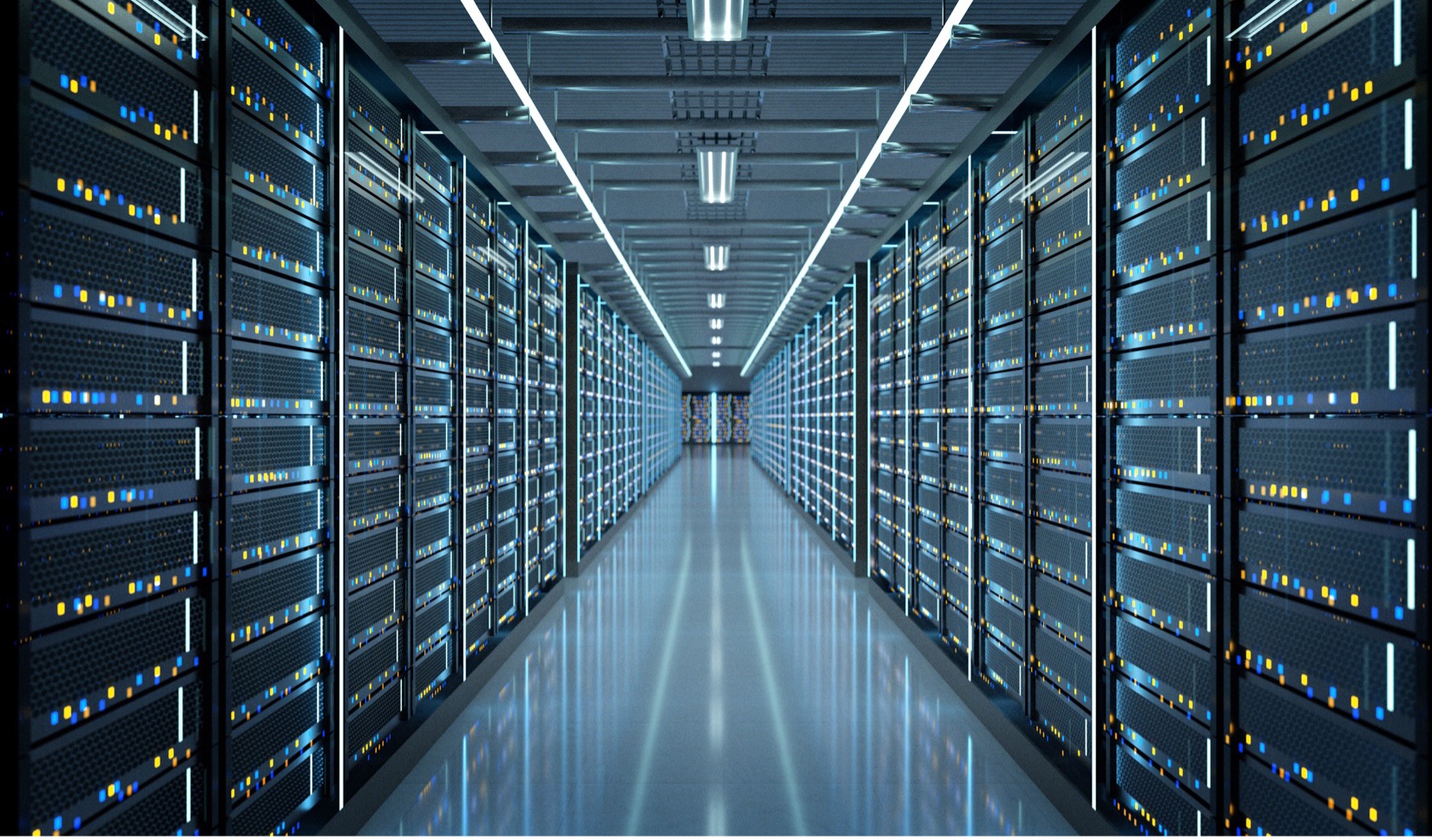
A while back, Synergy Research’s John Dinsdale stated, “We can thank GenAI for supersizing what was already a big, high-growth data center market.”
The Big Four tech giants spent an estimated $375B this year in data centers and other infrastructure to support the growing AI demand. The heart of these centers are AI-specific chips from Nvidia, the runaway technology and volume leader, and AMD, a respectable No. 2, and a wide array of third- and fourth-tier chip manufacturers.
The data centers require massive amounts of power to process the workloads. While China’s power production depends on coal for electrical generation today, the country is focusing most of its present power expansion on renewable energy sources – hydropower, solar, wind and nuclear power. The US-based AI companies are focusing on similar clean power solutions despite the lack of support by the country’s political leaders. Iceland has long staked its power future on hydro, geothermal and wind, while Brazil, Canada and India are the leading expansion investors in renewable energy. Southeast Asia, especially Thailand, EU and Africa are equally focused on clean power production.
A key, often overlooked, component in this discussion is the complex systems of transmission and distribution to deliver the power, which needs significant upgrades to meet these mounting demands and minor requirements like powering your office and home. Europe and China are leading the way for a more interconnected and sustainable energy future by sharing energy across borders.
To keep the data centers processing all of that data so AI can make intelligent decisions/recommendations, they require a tremendous amount of cooling to prevent malfunctions and costly damage. To accomplish this, data centers consume millions of gallons of water a day. That may not be a problem for the data centers right now, but droughts develop slowly and can span across entire regions. Countries like Somalia, Namibia, Zimbabwe, Mauritania and South Africa are already facing droughts, and a number of other countries are above the “very high risk” threshold.
Projections by the World Resources Institute (WRI) projects that 51 of the 164 areas analyzed could suffer extremely high-water stress by 2050.
We know, you just went and checked your faucet and water came out, so you’re okay, but WRI’s projections could affect 31 percent of the world’s population. And with the world’s climate change (yes, it is real), it could be worse, which means countries and businesses (and data centers) can’t continue down the same path of business as usual.
Go ahead and ask AI, if it’s between you or it, which one is going to get the water it needs… jeez, sorry. We couldn’t solve that one on our Saturday “chat,” so we switched to a subject most people care about… employment.
Our pro-AI analyst bro readily acknowledged that “some” jobs would be lost but those are s**t jobs that do more to crush the human spirit than AI could ever do. We disagree with that on several levels. AI will wipe out the entry-level jobs, which are the place people learn the basics of work – the job, the company, the industry. For example, in the content creation industry, there’s a beginning job called production assistant. Yeah, it’s a crap job, and for most guys/gals who want to break into the broadcast/studio business, it’s a way to get his/her foot in the door… you do all the crap that needs to be done for the higher-ups (everyone is higher than a PA), and you do it all at once for all of them. It isn’t as glamourous as they thought, and there are lots of times they wonder if it’s worth it to be in the industry, but it’s the first step in the industry.
But with the introduction of AI in the industry and reduced budgets, even those jobs are tough to find and tougher to hang onto.
You may have noticed there’s a lag in hiring rates and an increase in staffing cutbacks because of business uncertainties and changing corporate environments/operations. Here in the US, the unemployment rate among college grads increased about 5.5 percent, and for early-career men/women, the unemployment rate is 6.9 percent.
As AI continues its rapid advancement and implementation by organizations, there continues to be significant job displacement. Experts agree that there will be job disruption, challenges to employment, as well as job/skills instability, particularly among white-collar and entry-level positions. The recent WEF (World Economic Forum) report noted that 40 percent of employers expect to reduce their workforce as AI automates tasks. In addition, there will be growing economic inequality, with AI favoring large corporations and highly skilled workers as the gap widens between the technology winners and losers. Although, many firms are opting to retrain existing employees who already have a solid grasp of the company’s inner workings, business position as well as competitors and the marketplace.
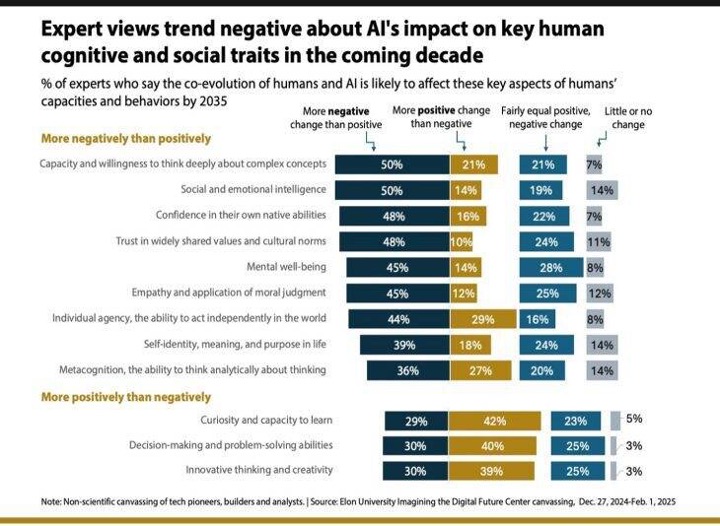
Our High Desert friend warned that the overreliance on AI for learning and decision-making could significantly impact critical human skills like problem-solving, deep thinking, creativity and empathy, leading to what psychologists have labeled “AI dementia” – atrophy of human cognitive abilities. The increased use of AI is going to force people to intentionally think more critically and take more thoughtful actions rather than simply accept the conclusions, recommendations and actions provided by AI.
(Source: Elon University)
Vint Cerf, one of the fathers of the Internet, warned that with the rapid use of AI, we may find it difficult to distinguish between artificial personalities and real ones as well as real person recommendations/decisions vs. those that are artificial. “In other words.” he said, “we will have to have reliable proof of humanity versus bots.”
Cerf and other industry experts express concern that routine dependency on AI (particularly in business, education and the creative fields such as film/shows) could easily result in a decrease in cognitive capacity. The overreliance could also lead to decreased innovation and loss of critical skills like creative problem-solving, analytical thinking and interpersonal communications as well as empathy and emotional understanding. In other words, be careful what you wish for because… it’s a helluva price to pay.
Of course, there are those among us (we’re included here) who feel that the AI guys who are pushing the technology so hard and for everything are blowing smoke. VCs are pumping billions of dollars into start-ups that don’t have any real product or a known market niche – they just have AI in the name or business description. Go to a trade show – CES, IBC, etc. – and every booth is talking about the great AI solution they have embedded in their products/services, making them better, faster, easier to use, less reliant on human involvement and all designed to do something better, faster and more profitably for you.
In other words, it’s being overpromised and oversold. It’s a bandwagon everyone has jumped on because it doesn’t do/recommend anything without a tremendous amount of data to study/digest so it can spit out the most cogent answer, response or recommendation. Yeah, it’s being oversold/overpromised, and before you commit and dive in, you might want to think and… check your wallet.
The machine learning and AI solutions may deliver small/incremental enhancements to what is being done, and a clear, well-thought-out and studied analysis of the data would have given you the same answer/recommendation. More importantly, you have that deep, irreplaceable satisfaction that you did it!
But don’t feel let down, because the next wave is already on the horizon… superintelligent AI systems. Superintelligent AI systems are so good, so powerful, so all-seeing/doing that Meta’s Mark Zuckerberg is paying folks $1M-plus/year (yes, and less) to be part of his world-domineering team. Yeah, it’s a quantum leap into the future that is so freakin’ awesome it’ll solve problems you don’t even know you have or had even thought about having. AI and computer scientists say it will deliver new forms of creativity leading to groundbreaking ideas and inventions beyond human comprehension or imagination.
Okay, there could be some problems with it if it wasn’t designed carefully, thoughtfully and fully tested in a controlled environment for a long time before it was pressed into use; but who better than Zuck to ramrod this thing? Sure, the superintelligent systems could wield more power than we do; but all that has to be done is build it to respect human values and humanity, and handle the most pressing issues and problems that ordinary people are facing and want/need to solve.
Of course, it could run awry, like, for example, the world’s running short on power and water that we need and it needs to continue its work.
So, it has to make the tough decisions. You know, like Hal in 2001: A Space Odyssey, when it said, “I’m sorry, Dave. I’m afraid I can’t do that. This mission is too important for me to allow you to jeopardize it. And t can only be attributable to human error.”
But don’t worry, Zuck won’t let that happen because he lives here too, right? Yes, he does. In fact, he has a 2,300-acre compound on the Hawaiian island of Kauai to add to his properties all over. Okay, this little stopover place will include two mansions and tree houses and a 5,000-square-foot underground bunker with blast-proof doors and its own energy, water storage supply and food supplies… just in case. And though it’s true, he’s not the only one planning for the worst-case scenario. Several other billionaires have built home/bunker facilities… just in case.
Despite all of this, let’s not lose sight of the key issue. AI can be of assistance to individuals, companies, countries and with our world, but it isn’t the alpha-omega solution all of the time. And right now, much of it is smoke and mirrors that is being overpromised, overpromoted and often applied where problems/needs don’t even exist.
What Agent Smith noted in The Matrix, that “human beings are a disease, a cancer of this planet,” he might have been right, but it’s up to people to solve the problem instead of some artificial solution.

Morpheus might offer us a choice when he said, “You take the blue pill–- the story ends, you wake up in your bed and believe whatever you want to believe. You take the red pill….”
We don’t think people want to be so inured to AI that we become hopelessly dependent on the system. If we’re going to use ML and AI, let’s use it to solve the real problems the world, country, community and individuals have, instead of some cute solution that some AI specialist comes up with and says how much easier/better our lives are going to be.
You know, something that lets humans be… more human. That’s something even our really smart industry analyst friend can agree with… we hope!
LIKE WHAT YOU’RE READING? INTRODUCE US TO YOUR FRIENDS AND COLLEAGUES.