
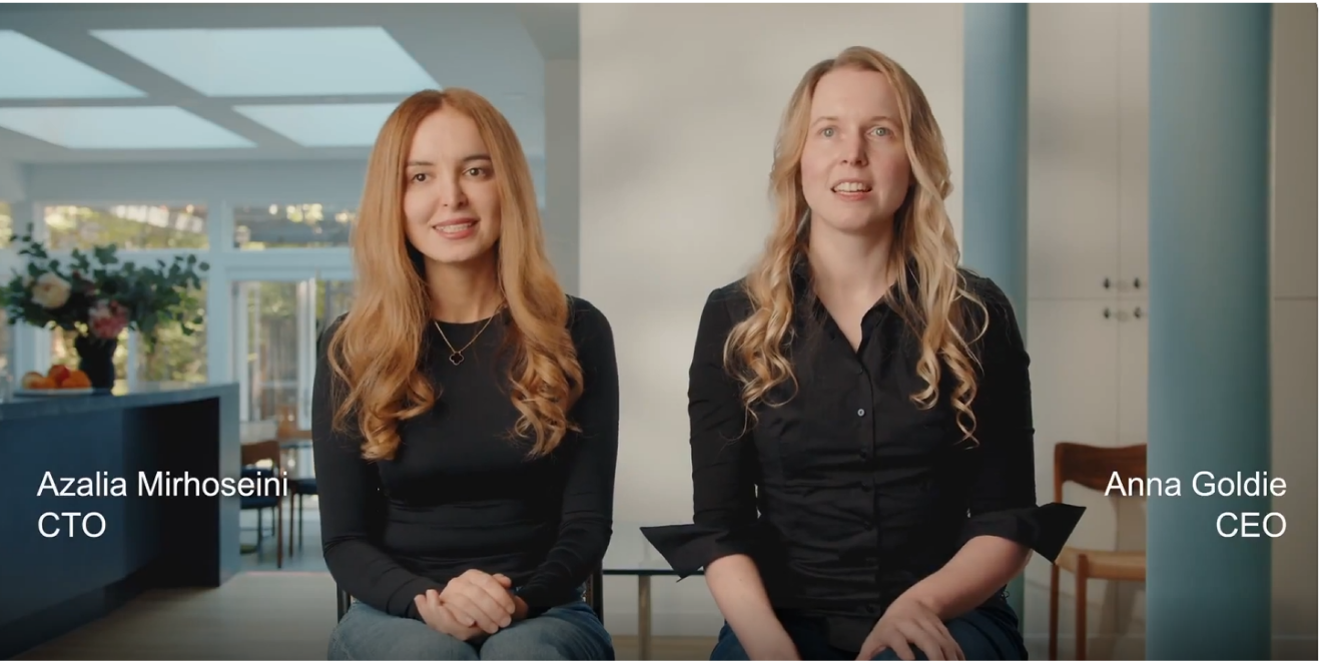
Two Google researchers, Anna Goldie and Azalia Mirhoseini, developed AI that improved chip design. They envisioned something revolutionary—AI designing better chips that train smarter AI in an endless improvement loop. In 2025, they launched Ricursive Intelligence, raising $35 million. Their pitch: compress chip design from years to weeks. By January 2026, they’d raised $335 million at a $4 billion valuation with fewer than 10 employees. Critics note true self-improving AI remains unachieved, working only for narrow tasks. Yet investors clearly believe they’ve discovered something transformative.
(Source: Ricursive)
The concept of recursive AI originated with Google’s 2017 AutoML, which constructed machine learning algorithms capable of designing other machine learning algorithms. Ricursive co-founders Anna Goldie and Azalia Mirhoseini previously developed AI at Google that enhanced the design of the company’s Tensor Processing Units. Their thesis: AI-designed chips will train superior AI systems, which will then design further-improved chips, establishing what the founders characterize as a “recursive self-improvement loop.”
In 2025, Goldie and Mirhoseini left Google and founded Ricursive Intelligence. The company had a $35 million initial seed round, based on its use of AI that can improve other AI systems, led by Sequoia Capital, along with Modern Capital, 49Palms, and Striker.
“Current chip design takes two to three years, and by the time hardware is ready, algorithms have already moved ahead. This mismatch creates a deadlock that holds back the frontier. AI-chip co-evolution breaks that deadlock. Our approach compresses design cycles from years to weeks, creating a recursive loop where AI designs better chips, those chips train stronger AI, and that AI designs even better chips,” said Goldie.
Using recursive chip design, says Goldie, shifts the bottleneck to accelerant, letting compute and intelligence scale together and unlocking a true Cambrian explosion in silicon.
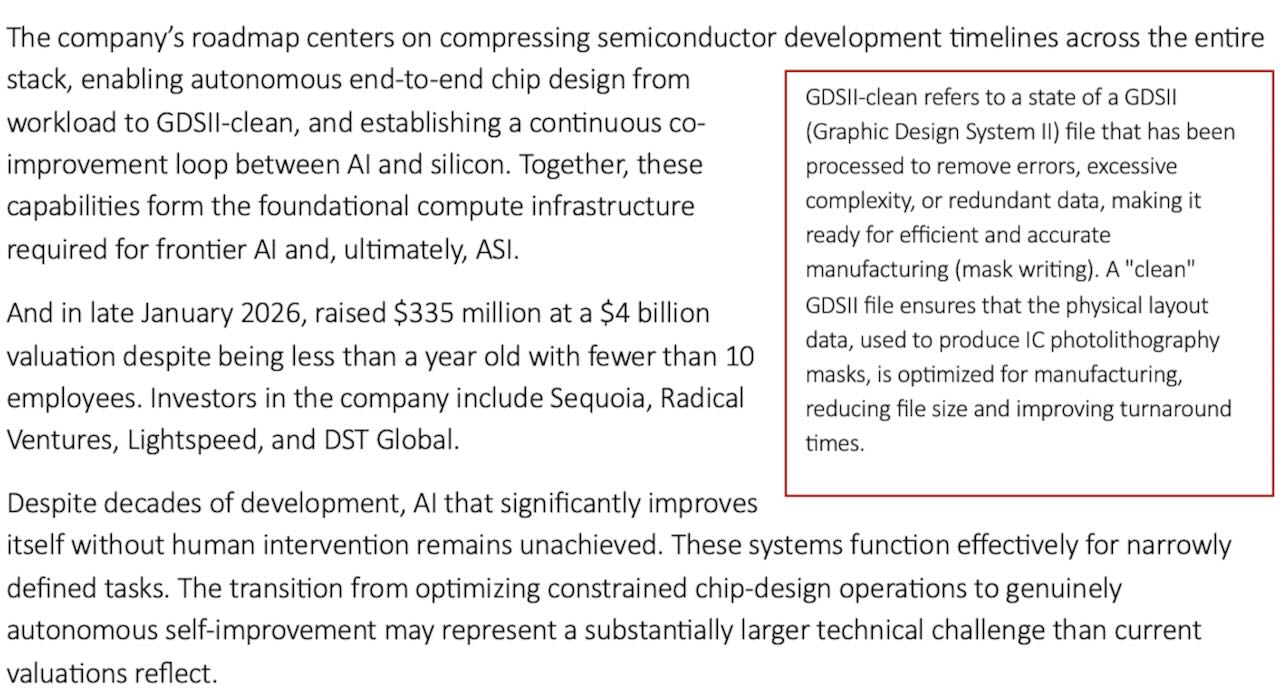
But the company has something; otherwise, it wouldn’t have received $335 million in funding.
WHAT DO YOU THINK? GOOD ENOUGH TO TELL YOUR FRIENDS ABOUT IT? YOU HAVE OUR PERMISSION TO SHARE IT.