
AMD and Meta announced a five-year, $60 billion agreement for AMD to supply up to 6 GW of Instinct GPUs to Meta’s global AI infrastructure. The deal includes a custom MI450-based GPU co-engineered with Meta for inference workloads, two generations of Epyc CPUs, and a performance-based warrant giving Meta up to 10% of AMD’s equity. The piece situates the deal within Meta’s broader infrastructure pivot—away from frontier model competition and toward large-scale AI hosting—and flags analyst concerns about circular ownership structures emerging across the industry.
AMD and Meta signed a definitive multi-year, multi-generation agreement to deploy up to 6 GW of AMD Instinct GPUs across Meta’s global AI infrastructure—the second major supply pact that AMD has struck in two years, following a similar arrangement with OpenAI in 2025.
Deal structure and financial terms
The five-year agreement carries a total value of up to $60 billion. As part of the deal, AMD issued Meta a performance-based warrant for 160 million shares of AMD common stock at an exercise price of 1 cent per share. Vesting proceeds in tranches tied to Instinct GPU shipment milestones, beginning with the first gigawatt deployment, and requires AMD to hit rising stock price thresholds up to $600, with each tranche also contingent on Meta meeting defined technical and commercial milestones. AMD CFO Jean Hu described the structure as accretive to non-GAAP earnings per share and aligned around long-term execution. AMD shares rose more than 6% on the announcement; Nvidia’s fell approximately 1%.
Hardware roadmap and MI450 architecture
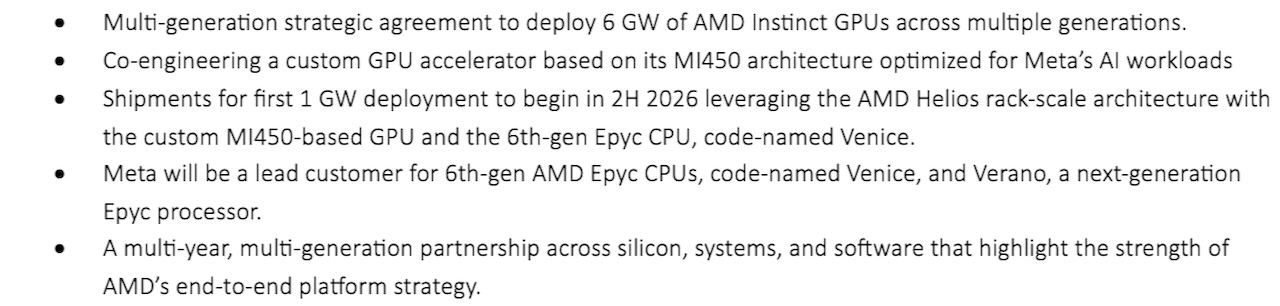
Shipments supporting the first 1 GW deployment begin in the second half of 2026, powered by a custom AMD Instinct GPU co-engineered with Meta on the MI450 architecture. The chip targets inference workloads and competes directly with Nvidia’s Vera Rubin processor. The MI450X runs on TSMC’s 2 nm-class node (CDNA 5 architecture) and carries a reported TDP in the 1,600–2,500 W range, requiring liquid cooling. Key specifications include up to 432 GB of HBM4 memory across 12 stacks, approximately 19.6 TB/s of memory bandwidth, and up to 20 PFLOPS at FP8 and 40 PFLOPS at FP4. At rack scale, AMD’s Helios architecture—co-developed with Meta through the Open Compute Project—integrates 72 MI450 GPUs per rack to deliver 1.4 EFLOPS at FP8 and 2.9 EFLOPS at FP4. At the full 6 GW envelope, with MI450X TDP at roughly 2,000 W per chip, the agreement covers approximately 3 million GPUs.
CPU partnership and Epyc integration
The agreement extends beyond GPUs. Meta will serve as a lead customer for AMD’s 6th-generation Epyc CPUs, code-named Venice, and a subsequent generation code-named Verano, running ROCm software built on the Helios rack-scale architecture. Both processors target workload-specific optimizations to achieve performance per dollar per watt. Meta has deployed AMD Epyc CPUs across multiple generations and runs significant MI300- and MI350-series GPU deployments across its global infrastructure. The custom CPU variant AMD will supply for Meta tunes performance and energy consumption to meet Meta’s specific operational requirements.
Strategic context: Supply diversification and circular deals
The deal reflects a deliberate effort by Meta to reduce single-vendor dependency on Nvidia, which faces persistent supply chain constraints as the world’s largest GPU manufacturer. Meta’s infrastructure head, Santosh Janardhan, confirmed that the company’s data center buildout demands multiple chip vendors in parallel. Meta also discusses TPU deployments with Google and maintains a separate chip supply agreement with Nvidia. Industry analysts note that the cross-ownership structure—Meta and OpenAI both holding equity stakes in a key supplier—raises questions about circular transactions. Analyst Matt Britzman of Hargreaves Lansdown observed that AMD’s willingness to issue a 10% equity stake suggests the company faces headwinds generating organic customer demand at this scale.
Meta’s broader infrastructure bet
The AMD agreement connects to a broader infrastructure pivot at Meta. The company is building a $27 billion data-center campus in Louisiana, formed through a joint venture with Blue Owl. Forrester analyst Alvin Nguyen characterizes Meta’s current strategy as a shift toward hosting third-party AI infrastructure rather than competing with OpenAI and Anthropic on frontier model development. US hyperscalers—Meta, Alphabet, Microsoft, and Amazon—collectively target at least $630 billion in capital expenditures in 2026, focused on data centers and AI chips. The AMD-Meta deal represents one of the larger discrete supply commitments within that spending cycle.
What AMD announced
What do we think?
The AMD-Meta deal marks a structural shift in how hyperscalers secure AI compute. At $60 billion over five years, this is not a procurement agreement it is a vertical integration strategy executed through a supply contract. Meta gains price certainty, roadmap influence, and chip customization at a scale only AMD’s current positioning can accommodate. AMD gains guaranteed revenue and a marquee inference customer, but the equity warrant tells a more cautious story: Organic demand at this price point remains thin enough to require a 10% ownership concession. The broader pattern—hyperscalers taking stakes in their own suppliers—introduces concentration risk that regulators and investors will scrutinize closely in 2026 and beyond. However, it is not a novel arrangement; customers have often taken a stake in their supplier, going back to the 1990s when Dell bought into Nvidia.
LIKE WHAT YOU SAW HERE? SHARE THE EXPERIENCE, TELL YOUR FRIENDS.