
At 3DExperience World, Dassault Systèmes and Nvidia announced they are developing a shared industrial AI platform that combines digital twins and artificial intelligence, respectively, from the two industry giants. This partnership establishes a new foundation for industrial AI. The new infrastructure will power and accelerate Dassault Systèmes’ entire portfolio by using Nvidia open models and libraries, which the companies believe will unlock new opportunities across biology, materials science, engineering, and manufacturing.
(Source: Dassault Systèmes)
Dassault Systèmes and Nvidia are two industry powerhouses in their respective universes. Dassault Systèmes shines brightly with its virtual twin technology across manufacturing industries, life sciences and healthcare, and urban infrastructure. Nvidia does likewise with its AI infrastructure and processors. Now these stars are aligning through a new strategic partnership that establishes a shared industrial architecture for AI across industries for advancing physical AI.
The two companies say the combination of Dassault Systèmes’ virtual twin technologies with Nvidia AI infrastructure, open models, and accelerated software libraries will establish science-validated industry World Models and new, elevated ways of working through skilled virtual companions on the Dassault Systèmes’ agentic 3DExperience platform.
This partnership foundation, says Dassault Systèmes, is built on a shared long-term vision for how industrial AI will be built, validated, and deployed at scale, using a unique combination of technology contributions from each company.
The collaboration was announced earlier this month at Dassault Systèmes’ 3DExperience World by Dassault CEO Pascal Daloz, who was joined on stage by Nvidia founder and CEO Jensen Huang, as they addressed the engineering crowd in attendance.
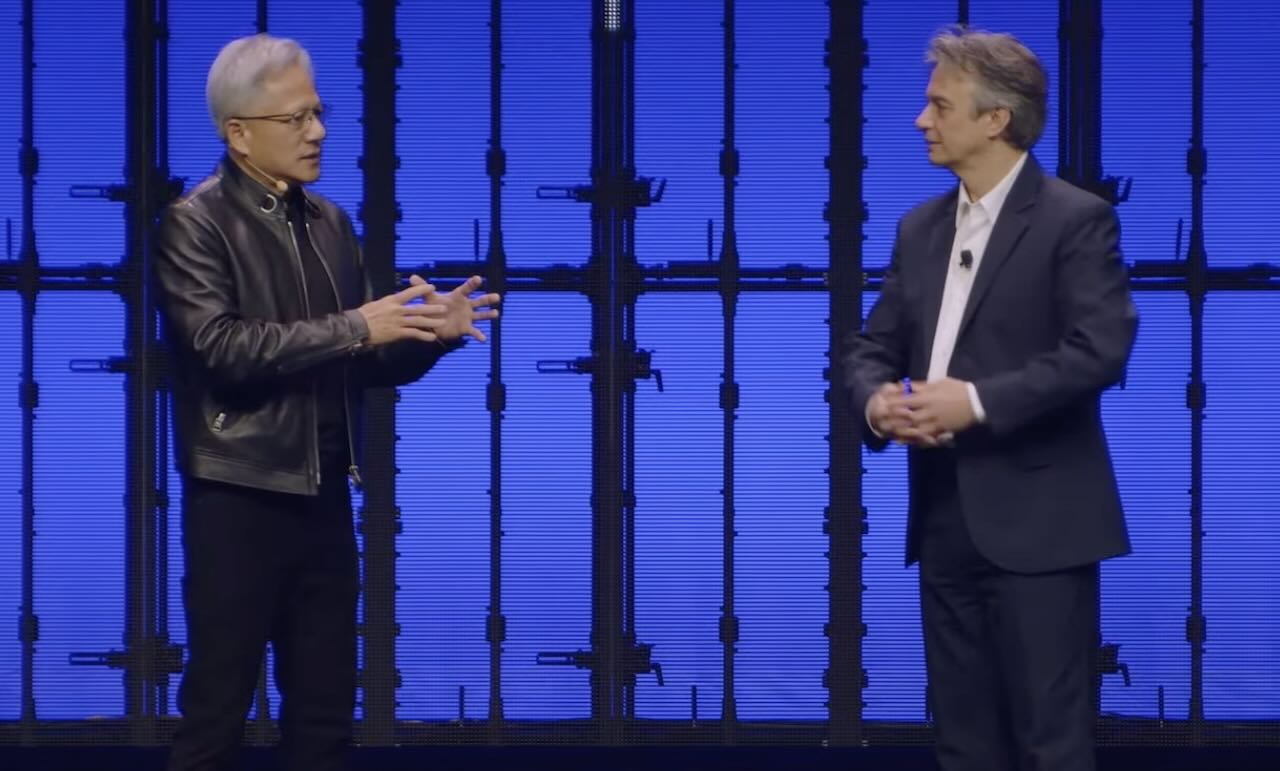
Nvidia’s Jensen Huang (left) and Dassault Systèmes’ Pascal Daloz (right) at 3DExperience World. (Source: Dassault Systèmes)
“We are entering an era where artificial intelligence does not just predict or generate, but understands the real world. When AI is grounded in science, physics, and validated industrial knowledge, it becomes a force multiplier for human ingenuity,” said Daloz. “Together with Nvidia, we are building industry World Models that unite virtual twins, and accelerated computing, to help industry design, simulate, and operate complex systems in biology, materials science, engineering, and manufacturing, with confidence. This partnership establishes a new foundation for industrial AI. Together, we are bringing the virtual twin factory with the AI factory.”
It’s no secret that Nvidia has been focusing on physical AI, which is grounded in the laws of the physical world. Huang calls it the next frontier of artificial intelligence.
“Together with Dassault Systèmes, we’re uniting decades of industrial leadership with Nvidia’s AI and Omniverse platforms to transform how millions of researchers, designers, and engineers build the world’s largest industries,” Huang stated.
Partnership combines Dassault Systèmes and Nvidia technologies. (Source: Dassault Systèmes)
The team approach calls for Dassault Systèmes to deploy AI factories through its cloud-branded Outscale as part of its sustainable and sovereign cloud strategy. Outscale AI factories will harness the latest Nvidia AI infrastructure, bringing additional capabilities to operate AI models in the 3DExperience platform. Nvidia, meanwhile, is adopting Dassault Systèmes model-based systems engineering (MBSE) to design AI factories, starting with the Nvidia Rubin platform and integrating into the Nvidia Omniverse DSX Blueprint for large-scale AI factory deployment.
This is not the first collaboration between the two companies. Their relationship began approximately 30 years ago during the last computing platform revolution, as Unix workstations were migrating to Windows-based workstations. And now, they are again working together as they reinvent the computing platform, Huang told the 3DEperience World crowd.
“The idea of a virtual twin, of course, is to represent the physical world in a computer. And so, now, we’re going to represent the physical world at a much, much larger scale in a completely revolutionized computer, an AI computer,” said Huang.
According to Huang, the last generation of designs were structured representations, where everything was specified—the geometry, different materials, everything. Now, that’s going to be a generative computing model, and in the world of generative computing models, the entire computing stack is being reinvented, he explained. And because AI is foundational to every industry, he believes AI is going to become an infrastructure, just as water, electricity, and the Internet are today, AI will be as well.
“We’re growing so fast because every single industry needs to build it. Every single country will be powered by it. And, literally, every society will have it. So, this is the beginning of a new industrialization, which is really fantastic for you, because, as you know, Dassault is the engine of the representation of everything you want to build,” said Huang.
In the past, a third of our time was spent in design and digital, and maybe two-thirds of the time in physical, according to Huang. He believes it is very likely that in the future, we’re going to spend 100% of the time in digital. And even after designing, simulating, and validating, it will have to be integrated using software, so everything that’s inside the Dassault Systèmes software.
“Everything will be software-defined. We’ll be designing everything, operating everything, as a virtual twin, and realizing your vision for the first time,” Huang said to Daloz.
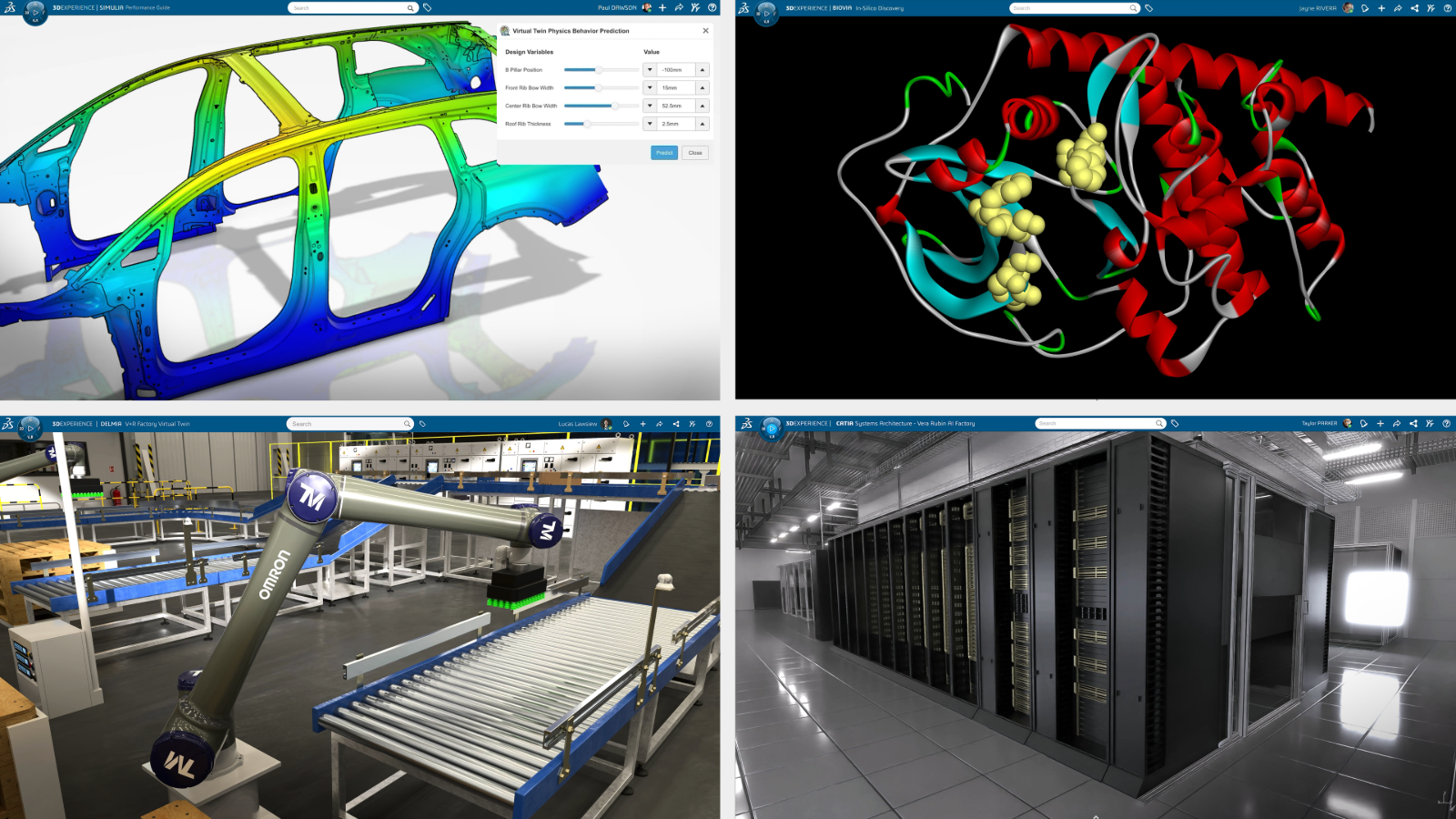
And “all the -ias”—Catia, Biovia, Delmia, etc.—will be built on top of Nvidia, as this new infrastructure will power and accelerate Dassault Systèmes’ entire portfolio by using Nvidia open models and libraries, which the companies believe will unlock new opportunities across biology, materials science, engineering, and manufacturing.
Some examples of that include:
• Advancing biology and materials research: The Nvidia BioNeMo platform combined with Biovia science-validated world models will accelerate the discovery of new molecules and next-generation materials.
• AI-driven design and engineering: Simulia AI-based Virtual Twin Physics Behavior leveraging Nvidia CUDA-X libraries and AI physics libraries empowers designers and engineers to accurately and instantly predict outcomes.
• Virtual twins for every factory: Nvidia Omniverse physical AI libraries integrated into the Delmia virtual twin of global production systems enable autonomous, software-defined production systems.
• Virtual companions supercharge Dassault Systèmes’ users: The 3DExperience agentic platform, combining Nvidia AI technologies and Nvidia Nemotron open models with Dassault Systèmes’ industry World Models, powers Virtual Companions to tap into deep industrial context, delivering trusted, actionable intelligence with industrial-scale efficiency.
Daloz said success is not about automation—people don’t want to automate the past, they want to invent the future—and that is the reason for this new chapter in the Dassault-Nvidia partnership.
What do we think?
Dassault Systèmes and Nvidia have been game-changers in their respective industries for decades. Sometimes companies in positions such as this will step outside their lane and try to go it alone to achieve a larger vision. However, success in one area does not guarantee success in another. But in this case, both Dassault Systèmes and Nvidia recognize their respective strengths as well as those of the other, exemplifying the phrase “Together we’re stronger.” And as a result, they are establishing a new foundation for industrial AI.
YOU LIKE THIS KIND OF STUFF? WE HAVE LOTS MORE. TELL YOUR FRIENDS, WE LOVE MEETING NEW PEOPLE.