
Intel finally gave Crescent Island a name and some numbers. The Intel GPU D-Series, led by the D270, delivers 1.3 PFLOPS of FP8 and 1.5 TB/s of bandwidth, holds up to 480 GB of LPDDR5X, and runs at just 350 W with plain air cooling. That means it slides into servers you already own. Samples have already reached customers. So here’s what’s inside, what the memory math says about 300 billion-parameter models, and what ISVs, chip teams, and CIOs should watch.

Air-cooled inference AIBs slide into the server racks enterprises already run.
Intel used the OCP Global Summit on October 12, 2026, to name Crescent Island. The AI inference accelerator now carries the brand Intel GPU D-Series, and the D270 leads the family. Intel also put numbers on it for the first time: 1.3 PFLOPS of peak FP8 compute and 1.5 TB/s of memory bandwidth, in a 350 W, air-cooled PCIe 5.0 x16 card. Customer sampling has started. Intel has not announced pricing, general availability, or independent performance results.
A GPU with no graphics
The D270 runs on Xe3P, an inference-tuned derivative of Intel’s Xe3 design, and it marks the first chip on that architecture. Intel removed the ray-tracing hardware, the 3D graphics units, and the display path, and spent the die area on compute. The chip has 32 Xe3P cores, each with eight vector engines and eight XMX matrix engines, for 256 of each. A 32 MB unified L2 cache sits behind the cores, and each core carries a 1 MB register file and 512 KB of L1 cache.
Intel redesigned the XMX engines. Xe3 uses a four-deep systolic array; Xe3P goes 16 deep, which lets each engine do more multiply-accumulate work per operand fetch. The chip supports data formats from FP4 to FP64, and FP4 lets model owners halve weight storage relative to FP8. A media block with four encoders and four decoders handles video for multimodal pipelines.
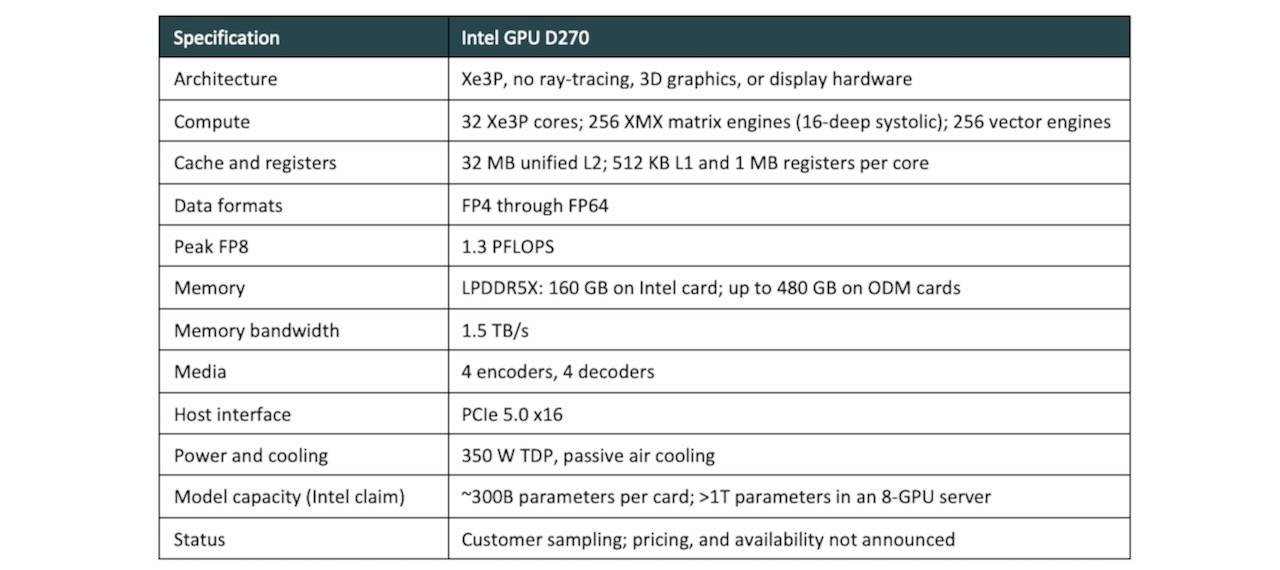
Table 1. Intel GPU D270 specifications. (Source: Intel)
Memory first, compute second
The D270 trades raw compute for capacity. Intel’s own card ships with 160 GB of LPDDR5X, and ODM partners can build cards with up to 480 GB. LPDDR5X costs less per gigabyte than HBM and draws less power, and it delivers less bandwidth, which explains the 1.5 TB/s figure.
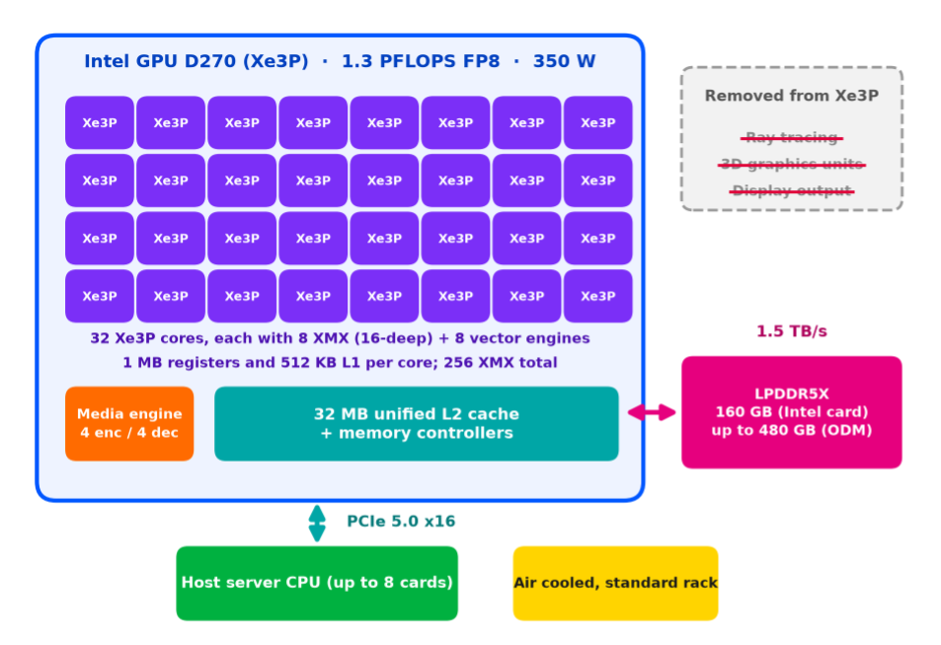
Figure 1. Intel D270: 32 Xe3P cores, 32 MB L2, LPDDR5X, PCIe 5.0.
Intel says one card can serve models up to 300 billion parameters and an eight-GPU server can run models beyond 1 trillion. The math holds with conditions. A 300B-parameter model at FP8 needs about 300 GB for weights alone, so that claim depends on a 480 GB partner card, or on FP4 weights squeezed onto the 160 GB Intel card with little room left for KV cache. Bandwidth sets the decode ceiling: A dense 300B FP8 model that reads every weight per token tops out near five tokens per second per stream on 1.5 TB/s. Mixture-of-experts models, which activate a fraction of their parameters per token, and batched serving change that picture. Buyers should model their own workloads before they size a deployment.
On paper, the D270 delivers about 3.7 TFLOPS of FP8 per watt and roughly 1.15 bytes of memory bandwidth per 1,000 FLOPS. That ratio favors prefill and batched serving, where compute dominates, over single-stream decode, where bandwidth dominates. Long-context work fits the design: A large KV cache needs capacity, and 480 GB gives operators room to hold many concurrent sessions in memory.
A different envelope from Rubin
Each Rubin GPU in Nvidia’s Vera Rubin NVL72 rack delivers a theoretical 17.5 PFLOPS of FP8, about 13 times the D270, and needs liquid cooling at a power level in the kilowatts. Intel aims at standard air-cooled rack servers with up to eight GPUs, the class of machine Nvidia serves with HGX. At 350 W per card, an eight-card server draws 2.8 kW for accelerators, a load many enterprise data centers already handle.
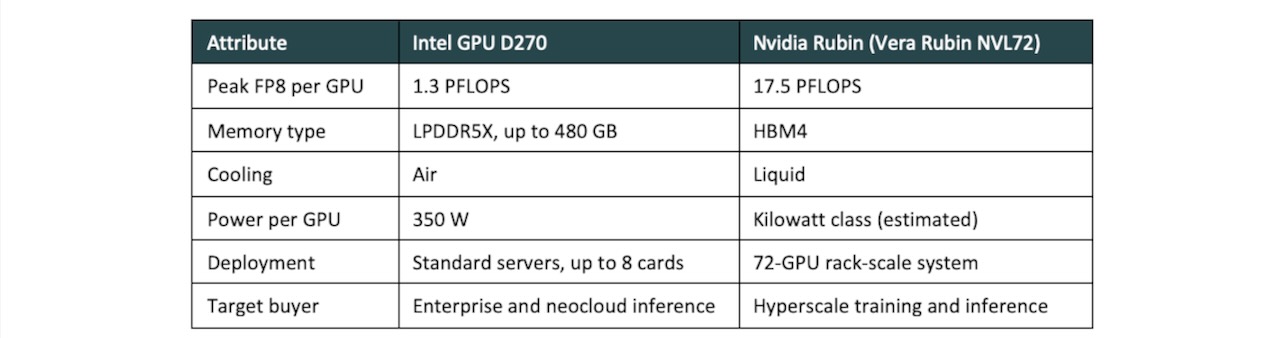
Table 2. Two inference envelopes; Rubin power is an estimate. (Sources: Intel and Nvidia)
The eight-card picture raises one engineering question. Intel has not described a dedicated scale-up fabric, so multi-card inference on a trillion-parameter model would ride on PCIe 5.0 links, and tensor-parallel traffic between cards will test them. Partner server designs will show how Intel handles that link.
Software decides the outcome
Intel builds the D-Series on its common Xe software foundation, the stack that spans Xe cores in its integrated and discrete GPUs, so code can move across Intel GPU platforms. Intel lists support for vLLM, SGLang, llm-d, and Nvidia Dynamo, along with KV-cache-aware routing and heterogeneous agent orchestration; it promises PyTorch and open-model support at launch. Its target list covers multi-tenant AI services, long-context and concurrent inference, robotics, and other latency-sensitive workloads. Intel works with OEMs, ODMs, neoclouds, ISVs, appliance makers, and AI-native companies to bring cards to market.
For ISVs, the D-Series adds one more target to validate, and the framework list lowers that cost. For silicon teams, the D270 makes a public bet on capacity per watt over FLOPS. For CIOs, it offers a route to on-premises inference with no new cooling plant.
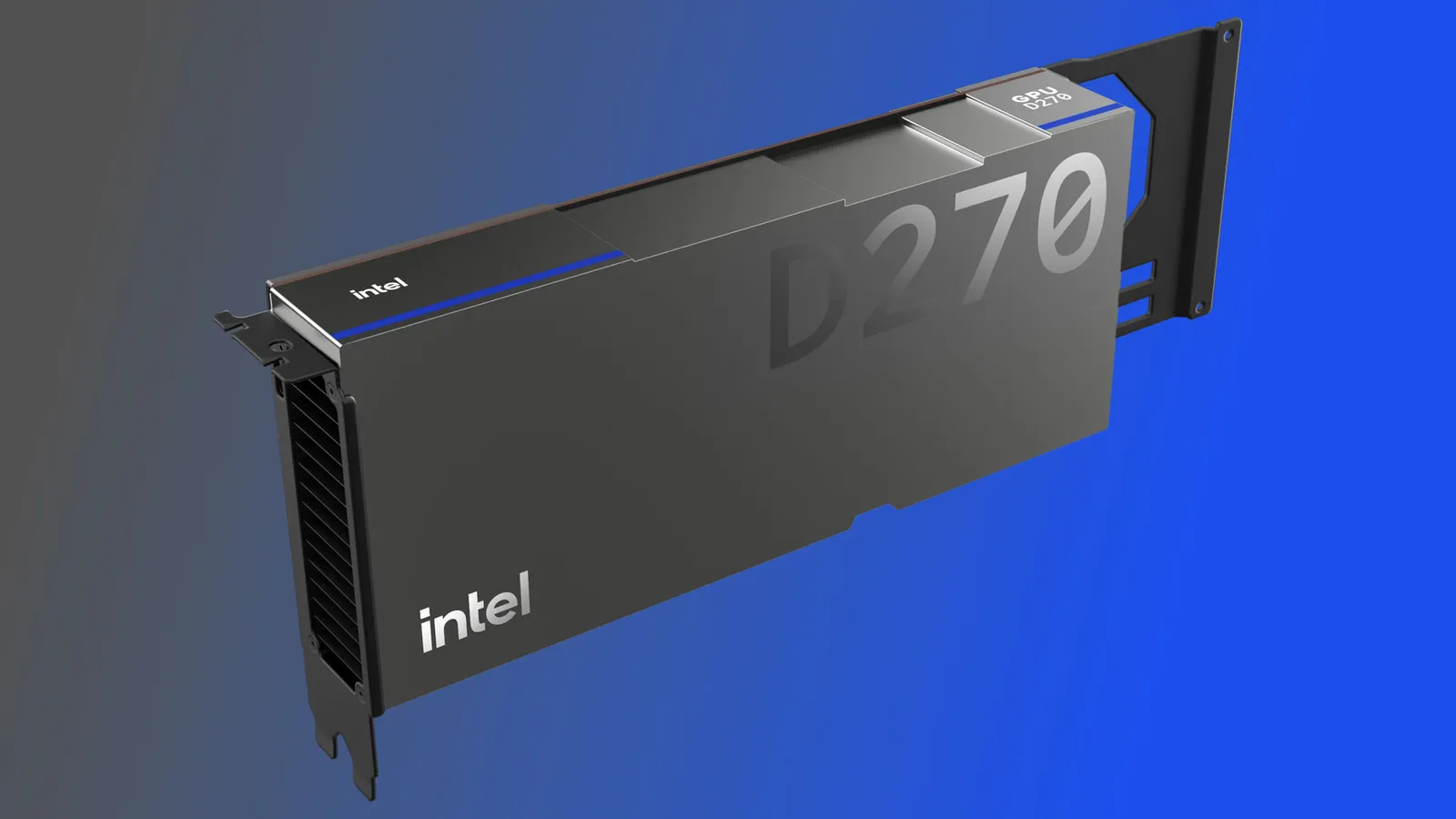
Figure 2. Intel’s D270. (Source: Intel)
Intel’s track record
Intel needs this one to land. The Data Center GPU Max family, with the code name Ponte Vecchio, missed its market, Intel shelved its follow-ons, and a string of AI silicon acquisitions never formed a coherent strategy. The D-Series takes a narrower aim: inference, standard servers, and moderate power.
Demand for inference cycles keeps climbing as agentic workflows multiply token counts. A card that fits existing racks and holds large models in memory addresses a real gap in the market. Cost per generated token and software maturity will decide whether the D270 earns a place next to Nvidia and AMD accelerators, and those numbers arrive with general availability.
What do we think?
Intel picked a realistic, winnable fight. The D270 leaves Rubin’s market alone and goes after the enterprise rack that can’t take liquid cooling, where capacity per watt counts. The 1.5 TB/s bandwidth will cap decode speed on dense models. We want to see independent tokens-per-second and cost-per-token numbers, plus real pricing, before we call this Intel’s return to data center AI.
Inflection point. Inference spending now shapes AI hardware, and the D270 shows a second path forming next to the liquid-cooled rack: high-capacity, low-power cards that drop into existing servers. If Intel, and others that follow the same LPDDR route, deliver competitive cost per token, enterprises can run large models on premises with no facility upgrades. That would mark an inflection point for enterprise AI deployment. The D-Series by itself can’t prove it; pricing and independent benchmarks over the next 12 months will.
AND IF YOU LIKED WHAT YOU READ HERE, DON’T BE STINGY, SHARE IT WITH YOUR FRIENDS.