
MediaTek says it is staying Android-first in notebooks, but that stance looks more strategic now that Google is building a desktop OS on the Android tech stack. If Google can make Android a credible desktop-class platform, MediaTek may gain a second path into premium Arm notebooks without needing Windows as urgently as before. Lenovo and Google are reinforcing that argument by presenting their work with MediaTek as a tightly coordinated “virtual vertical victory” model designed to deliver a more seamless cross-device experience for the large installed base of Android users.
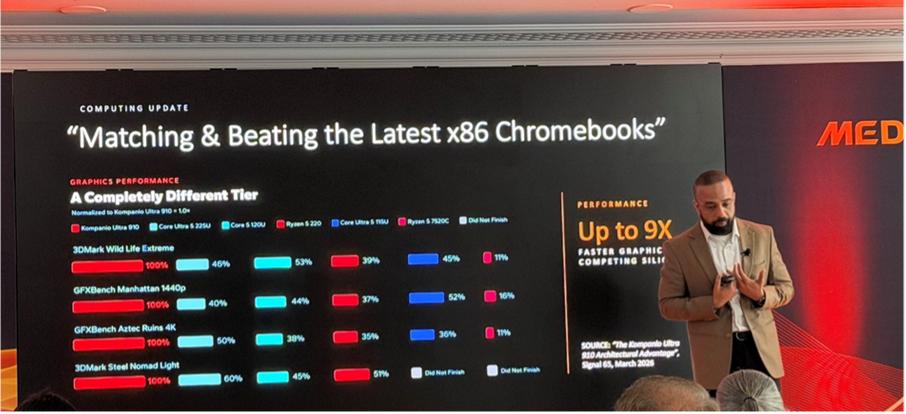
PD Rajput, MediaTek’s VP of computing platforms. (Source: JPR)
MediaTek is staying focused on Android-based computing for now, according to feedback they gave to Jon Peddie Research at the MediaTek Analyst Day on April 1 in San Francisco. Given comments from Google’s John Solomon on a panel at the same event, that’s starting to look less like caution and more like positioning.
PD Rajput, MediaTek’s VP of computing platforms, was direct. When we asked him whether MediaTek might support other operating systems, he said the company would “stay focused in a single-OS approach with Android” while evaluating other options as the market evolved. The logic is straightforward: MediaTek already has scale, ecosystem reach, and competitive silicon across phones, tablets, TVs, Chromebooks, and automotive. A single-OS focus lets it compete on the factors it cares about—price, battery life, AI performance, and time to market—without fragmenting its resources.
For years, Windows for Arm looked like the unavoidable destination for any chip supplier that wanted to move beyond mobile into premium notebooks. That assumption is less solid now because Google is building another path.
Solomon, who leads Google’s laptop, tablet, and Android enterprise businesses, confirmed that Google is “building a desktop operating system on the Android tech stack.” He framed it around scale and AI deployment: the ability to push capabilities across device types without maintaining separate software stacks. The pitch to premium Android phone users still running Windows PCs is essentially: You’re leaving continuity on the table. Working with MediaTek and Lenovo, Solomon argued that Google can deliver things “you just can’t do when you’re working cross-platform.”
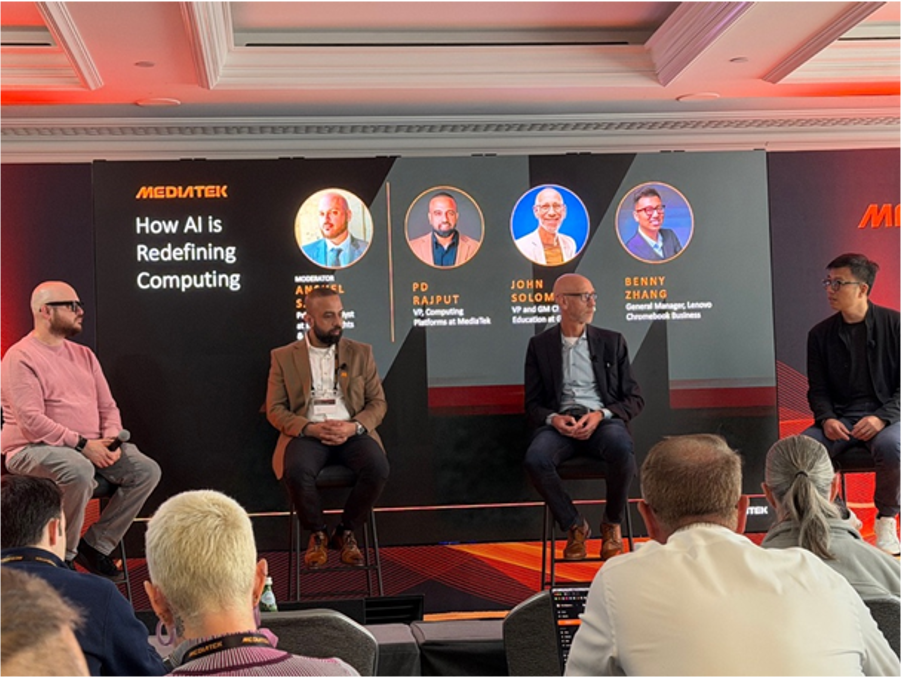
Figure 1. PD Rajput (MediaTek), John Solomon (Google), and Benny Zhang (Lenovo) speaking on a panel moderated by Anshel Sag (Moore Insights) at MediaTek’s Analyst Day 2026. (Source: JPR)
The competitive question is not whether MediaTek should chase Windows. It’s whether a coherent Android desktop will make that chase less necessary.
Rajput cited MediaTek’s growing Chromebook share and made strong performance claims for the Kompanio Ultra 910 platform. Solomon went further, calling the Lenovo Chromebook Plus 14 his single recommendation for the best Chromebook on the market right now—best balance of battery, performance, and on-device AI. Benny Zhang, general manager, Chromebook BU at Lenovo, described the three-way collaboration as a “virtual vertical victory,” planned 18 to 24 months out against a shared target experience, not assembled from separate roadmaps.
Apple’s MacBook Neo is putting pressure on the premium Chromebook segment. Google, Lenovo, and MediaTek are arguing that close coordination can approximate some of the same benefits Apple enjoys over product planning and stack, without vertical integration. If they’re right, the next phase of affordable AI-capable notebooks isn’t a clean two-way contest between Apple and Windows. There’s a third shape evolving from the historically low-end and education-focused Chromebook market.
Open questions remain. MediaTek cited GPU as an area of differentiation as Android notebooks push into gaming and content creation, but it’s not yet clear that’s the case. Apple is applying more pressure in the same broad price band, Qualcomm’s privileged Windows position has weakened, and the industry is increasingly asking who else can field credible Arm PC silicon. If MediaTek wants to step into that opening, GPU architecture becomes a much bigger strategic decision. Nvidia would be the obvious high-profile route. Imagination has also recently shown that DirectX support is no longer out of reach for alternative IP. For now, MediaTek is staying focused and staying with Arm Mali.
What do we think?
Google’s desktop announcement materially changes the strategic calculus for Arm chip suppliers with Android roots. Windows for Arm was previously close to a prerequisite for anyone trying to move into premium notebooks based on Arm IP. It’s now looking more like an option. MediaTek’s single-OS discipline looks better today than it would have two years ago, not because the Windows opportunity has shrunk, but because a credible second route is forming.
The risk is execution. Google’s track record with desktop ambitions is not unblemished, and “virtual vertical” is only as good as the integration it actually produces. If the Lenovo partnership delivers, the framing holds. If it fragments, MediaTek’s Windows question comes back sooner than Rajput’s answer implied.
WHATYA THINK? LIKE IT? DON’T BE STINGY, SHARE IT WITH YOUR FRIENDS.