
MediaTek’s Q3 revenue rose 18.3% from a year ago to NT $168.1 billion (about US $5.25 billion), and EPS reached NT $17.50. Smart Edge Platforms grew 63% and now supplies 58% of sales, and the first AI accelerator began shipping in September. Mobile phone revenue fell 17%. A US $3.9 billion convertible bond lifted cash, and inventory climbed to NT $153.5 billion. Q4 guidance of NT $210.1 billion to NT $221.8 billion implies 25% to 32% growth and includes US $2.5 billion from the accelerator. Operating margin reached 16.1%.
MediaTek’s profits grew with sales. Gross margin held at 46.3%, up 0.1 points from Q2 and down -0.2 points from a year ago. Operating expenses rose 15.5% YoY to NT $50.7 billion, including R&D of NT $42.2 billion, or 25.1% of revenue. Operating income climbed 22.2% to NT $27.1 billion, a 16.1% margin. Net income rose 10.8% to NT $28.2 billion because non-operating income fell to NT $6.5 billion from NT $7.8 billion a year ago and the income tax charge rose to NT $5.4 billion from NT $4.5 billion. EPS reached NT $17.50, up 10.5%, and non-TIFRS EPS was NT $17.92.
The New Taiwan dollar averaged 31.99 per US dollar in Q3, against 29.95 a year ago and 31.60 in Q2. At those rates, revenue of NT $168.1 billion equals about US $5.25 billion, up 10.7% YoY and 9.1% QoQ in US dollars. MediaTek measures its full-year growth target in US dollars.
Smart Edge replaces phones as the growth engine
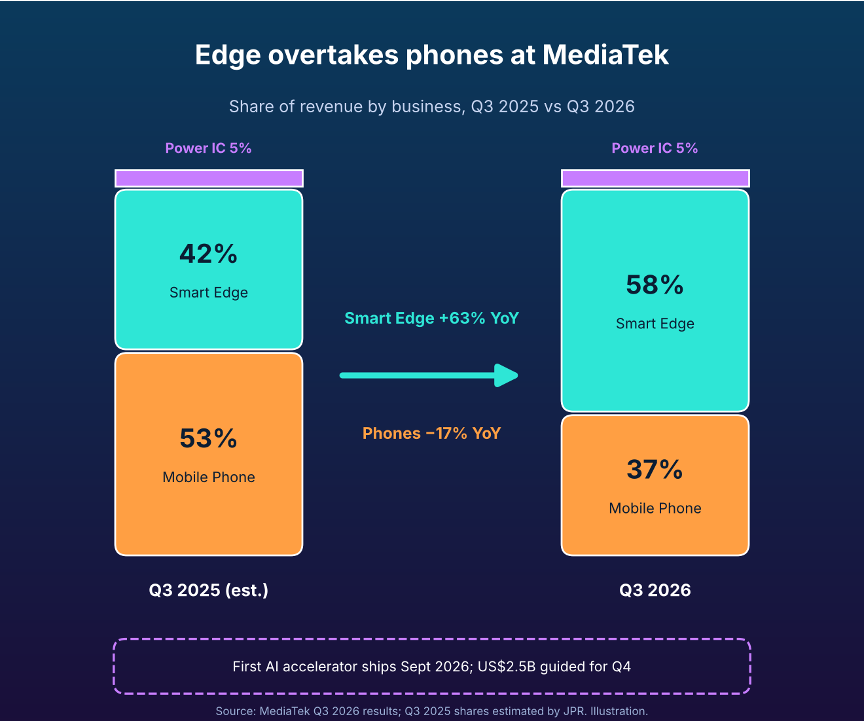
Smart Edge Platforms revenue rose 20% QoQ and 63% YoY, and supplied 58% of the total. Mobile Phone fell -1% QoQ and -17% YoY to 37%. Power IC rose 1% and 18%, respectively, to 5%. From the reported percentages, we estimate Smart Edge at about NT $97 billion and Mobile Phone at about NT $62 billion. A year ago, the two stood near 42% and 53% of sales, respectively.
Smart Edge growth came from volume production of new projects, including a 5G thin modem for a new smartphone customer, AI tablets, AI PCs, and automotive cockpits. TV SoC revenue rose on higher DRAM content. The flagship Dimensity 9500 appears in Samsung’s Galaxy Tab S12 series. Flagship phone chips performed well, including the first 2nm Dimensity 9600 Pro, and Power IC growth came mainly from data center share gains.
“We have already commenced initial shipments in September,” said Rick Tsai, MediaTek CEO, about the first AI accelerator. MediaTek is “confident of delivering 2.5 billion US dollars revenue in the fourth quarter.” The company is working with supply chain partners for additional capacity to meet demand.
AI accelerators, Nvidia, and capital
For 2027, Tsai expects the first accelerator program to reach the high end of a revenue target range of about US $16 billion, around 20% of the AI accelerator ASIC market. The second accelerator project is on track for high-volume production in the first quarter of 2028. At the Q4 guidance rate of NT $31.7 per US dollar, US $2.5 billion equals about NT $79 billion, roughly 37% of the guidance midpoint.
MediaTek cites progress on 448G SerDes, 3.5D advanced packaging and co-packaged optics. It connects custom XPUs to the NVLink ecosystem through NVLink Fusion with Nvidia and supports UALink for Ethernet-based rack architecture. On the edge, the RTX Spark AI PC, built on the N1X chip that integrates Nvidia GPUs with MediaTek SoCs, reached commercial availability in mid-October through major PC OEM partners. Development of a second-generation SoC is underway.
MediaTek completed a US $3.9 billion overseas convertible bond offering with participation from Nvidia and Alphabet. Tsai said it enhanced the company’s ability to secure capacity for critical components. Cash and current financial assets rose to NT $278.3 billion from NT $198.4 billion in Q2, financing activities brought in NT $107.7 billion, and non-current liabilities reached NT $151.1 billion from NT $34.5 billion.
Inventories rose 56% QoQ to NT $153.5 billion, about 2.7 times the NT $57.0 billion of a year ago. Operating cash flow turned negative at NT -$4.3 billion, against a NT $24.3 billion inflow in Q2. The prepared remarks do not explain the inventory build. The component-capacity comment suggests preparation for the Q4 ramp, and Q4 results will show whether that inventory converts to revenue.
Q4 guidance points to a step up
MediaTek guides Q4 revenue to NT $210.1 billion to NT $221.8 billion, up 25% to 32% QoQ and 40% to 48% YoY. It guides gross margin to 45% plus or minus 1.5 points and the operating expense ratio to 26% plus or minus 2 points. At the midpoints, that implies an operating margin near 19%, up from 16.1% in Q3, when operating expenses took 30.2% of revenue. Management now expects full-year US-dollar revenue growth to exceed its earlier high-single-digit target.
The guidance leaves about NT $137 billion for everything except the accelerator, below Q3’s total of NT $168 billion, and the remarks do not break out Q3 accelerator revenue.
What do we think?
MediaTek’s Q3 shows the mix moving from phones to edge platforms and AI accelerators. Revenue and operating income grew double digits, and the Q4 guide implies a higher operating margin. The convertible bond, with Nvidia and Alphabet taking part, funds component supply. We want to see inventory convert to revenue, accelerator margins, and the phone decline stabilize.
Inflection point. The accelerator’s path from first shipment in September to US $2.5 billion in Q4 is the quarter’s clearest inflection signal. That Q4 figure exceeds Q3 mobile phone revenue of about US $1.9 billion. An inflection point for the whole company requires the 2027 target near US $16 billion, a second accelerator in volume in 1Q28, and gross margin that holds near 45% as the mix shifts. Q4 and Q1 results will show whether accelerator revenue repeats at that scale.
AND IF YOU LIKED WHAT YOU READ HERE, DON’T BE STINGY, SHARE IT WITH YOUR FRIENDS.