
Nvidia’s RTX Spark pairs a Grace CPU, custom built with MediaTek, with a Blackwell GPU and up to 128 GB of unified memory in a Windows PC platform built for local AI agents, gaming, and content creation. Laptops ship October 16, with compact desktops available in November. This article looks at why local AI took off in 2026, what RTX Spark is, and where Nvidia’s software gives it an edge.
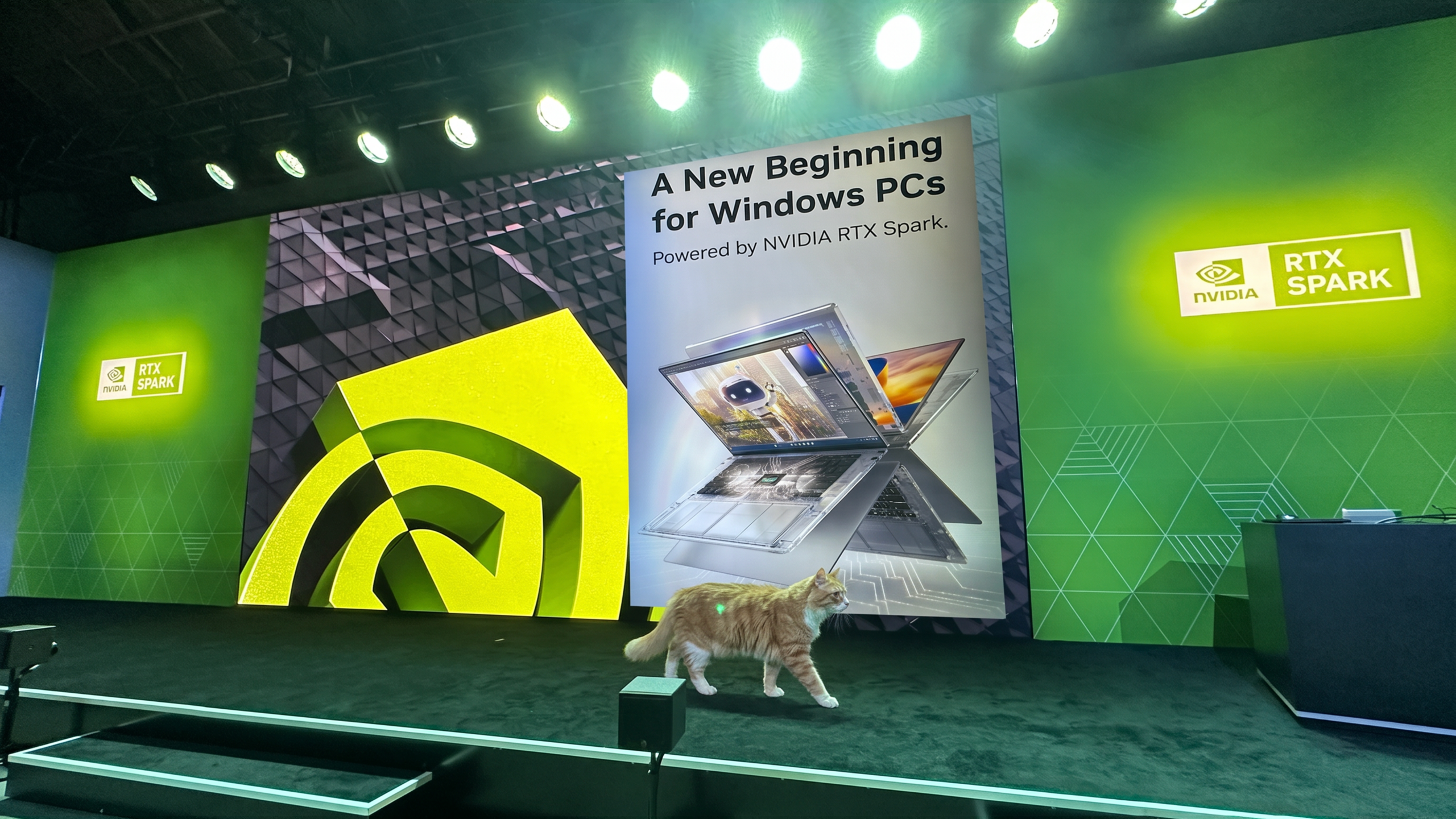
Figure 1. Nvidia stage at RTX Spark Editor’s Day, San Francisco, October 8, 2026. (Source: JPR)
Nvidia and Microsoft introduced RTX Spark at GTC Taipei during Computex on May 31, 2026. Nvidia calls the platform the first Windows PCs purpose-built for personal agents. Until today, client users interested in getting started with serious local AI were forced to pick two of the three things on their wish list: Windows, 128 GB memory, Nvidia software ecosystem.

In order to challenge the status quo and break into the consumer PC market, the three items are needed, and RTX Spark brings them together for the first time.
The localization of AI
For the first stretch of the generative AI boom, capable AI meant the cloud. Prompts went out to remote data centers, and answers came back. The user owned the screen, and someone else owned the compute. This is still, and will continue to be, the case for frontier models.
Data privacy, IP protection concerns, and token economics keep many consumer and corporate users away from doing anything more than experimentation when it comes to AI. The first local alternative came from x86 AI workstations built around discrete GPUs. A user could load an open model into the memory of one or multiple top-of-the-line workstation graphics cards to run it privately. That worked, but the model had to fit in the card’s dedicated memory. While workstations are still the fastest local option, they are out of reach for most people. Nvidia DGX Station brought even more performance and a massive coherent memory space, and now they support Windows too, but still only a corporation can justify a workstation like that to serve a team of AI-hungry users.
Nvidia’s DGX Spark moved the equation by putting large memory pools and CUDA compatibility in a deskside box. It runs DGX OS (Linux), and Nvidia describes DGX Spark as the most capable personal agent AI computer for developers that need a Linux environment. RTX Spark is the Windows chapter of that story. It takes the same idea, a Grace Arm CPU (N1X), a Blackwell GPU, and a large pool of unified memory—and puts it into laptops and small desktops that run Windows 11.
What is RTX Spark?
RTX Spark is a superchip platform. In its top configuration, a 20-core Grace Arm CPU, custom built with MediaTek, sits next to a Blackwell RTX GPU with 6,144 CUDA cores and fifth-generation Tensor Cores. This chip is available for RTX Spark desktops and laptops. The two share up to 128 GB of unified memory, according to Nvidia. The company claims up to 1 PFLOPS of FP4 AI performance and lists a power range of 45 to 80 W. A second configuration of RTX Spark, exclusive for laptops, uses a 5,120-core GPU, an 18-core CPU, and up to 64 GB of memory. This option will help reach the starting-from list prices.
The CPU is Arm-based, meaning that initially, Windows 11 on RTX Spark relies on Microsoft’s Prism emulator to run 32-bit and 64-bit x86 applications, unless a native Arm version of the application is available, and there are a lot already (more on this later).
Nvidia lists six laptop partners: the Asus ProArt P16, Dell XPS 16, HP OmniBook Ultra 16, Lenovo Pro 9n, Microsoft Surface Laptop Ultra, and MSI Prestige N16 Flip AI+. Compact desktops are planned from Acer, Asus, Dell, Gigabyte, HP, Lenovo, and MSI, along with a Surface RTX Spark Dev Box from Microsoft.
“The PC is being reinvented,” said Jensen Huang, Nvidia founder and CEO.
Three main differentiators
Nvidia frames RTX Spark around three pillars, as shown on a presentation slide.
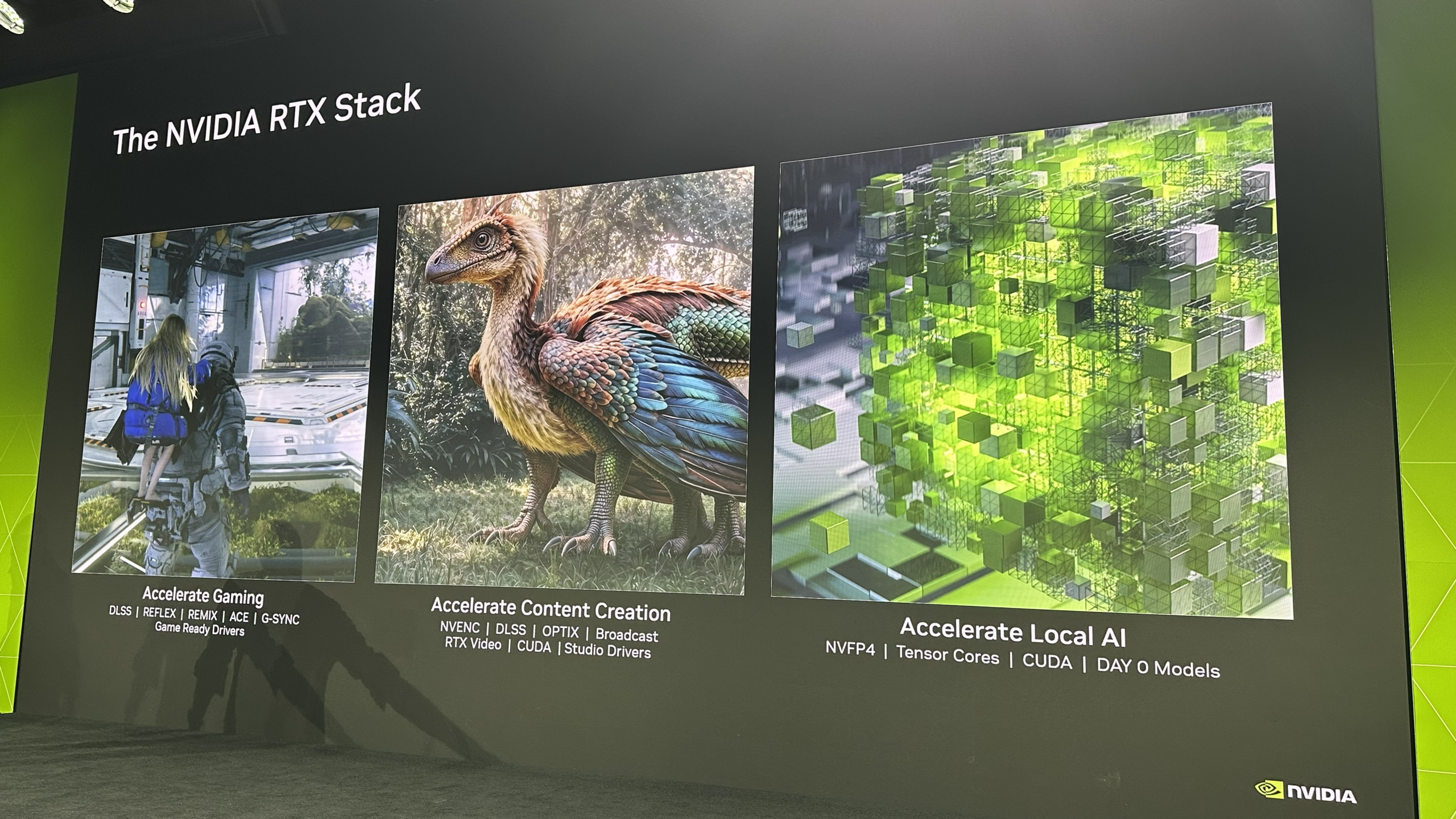
Figure 2. The Nvidia RTX Stack: accelerate gaming, content creation, and local AI. (Source: Nvidia presentation, photo by JPR)
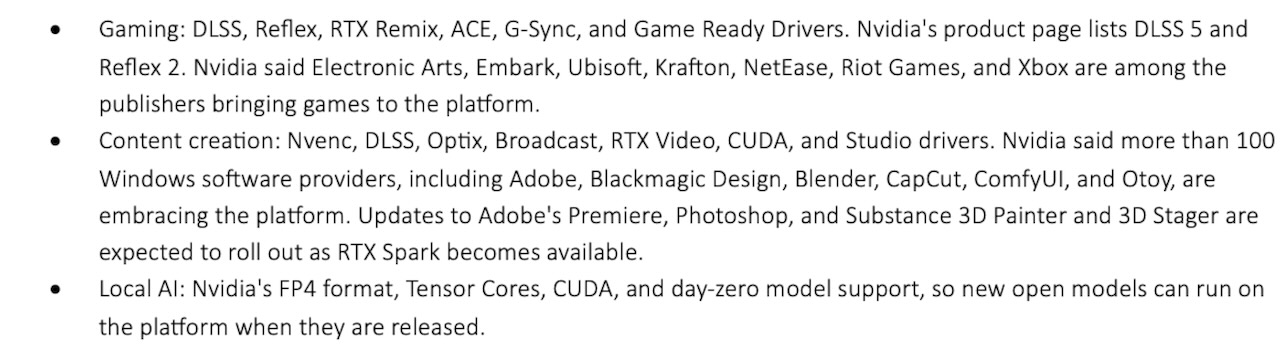
The common thread is CUDA, which Nvidia says runs natively on RTX Spark, along with the complete Nvidia software stack, according to Huang. For gaming, Arm compatibility is the open question. Microsoft said native anti-cheat support from Epic’s Easy Anti-Cheat and BattlEye, along with expanded Prism compatibility, is meant to close that gap. Games will have to migrate to RTX Spark one by one. Nvidia showed us plenty of games running flawlessly, and gave us a short list of big titles that will come in 2027, including Call of Duty: Modern Warfare 4.
2026: The year local AI exploded
Nvidia titled one of its slides “2026: The Year of Local Agents,” and the three charts on it make the case.

Figure 3. 2026: The Year of Local Agents. (Source: Nvidia presentation, photo by JPR)
The first chart tracks agent harnesses, the software that lets a model call tools, read files, and operate applications. OpenClaw, Hermes, Pi, and PyTorch have shown the world the level of interest in local AI.
The second chart plots scores on the AA Intelligence Index, charted by model release date through September, 2026. It shows local models, which Nvidia defines as 180 billion total parameters or fewer, now reaching the same intelligence scores that proprietary cloud models hit not long before. Nvidia’s pitch is that the gap between frontier and local is closing, not that local has caught up outright. The future is undisputably hybrid, with frontier models bringing the latest capabilities, and through optimization, quantization, and refining, such advancements in AI will find their way into smaller models and, therefore, local AI.
The third chart shows Hugging Face downloads of local models rising from 319 million in 2025 to more than 1.68 billion so far in 2026, roughly five times higher. Nvidia sourced the figure from Hugging Face’s top 20 LLM downloads. Downloads are not the same as active users, and the data reflects Nvidia’s selection, but the direction is clear, and it makes very clear why Nvidia acquired Hugging Face recently. Millions of users get their models there, and now Nvidia can assure their latest and most optimized versions are front and center.
Software ecosystem hits the ground running
Hardware without software is a science project, and Nvidia knows it. One of our favorite slides in the presentation was the Agent-Ready Ecosystem of RTX Spark Apps, listing built-in tools, skills, and MCPs for PC agents.
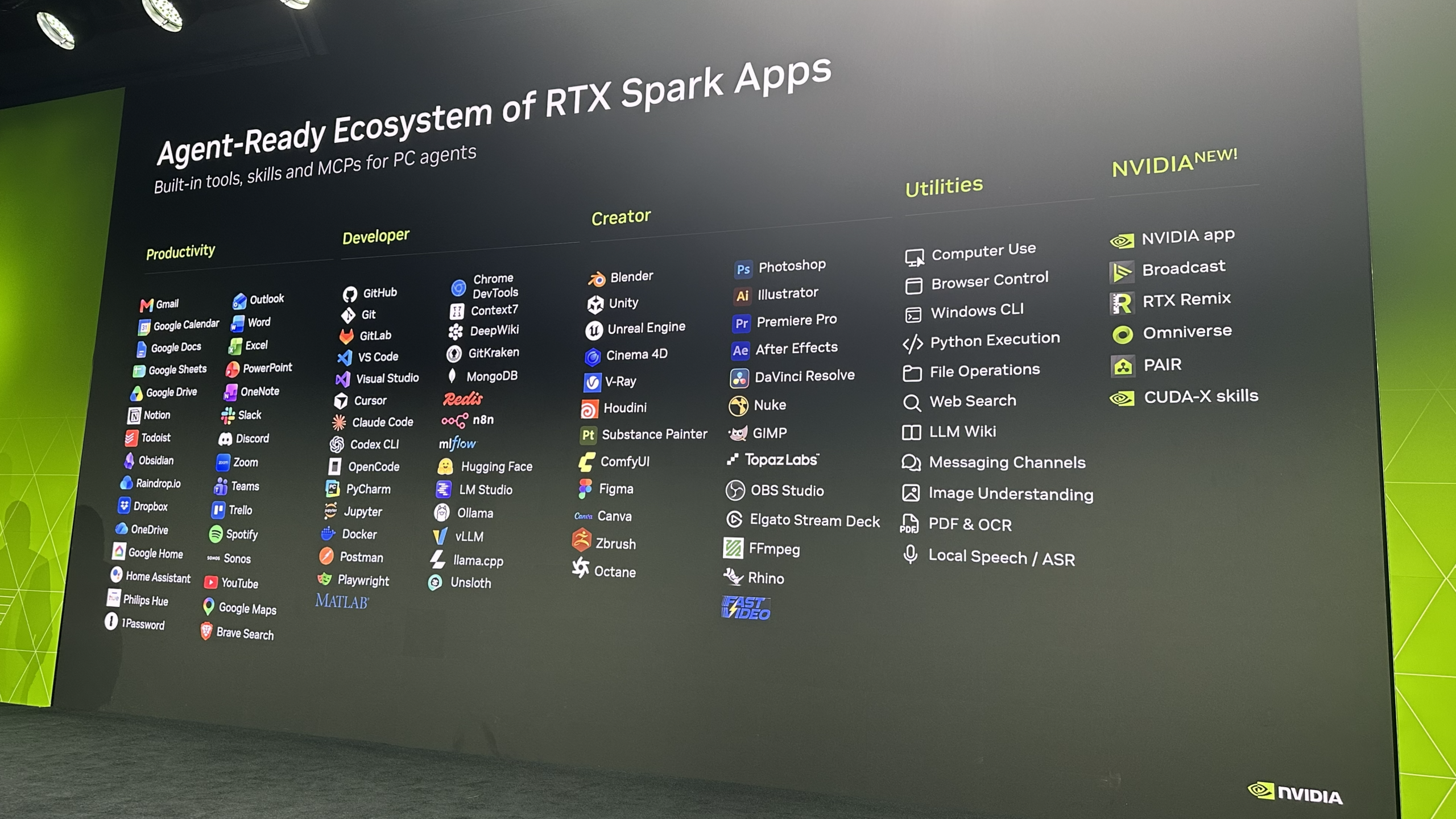
Figure 4. Agent-Ready Ecosystem of RTX Spark Apps. (Source: Nvidia presentation, photo by JPR)
The slide groups the ecosystem into four columns, plus a fifth for Nvidia’s own offerings, just to list some key applications:
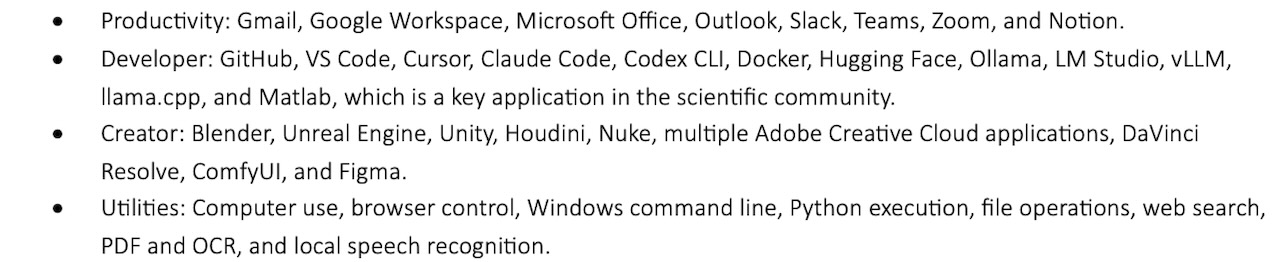
Some of these applications are high in JPR’s priority list for workflow analysis. JPR Labs is testing some of them on RTX Spark right now; stay tuned for more details in the following days.
Nvidia also understands that simplifying local setup for agent software is critical to reach the next level of users. RTX Spark offers a welcome guide for users to get started with Hermes Agent, OpenClaw, and Perplexity’s Portable Computer.
The Nvidia advantage
The last column of the ecosystem slide, marked new, shows what Nvidia brings itself: the Nvidia app, Broadcast, RTX Remix, Omniverse, Pair, and CUDA-X skills.
PAIR, short for Personal AI Router, is the most interesting, and it’s coming out of beta as part of this announcement. It routes separate inference jobs between machines on a network rather than splitting one model across them. In a demonstration, Nvidia spread the work of multiple helper agents across an RTX 5090 PC, an RTX Spark laptop, and a DGX Spark. That means any AI-capable system you currently own or will get in the future, will become another node in your AI network. This is a brilliant move by Nvidia, reducing buyer’s indecision of users waiting for the next platform. Now they can buy the latest system and make their AI network stronger with the next one. Nvidia also mentioned that PAIR is not exclusive to Nvidia hardware. It will be interesting to see how another node behaves.
What do we think?
There is no way not to be excited for the arrival of RTX Spark—a platform capable of disrupting the x86 client PC market, from Nvidia, a company with the knowledge, patience, and resources necessary to work with Microsoft to enable Windows on Arm.
Qualcomm has put years of effort to achieve just that, and Nvidia will, to an extent, help Qualcomm run Windows better. Although most of their focus will be on enabling and migrating the GPU acceleration they have with CUDA. Beyond the technical enabling, Nvidia counts on the brand recognition and ISV relationships that Qualcomm can only dream of, at least on the PC market.
RTX Spark, as unique as it is, enters a crowded field. Apple M5/M6-based Macs, AMD’s Ryzen AI platform, Intel’s Panther Lake, and Qualcomm’s Snapdragon X have their eyes on local AI capabilities. Each one of them plays at a different level of capabilities, performance, cost, and software ecosystem. Independent testing will matter once the laptops ship tomorrow October 16.
It will be very exciting to see the market motions in the next few years as Qualcomm establishes its brand and enables applications, AMD keeps building up its ROCm software, Apple continues the MLX development, and Intel comes to market with silicon that can seriously compete in local AI at the new Microsoft Builder level, not only in the Copilot+ category.
What matters today is that Nvidia RTX Spark is now available. We will continue sharing our findings in the Asus ProArt P16 laptop, so stay tuned for more details in the following days.
In a world where Nvidia was supposed to put its foot in the door, it instead came like a boulder crashing down the chimney, carrying gifts for everyone to be excited about.
– The Workstation Cavalry
AND IF YOU LIKED WHAT YOU READ HERE, DON’T BE STINGY, SHARE IT WITH YOUR FRIENDS.
Disclaimer: This article is not financial advice. The content is for informational purposes only. The author may own shares in companies mentioned, and readers should not consider this article a recommendation to buy, sell, or hold any assets.