
The rise of AI image generators has occurred recently and has progressed swiftly. In August 2025, Google’s Nano Banana was released, followed three months later by a Pro version, aimed at professionals, that produced next-level quality and accuracy—but at a premium price compared to the initial version for the more casual user. Alibaba challenged Nano Banana Pro with its Qwen Image 2.0, with similar features and a lower price per image. Google countered, not by messing with its Nano Banana Pro delivering top-quality images, but with the new Nano Banana 2.0, which produced images of slightly less quality than its Pro version but faster and cheaper.
When it comes to selecting an AI image generator, pricing can be a major consideration. Sure, there are other factors to consider, such as output quality and speed. But for those users, especially enterprises, running high-volume image workflows, well, money matters—a lot. Yet, for those needing accurate, high-quality AI image generation, there was little choice but to ante up, following the idiom, “You get what you pay for.” But recently, Google turned that phrase on its head.
AI image generators arrived on the market in short time, and in no time, people have bunches to choose from. But not all of them produce the same quality of results, nor are they all priced the same. There are different plans, some being free, but there are usually caveats in terms of number of generations, resolution, priority of generation, etc.
The great thing about AI models, and, subsequently, AI image generators, is that they are constantly improving, quickly leading to new and improved versions. Google released the original Nano Banana in August 2025, and its popularity quickly soared. Then, Nano Banana Pro, powered by Gemini 3 Pro, hit the market in November 2025. Representing a significant advancement in AI image generation, it was lauded for its increased speed, ability to follow instructions, image text accuracy, and rendering refinement compared to the original.
But, Nano Banana Pro’s “better” comes at a price. But for professional creators whose work requires the kind of high-quality output that Pro offers, that was the cost of doing business. But, not for long.
On February 10, 2026, along came Alibaba’s Qwen Image 2.0 professional AI image generator, creating high-fidelity, native 2K resolution images during creation, not at upscaling, with a deep understanding of both text prompts and image generation. Whereas the earlier Qwen Image used separate models for image generation and modeling, the new 2.0 uses just a single model. As a result of its single-model structure, it avoids the typical quality degradation that occurs when outputs are transferred between two different models.
Moreover, Qwen Image 2.0 costs less than Nano Banana Pro—though exactly how much less is difficult to pin down due to so many variables at play when generating an image. It’s a kin to comparing apples to, well, bananas. Given that on the surface, the reported differential appears insignificant (pennies/nickels per generation), the total adds up quickly for heavy users. As a result, professional users no longer had to choose between quality and price, as Qwen was delivering on both fronts.
But wait, “flash” forward a mere 16 days. Not to be outdone, Google DeepMind released Nano Banana 2 on February 26, 2026 (how’s that for timing?), built on the Gemini 3.1 Flash Image model. It produces high-quality images similar (but not identical) in quality as the Nano Banana Pro but does it much faster—2× to 3×faster—as it uses some capabilities found in the Pro version along with some new ones. It can also maintain character consistency (for up to five characters) and fidelity of up to 14 objects in a single workflow, according to the company. It has multi-lingual capabilities, translating image text into various languages within the same creation/editing workflow. And, it offers image resolutions from 512 pixels to 4K.
While Nano Banana 2 offers high-fidelity images at greater speed, perhaps its most attractive feature is its pricing, said to be on par and even slightly less than its competitor.
It’s also worth noting that upon release, Nano Banana 2 became the default for image generation in the Gemini app and in Google’s Flow video editing tool. It is also distributed across a host of other Google and Gemini applications.
Pricing for image generation is confusing based on plans and a multitude of factors, including AI model type, differential pricing strategies, cost and efficiency of compute resources, etc. But, no matter how you slice it, it looks like Google is offering a fresh alternative for those balancing quality, quantity, and cost.
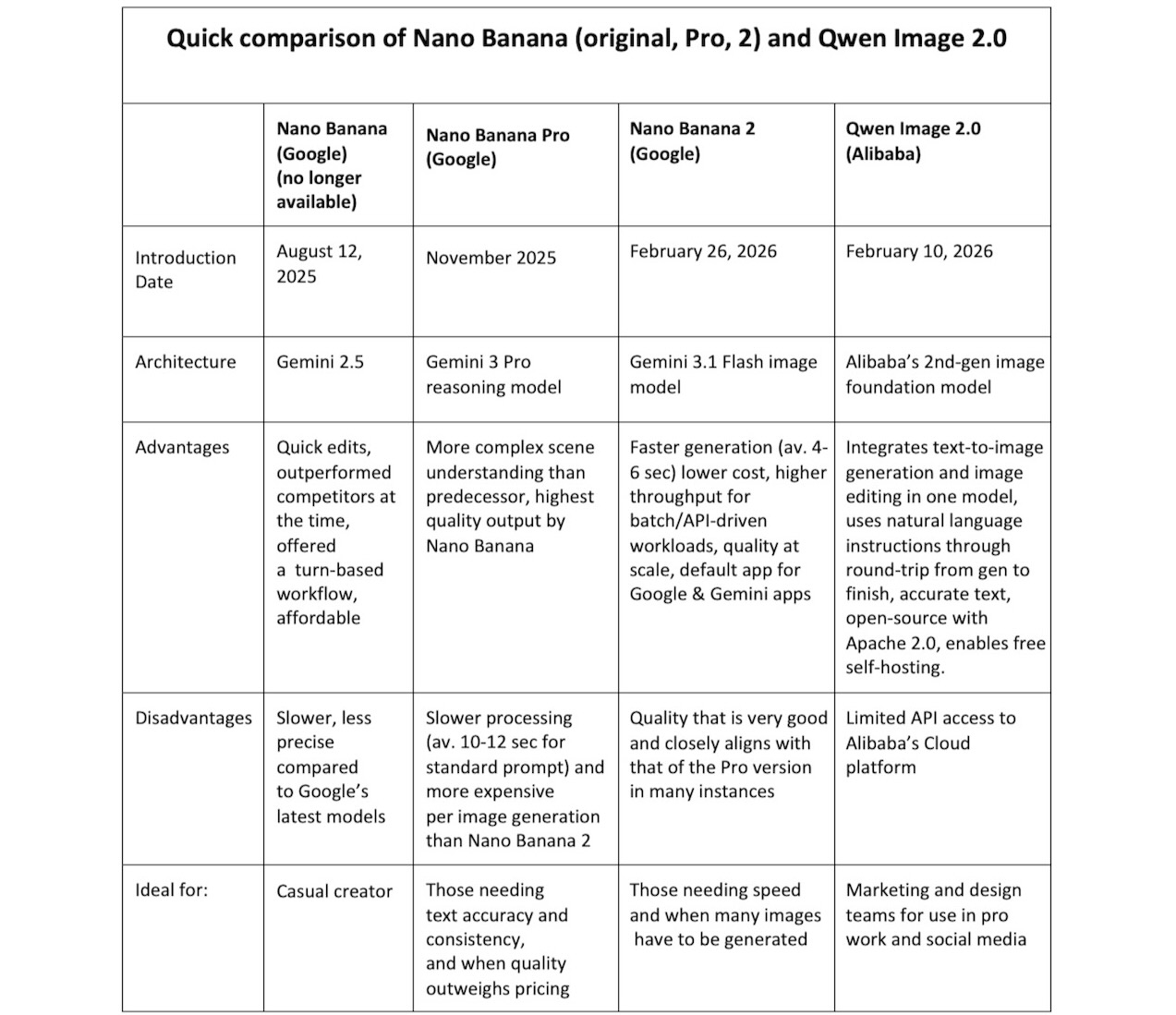
In doing so, did it bruise its own Nano Banana Pro? The two products, while similar, are not the same, each offering different advantages that will be more appealing to certain types of users. If all things were equal, perhaps the newcomer might be cutting short its predecessor Pro’s shelf life. But the products are not equal, and Google is not sacrificing its own stock for an advantage at the market against opponent Alibaba.
For now, at least, the fresh factor goes to Google.
WHAT DO YOU THINK? LIKE THIS STORY? TELL YOUR FRIENDS, TELL US.