
Elon Musk wants to build his own chip factory. The announcement of Terafab—a joint Tesla-SpaceX semiconductor fab in Austin, Texas, targeting 2 nm process technology—is either the most ambitious vertical integration play in decades or the most expensive negotiating tactic in history. Either way, it signals something real about the state of AI chip supply. Here is what Terafab actually means, why the space-grade chip angle matters more than the headline number, and what it tells us about where semiconductor supply chains are heading.
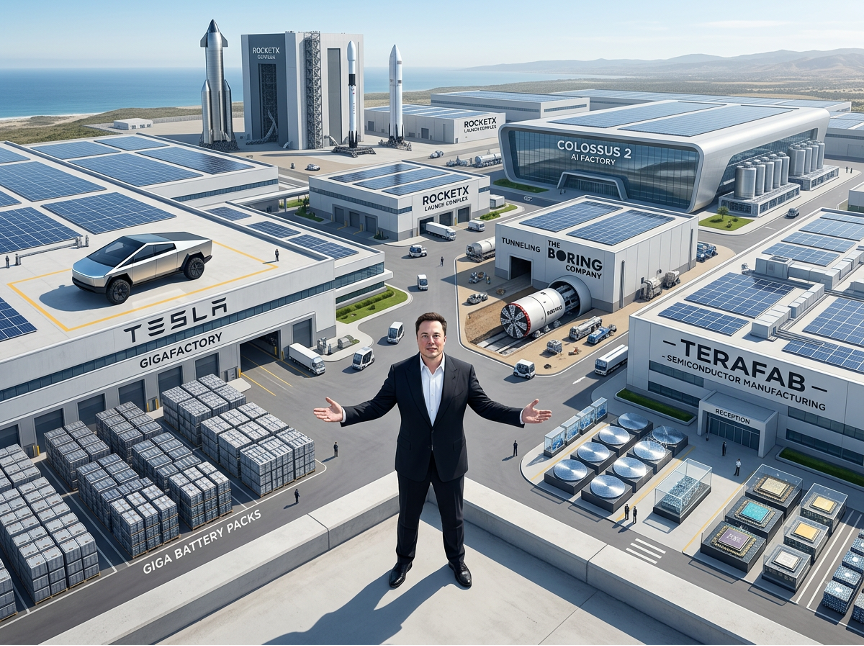
Behold, all I own and more.
Elon Musk announced Terafab, a joint Tesla-SpaceX fab planned for Austin, Texas, targeting 2 nm process technology. The facility would produce two chip variants—one optimized for Tesla vehicles and Optimus robots, the other hardened for radiation and thermal stress in orbital environments serving xAI, now a SpaceX subsidiary. Musk cited interim terrestrial compute targets of 100 to 200 GW annually, with a TW aspiration for space. No timelines accompanied either figure.
Building a leading-edge fab requires billions in capital, a decade of process engineering expertise, and 18-month-plus equipment lead times from suppliers including ASML. Musk possesses none of these today. No newcomer has built a competitive leading-edge foundry in the modern semiconductor era—not Amazon, not Google, not any hyperscaler that has moved to custom silicon.
The supply-chain signal matters more than the fab itself. TSMC has committed over $165 billion in CapEx through 2028, yet AI-driven demand for advanced logic continues to outpace supply. When a customer at Tesla’s scale concludes that vertical integration beats waiting in the allocation queue, that tells you something concrete about the queue.
The space-grade chip angle is the credible wedge. Radiation- and thermal-hardened processors for orbital compute represent a genuinely underserved niche that no major foundry prioritizes at volume. SpaceX has applied to launch 1 million data center satellites, and a planned IPO this summer could raise up to $50 billion to fund the constellation—giving Terafab’s space variant a captive market that resembles vertical necessity more than vanity.
The Musk empire grows more structurally entangled with each move. Tesla invested $2 billion in xAI in January. xAI became a SpaceX subsidiary. Tesla sells Megapack batteries to xAI data centers. Grok runs in Tesla vehicles. Terafab would layer a shared semiconductor supply chain onto an already dense web of cross-entity dependencies that raises governance questions no SEC filing addresses cleanly.
Whether Terafab produces a single wafer or not, the announcement reshapes Musk’s negotiating leverage with TSMC, Samsung, and every supplier currently rationing chip allocations among hyperscalers. Amazon, Google, and Microsoft have all moved to custom silicon—none has attempted to own the foundry. The orbital AI infrastructure angle introduces a dimension most analysts have underpriced. No incumbent races to fill that gap. At minimum, Terafab forces the semiconductor supply chain to take Musk’s demand forecasts seriously.
What do we think?
Terafab is simultaneously a credible strategic bet and an implausible manufacturing claim. The space-grade chip rationale holds—SpaceX’s satellite constellation creates a captive demand signal that no external foundry addresses today. The terrestrial fab claim strains credibility against the realities of process engineering timelines. The more likely near-term outcome: Terafab becomes leverage in TSMC allocation negotiations and a platform for recruiting semiconductor talent. JPR will track equipment procurement and ASML order activity as the leading indicators of whether this moves from announcement to groundbreaking.
Terafab may mark an inflection point in how the semiconductor industry interprets demand signals. For three decades, foundry capacity has been built in response to proven customer volume. Terafab inverts that model—a customer announcing intent to build supply because the existing supply cannot meet its trajectory. If xAI’s orbital constellation proceeds at the scale Musk projects, purpose-built space-grade logic chips will become a distinct product category. The foundry industry has not yet priced that possibility. When it does, the capital allocation consequences will extend well beyond Austin.
WHAT DO YOU THINK? GOOD ENOUGH TO TELL YOUR FRIENDS ABOUT IT? YOU HAVE OUR PERMISSION TO SHARE IT.