
TechWatch

Lumai’s free-space bet on optical inference

Lumai’s head of product explains the company’s approach to optical AI compute.
David Harold

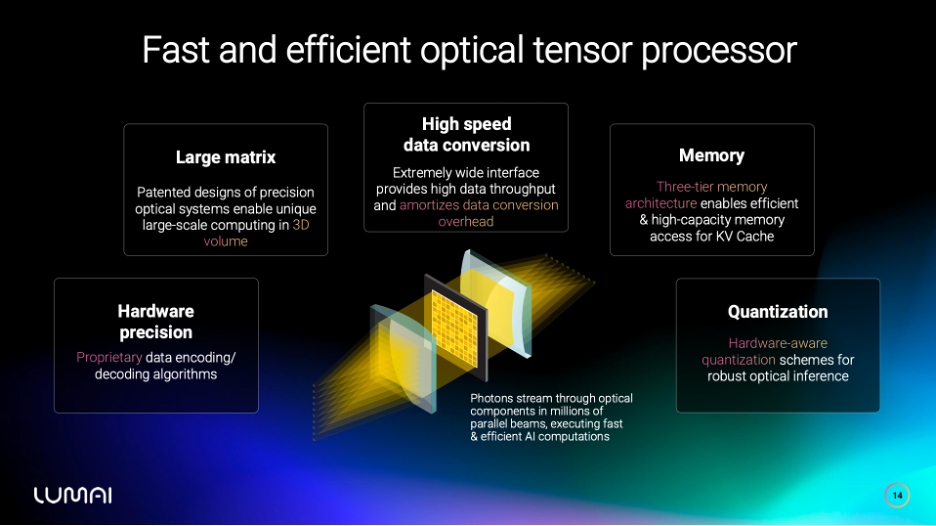
Lumai is taking a different route from most optical compute start-ups. Rather than building on integrated photonics, the Oxford, UK, company uses free-space optics to execute very large matrix operations for AI inference. Its Iris architecture achieves a native 2048 × 2048 optical matrix, aimed first at the compute-bound prefill stage of LLM inference. Lumai’s head of product, Phillip Burr, explains why Lumai is focused on prefill, why batch size matters, and why the company believes optical compute can beat digital systems on energy and cost. (Source: Lumai) Most optical compute architectures are built on integrated photonics: waveguides and modulators
...

Enjoy full access with a TechWatch subscription!

TechWatch is the front line of JPR information gathering service, comprising current stories of interest to the graphics industry spanning the core areas of graphics hardware and software, workstations, gaming, and design.

A subscription to TechWatch includes 4 hours of consulting time to be used over the course of the subscription.

Already a subscriber? Login below

This content is restricted

Subscribe to TechWatch