
Intel has released XeSS SDK 2.1.0, enabling XeSS Frame Generation (XeSS-FG) with Xe Low Latency (XeSS-LL) on non‑Intel GPUs that support Shader Model 6.4. This includes Nvidia GeForce GTX 10‑series Pascal or newer and AMD Radeon RX 5000‑series RDNA or newer. The update unlocks XeSS Super Resolution, frame generation, and latency reduction, though XeSS-LL requires XeSS-FG to run. Intel Arc GPUs process FG via XMX matrix cores, while AMD/Nvidia use compute shaders. XeSS now works in over 200 games, with XeSS 2 already supported in more than 20 titles.
Intel released the XeSS SDK 2.1.0 on Thursday, adding support for XeSS Frame Generation (XeSS-FG) with XeSS Low Latency (XeSS-LL) for non‑Intel GPUs. Owners of Nvidia, AMD, or Qualcomm hardware can now run XeSS 2 features without relying solely on their vendor’s upscaling tools. Any GPU that supports Shader Model 6.4 qualifies, including Nvidia’s GeForce GTX 10‑series Pascal or newer and AMD’s Radeon RX 5000‑series RDNA or newer. Developers can enable super resolution (XeSS-SR), frame generation (XeSS-FG), and low latency (XeSS-LL), though XeSS-LL requires XeSS-FG to function.

(Source: Intel)
The new SDK allows game developers to update their code to support XeSS 2 on a broader set of GPUs. XeSS 2 uses DP4a compute instructions for its super resolution and frame generation models, while Intel Arc Alchemist and Battlemage GPUs use XMX accelerators for the same tasks. Intel offers a software kit that developers can integrate into their games, letting players enable upscaling, frame generation, and latency reduction to improve performance. Before this release, only the upscaler could run on non‑Intel GPUs because Intel maintained two implementations—one for matrix cores in Arc GPUs and one for compute shaders.
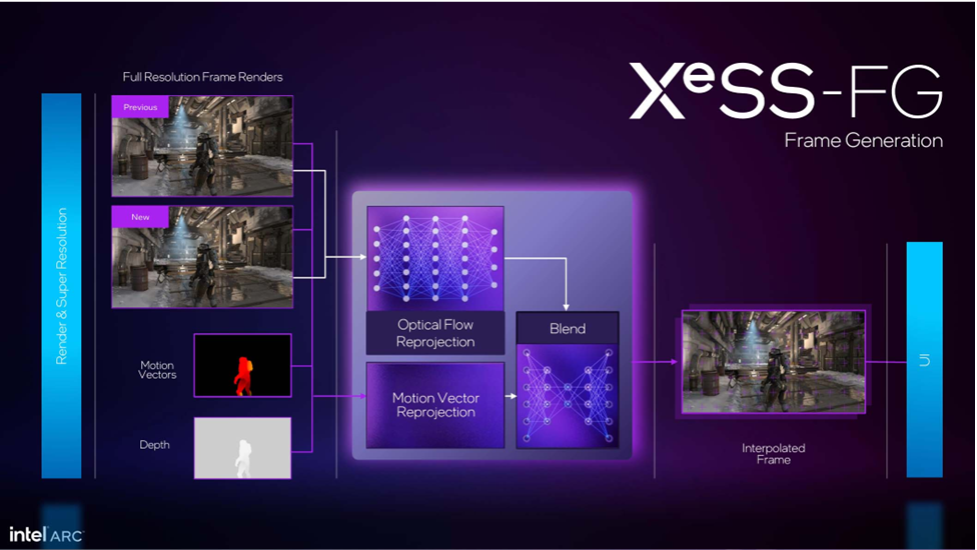
Figure 1. XeSS-FG. (Source: Intel)
The SDK update activates all features on any Shader Model 6.4 GPU. XeSS-LL only operates alongside XeSS-FG and cannot run on its own. Intel also added Vulkan API improvements for XeSS-SR. The frame generation path varies by hardware: Intel Arc GPUs perform frame interpolation through a neural network on matrix cores, while AMD and Nvidia GPUs execute a compute‑shader‑based method similar to FSR frame generation.
Intel introduced XeSS 2 technology last year alongside the Arc Battlemage B‑series graphics cards. XeSS-FG represents Intel’s first frame generation feature, powered by AI‑driven XMX engines. Shader Model 6.4 compatibility includes AMD Radeon RX 6000-, 7000-, and 9000-series cards and Nvidia GeForce RTX 30-, 40-, and 50-series cards—resulting in more compatible non‑Intel GPUs than Intel’s own.
By May 2025, XeSS worked in over 200 games, with XeSS 2 support present in more than 20 titles. The new SDK gives developers a straightforward way to add XeSS 2 support for a larger range of GPUs, which will expand the technology’s adoption in upcoming games.
LIKE WHAT YOU’RE READING? INTRODUCE US TO YOUR FRIENDS AND COLLEAGUES.