
Last year was one for the record books and now we’re all paying forward for our actions.
The way things are, it’s tough to believe 64 countries (including the EU) could agree that it’s time to reshape their futures, hold elections and pick a new group of people to govern them over the next “few” years.
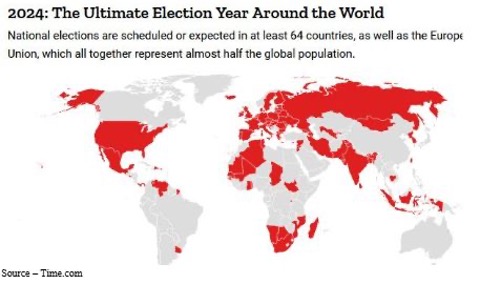
That’s right, 49 percent of the world’s population had the opportunity to participate in national elections to put new people in power to establish the direction and policies for “us.” Note—we didn’t say “free” elections and we didn’t say they were “fair.” They were just elections because sometimes the folks in power simply said, “There, we gave you a choice and congratulations, you got us … again.”
Today, in every country, there are some of us saying, “Don’t blame us, we didn’t vote for that/those idiots.”
Others of us say they made the right, intelligent decision after thorough research, studying all of the news reports and weighing all the facts. We’re not taking sides here, but in today’s instant news, “doing the research” is a major problem. Most of us only follow and believe those news sources that align with our values, our thinking. Everything else is well BS!
We simply do not believe that the vast majority of scoops and facts that appear first on social media – TikTok, YouTube, Instagram, X (twitter), etc. – is well-researched, balanced sources of news and information.
Sorry, we’re … biased. But then, our advanced degrees were in journalism and radio/TV.
Ridiculously hard-nosed journalism ethicists constantly emphasized to us that good journalists had one job/responsibility … gather the facts, present them clearly/concisely, and let people determine the outcome.
Yes, this was before everyone had an instant capture/tell the world device. We may have slipped over to the dark side—marketing/promotion—but we still believe the best source of credible news comes from a source that presents the story as objectively as possible. Everything else is educated/uneducated noise.
Unfortunately, our social media has elevated position advocates to the lofty status of citizen journalists.
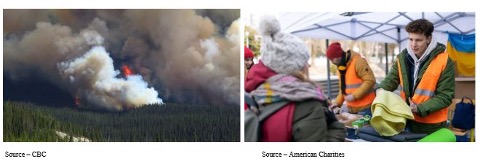
And it has produced some great news – Jewish lasers started the California fires, people can control the weather and direct hurricanes/cyclones to destroy properties/lives, you’re not really paranoid/pronoia people are out to get you/love you – to exist and thrive.
The growth of unvetted news and information causes disruption, confusion and … it’s not new. Since the beginning of recorded history, false and misleading stories have been weaponized to create doubt and manipulate public opinion. Just look back at any of the elections in the 64 countries last year.
The difference is that the digital world has simply made it easier and faster for sources to get important/breaking news out as well as spread fake stories using AI tools that can manipulate ideas and “facts.” The impact and ready availability of misinformation and synthetic news have had a stark impact on the trust of today’s news media – print, audio, and video.
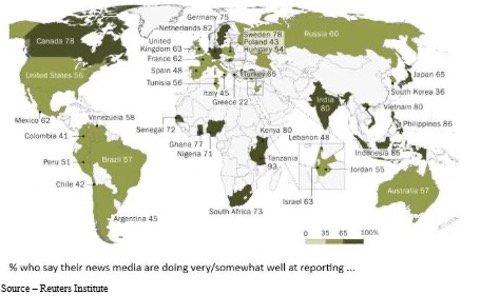
Reuters Institute’s latest Digital News Report showed that the trust in the news is only 40 percent across the 47 countries they and YouGov surveyed. Roughly 59 percent said they were concerned about fake news online.
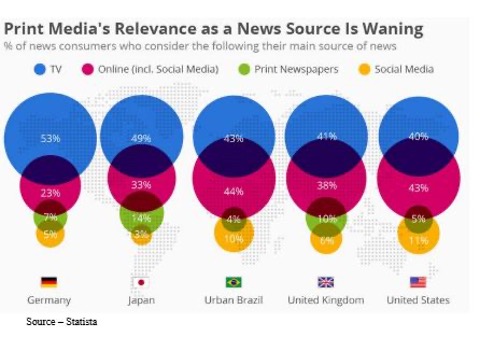
The availability and proclivity of various media outlets vary widely, depending on your background, media “experience,” and age. Nearly all of us grew up with television, but television news is facing the same difficulty as television networks — news and bundle viewership decline as people migrate to streaming home/personal entertainment. Most of the national and local TV services have adapted by expanding their distribution with FAST streaming services and establishing their own online ad-supported services.
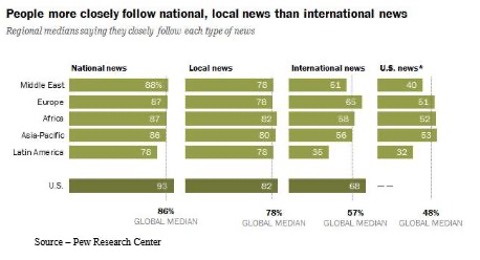
People everywhere feign a deep interest in the goings-on of the world around them. However, they really focus most of their attention on what is happening in their country and even more things that really affect them in their town, city, village, municipality, or commune. As the above chart illustrates, Pew Research has found 86% and 78% percent of people around the world are most interested in following national and local news, while 57% are less interested in news about the rest of the world.
We regularly scan the two “hometown” papers to check the rise/fall of housing in the area, activities of the city council, and other rulings that may/may not affect us directly. We also watch TV news shows on Tubi and Pluto to catch up on regional and state happenings as well as the weather. Not that there’s anything we can do about the weather, but … nice to know.
In fact, station/news management determined they needed to do more than simply present the news/weather with talking heads and added a virtual set to their weather segments. It didn’t change the weather, but it certainly made the weather more interesting than reading temperatures and weather changes off a static board.
We also noted that even their national coverage segment has added a virtual map showing how weather changes were sweeping across the country and how people in other areas were being affected.
Even though print media is fading, we still turn to their paid online versions, which tend to be more/slightly centrist coverage of national/international news — New York Times, Wall Street Journal, USA Today, and Britian’s The Independent. Then, for kicks — and a little sanity check, we’ll skim left- and right-leaning media like New York Post, Daily Mail, Guardian, The Raw Story.
While accurate, independent journalism remains important, it continues to be challenged, derided, and demeaned by mis- and disinformation, suffers from low trust, is constantly under attack, and struggles to remain a viable business. Independent and objective news coverage is difficult. No one — especially business and governmental leaders — likes to be called out for their shortcomings or errors (hey, we live in the US, we know). But today’s younger audience is less interested in reading or watching straight news, but rather news that is at least slightly entertaining.

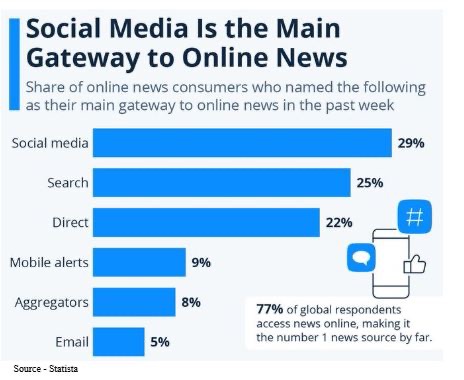
The fact isn’t lost on cable news, which is on the precipice and making moves to straddle the chasm between pay TV’s declining viewership and the unknown future of streaming and DTC delivery. AFP (Agence France-Presse), AP (Associated Press), Reuters, CNN, Bloomberg, and other global news services are shifting their activities to offer unfiltered long-form interviews and news analysis, short spot news clips, and hosted/produced podcasts and news reports.
While network and news executives are certain that serious news will sell profitably, the key is to find the right audience in the shifting environment that aggressively competes with social media sources that are rife with dis-/misinformation. Services such as TikTok, X, Instagram, YouTube, and other unfiltered/unvetted sites are the main news sources for about 30 percent of adults, according to Statista.
Pew Research found that social media’s well-trained algorithms deliver news/information over what might be uncomfortable, complicated truths. At the same time, according to Pew Research, people around the world agree that news media need to be unbiased and should present a balanced analysis of situations and activities.
People in Europe – more than 80 percent of respondents — place a premium on politically unbiased/balanced news coverage, while in the US, 78 percent say news media shouldn’t favor a political party but …
Networks, journalists, and news services have done a good job of accurately informing the public to date, but the period of crafted news that is professionally presented is long gone. The younger audience wants their news and information instantly and online, news that is guided by their own enigmatic and understood views of the world around us. Professional news organizations and executives are scrambling to figure out how news fits into folks’ streaming entertainment and sports world.
The agita and anxiety in news organizations are palpable as they rush to develop a product that will appeal to the audience and one where organizations will survive in today’s digital environment because people today are less interested in the news brand and more in the information.
As in almost every segment of business, AI enthusiasts have the answer … AI tools. They are still a long way from a solution because even in the social media areas, they have frequently only performed “fact laundering.” In countless instances, AI tools reference poorly fact-checked sources that cite dubious research and statistics and present the information as authoritative and credible. In a growing number of instances, AI is doing little more than exacerbating already low news credibility.
AI is only an instrument, a tool. It’s not something that can provide people with an accurate picture of what is going on around them and a look into what the future might hold. The news industry and journalists, as well as the entire M&E industry, face a lot of challenges, but they can/have to persevere because the stakes are too high for everyone.
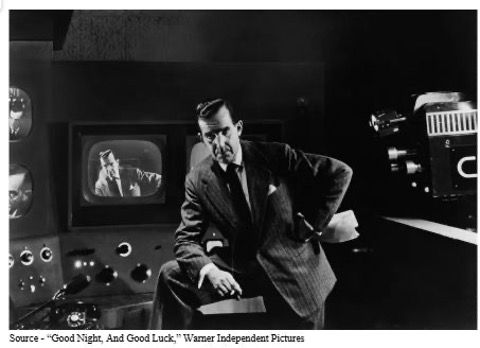
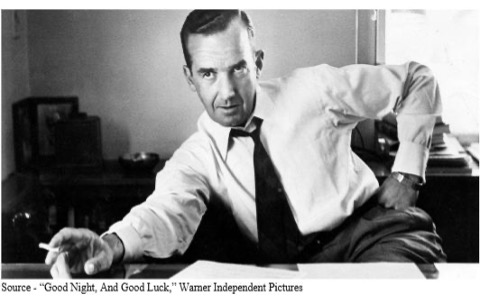
As Edward R Murrow said in 1958 during a speech to the Radio-Television News Directors Association, “Our history will be what we make it. If we go on as we are, then history will take its revenge, and retribution will not limp in catching up with us.”
He once noted that people have a built-in allergy to unpleasant or disturbing information, but if those who finance mass media news, those who look at it, and those who work at it don’t continue to search out and present/listen/watch it, we may see a totally different story too late. And it won’t always be popular because, as David Straithairn, as the fictional Murrow said in Good Night, and Good Luck, “the most trusted man in America is Milton Berle.”
We know, he’s before your time … look him up.
The world needs men/women who don’t fear to write, associate with, speak, and defend ideas/causes that are, at the moment, unpopular.
Andy Marken—[email protected]—is an author of more than 900 articles on management, marketing, communications, industry trends in media & entertainment, consumer electronics, software, and applications. An internationally recognized marketing/communications consultant with a broad range of technical and industry expertise, especially in storage, storage management, and film/video production fields; he has an extended range of relationships with business, industry trade press, online media, and industry analysts/consultants.