
Khronos Group and UHD World Association (UWA) are teaming up to make 3D tech even more awesome. They’re focusing on 3D Gaussian splatting, which turns tiny points into super-realistic 3D scenes. It’s already being used for cultural heritage tours (like virtual Machu Picchu), VFX, VR, and even robotics. This partnership will make it easier to use this tech across different industries, keeping everything open and compatible.

The Khronos Group announced a liaison agreement with the UHD World Association (UWA). The liaison creates a framework for collaboration and information exchange as emerging media types increasingly combine elements of video and 3D technologies in new configurations. UWA operates as an international organization that advances ultra-high-definition (UHD), immersive media, and next-generation spatial imaging technologies across broadcast, cinema, consumer electronics, and industrial applications. Its membership includes content creators, technology providers, broadcasters, and standards bodies working to enable interoperable, high-quality visual experiences at scale.
Khronos and UWA share common interests in advancing open, interoperable technologies for 3D graphics, UHD content, and immersive media experiences. The organizations will coordinate through this liaison agreement to accelerate development of international standards, avoid duplicated effort and fragmentation, and promote rapid standards adoption. Khronos delivered a keynote speech on the convergence of 3D and video standards for immersive media, and the value of the liaison between UWA and Khronos, at the 2025 UWA Summit and Member Conference in Shenzhen, Guangdong, China,
The scope of the liaison includes exchanging use cases and requirements, coordinating normative references, collaborating on domain-specific extensions, and sharing tooling contributions. The organizations will focus initial collaboration on 3D Gaussian splatting (3DGS), which gains momentum across use cases ranging from digital twins and geospatial visualization to immersive media and 3D social media—including bringing 3DGS capabilities to the Khronos glTF 3D asset delivery format.
“3D Gaussian splatting represents an important convergence of 3D graphics, imaging, and UHD workflows,” said Wengang Zhang, general secretary of UWA. “This liaison with Khronos provides an effective mechanism for aligning standards activities, exchanging insights, and supporting an open ecosystem that can grow quickly, compatibly, and interoperably from the beginning.”
“As 3D and video technologies converge in new forms of volumetric media, coordination between standards organizations becomes increasingly important,” added Neil Trevett, president of The Khronos Group. “Our liaison with UWA creates a channel for leveraging the complementary strengths and market adoption of both organizations—starting with 3D Gaussian splatting and extending to future collaborative opportunities as this space evolves across global markets.”
What do we think?
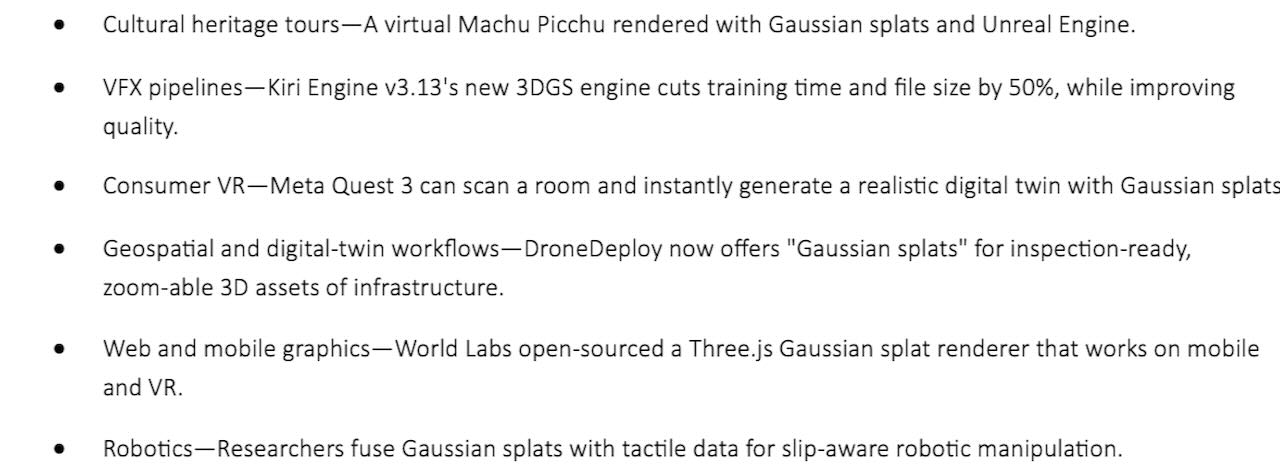
Gaussian splatting turns a cloud of tiny, semi‑transparent “splat” points into a smooth, photorealistic 3D scene that can be explored in real time. It is being used for:
Bottom line: Khronos and UWA are teaming up to embed Gaussian splatting into open standards like glTF, smoothing the path for the technique’s wider adoption across media, heritage, construction, and beyond. The method itself is already powering everything from virtual tours of ancient ruins to real‑time robot perception, and the partnership promises to keep the ecosystem open and interoperable.
WHAT DO YOU THINK? LIKE THIS STORY? TELL YOUR FRIENDS, TELL US.