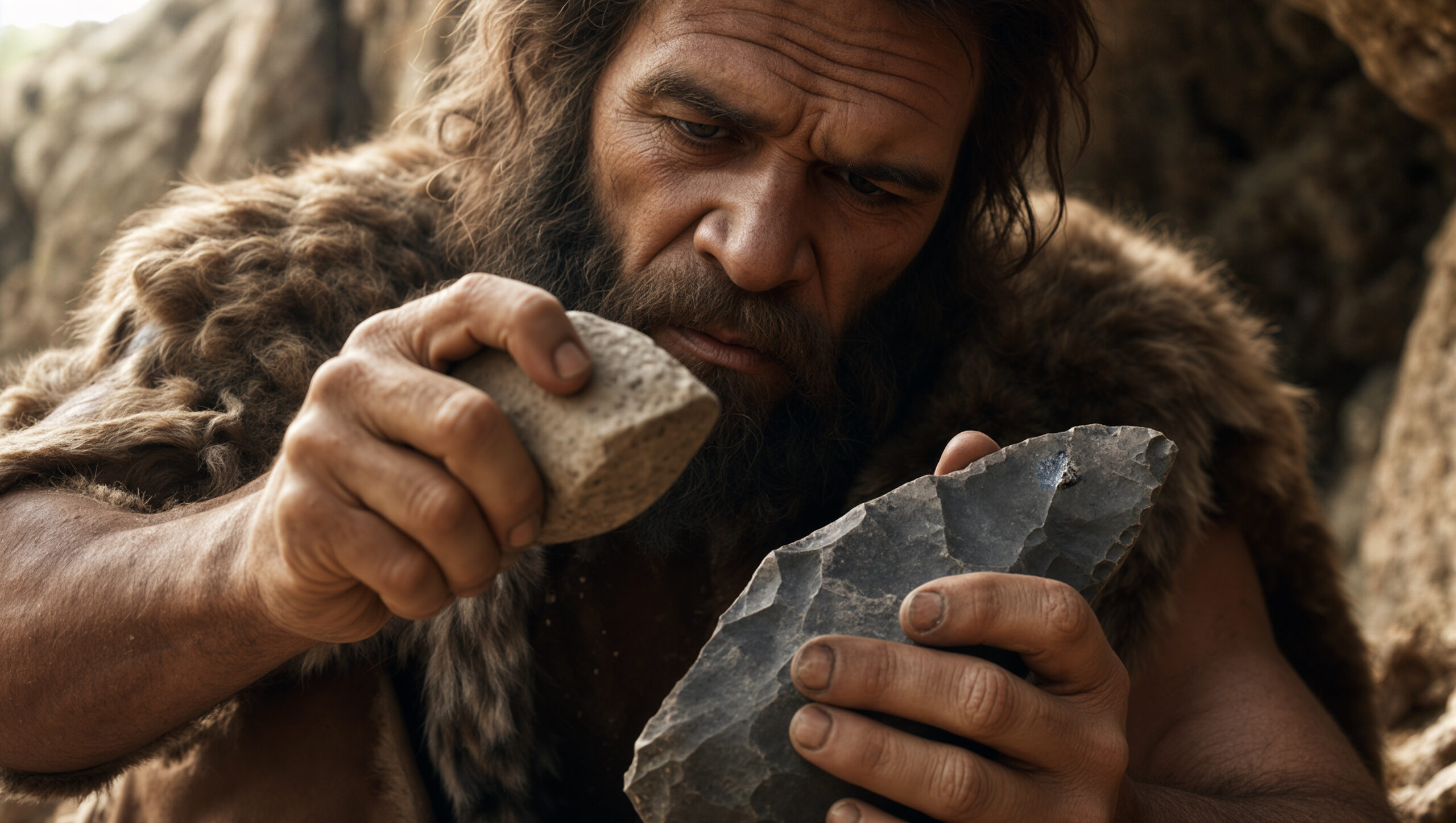
“Let’s say you’re telling the truth, and this is all a dream.” – Douglas Quaid, “Total Recall,” Carolo Pictures, 1990

Depending on who you want to believe, we’ll spend $650B on the low end or as much as $2.5T this year on AI. The problem is after plunking down all that money, we’ll have the equivalent of a five-year-old who’s just learning how to maneuver in the world. And we’re just getting warmed up in terms of investment.
Nvidia – a company and management team we really respect – powers the majority of the GPU engine world, and even they are investing in and supporting every start-up organization with AI in their name or business plan. (Their multibillion-dollar AI investment spree conspicuously excludes anthropic.) They’re doing it because they know the majority will either fizzle out, be bought out/merged with someone else or become hollow shells and slowly/painfully die of natural causes – money/interest dries up. They just don’t know which ones.
But for Jensen Huang and company, that’s okay because the survivors will more than cover the losers, and just like roulette, you have to play the odds.
Companies are projected to increase their investment in LLMs (large language models) by 72 percent this year, buying models from anyone who promotes one, because they don’t want to be locked into one that ends up being a dead end. There are hundreds/thousands of proofs-of-concept, applications, tools being developed, rushed to market so AI companies can meet their numbers and keep the investments rolling in. Do they work, do what they’re supposed to do, produce measurable/meaningful results, make life easier/better? No one really knows because you’re measuring it against… what?
Oh, sure, you can build a spreadsheet in a few minutes, you can create a report in a couple of hours, and our video creation friends can knock out a script in under a day, but is that all there is? AI promised everything – improved efficiency, innovation, accuracy, speed to market, new opportunities, enhanced customer satisfaction, added profit and, what the heck, life in general.
Has it? Compared to what?
One of our technically driven friends sees what amounts to an embarrassment of riches with all of the options that are all supposed to deliver immediate results almost across the board. All you have to do is identify your KPIs (key performance indicators) to measure your progress on meeting critical strategic goals that drive performance, enable you to make data-driven decisions and provide organizational focus, all while revolutionizing areas as advertising, marketing, journalism, entertainment, financial management.
At the same time, another equally astute friend has a slightly different view of our rush to implement AI anywhere, everywhere and magically results will appear for… everyone. He’s not opposed (nor are we) to AI and its many flavors, but rather, believes that a lot of research, work and testing needs to be done before we reap any real, meaningful benefits.
Organizations – including AI developers/marketers – struggle to find use case studies that can have room for inaccuracies (translation – failure rates are high). The costs increase exponentially as organizations begin to implement AI to attack complex problems and, across the board, or said a different way, is the cost worth the benefits? The work may be a masterpiece of execution, but it doesn’t consistently produce usable results and benefits; it’s just an IT masterpiece.
The results could produce, as Dario Amodei, president of Anthropic noted, a country of yes-men on servers.
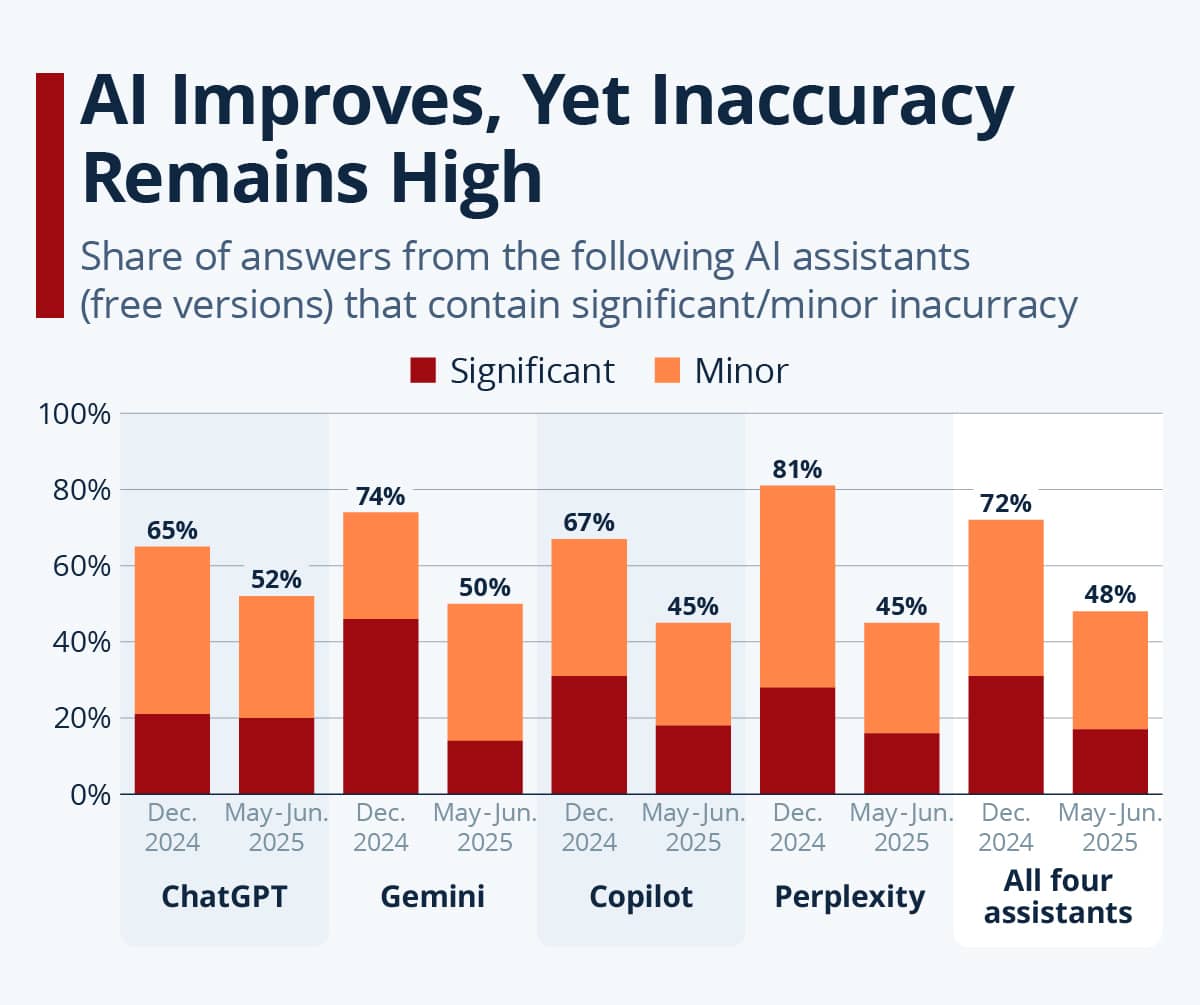
(Source: Statista)
Our cautionary friend – as most of us do – uses his search engine multiple times a day and BAM!! AI-generated results appear at the top of the page. And all too many folks accept the results as the definitive answer to their quest. If his mind questions even parts of the information requested, he will ask the same question multiple times in various ways.
Statista found that only a third of the people surveyed trusted the results, a quarter were less likely to trust them and 40 percent somewhat trusted them. Far from a wholehearted endorsement.
As with any prescription you take, there are side effects in the use of AI when you read the fine print, like widespread job displacement, particularly entry-level roles and staff culling, loss of control over certain processes while relying on technology and, best of all, better tracking of staff productivity, which can lead to stress and safety risks.
Even though we have over 10,500 AI data centers in the world in operation today and many more scheduled to be online by 2030, they hold, process and use only a sliver of information/data that has been developed and used by humans. For more than 300,000-plus years since we left central Africa and migrated globally, we have been developing and using information/data, but it as recent as 6,000 years ago we finally put down written records and cave art. Prior to that – and even today – we relied on oral stories passed from one generation to another. In fact, Socrates wasn’t a great fan of the written word, saying that the reliance of writing destroys the memory and weakens the mind. As we expand our reliance on digital data and information we’ll have to see.
It wasn’t until the 1820s that Charles Babbage developed the forebearer to today’s computer, the analytical engine that digitized data became practical. The machine automatically computed mathematical tables, eliminating human errors, but it laid the foundation for today’s computers. In 1946, the world’s first programmable, electronic, general-purpose computer (ENIAC), which weighed 30 tons, used 18,000 vacuum tubes and fit in a 1,500-sq.-ft. room. It was programmed by rewiring cables, and that was replaced by punch cards in the early ’50s. In the mid-1950s, the first hard drive was produced and shipped with 5 MB of random storage capacity, weighed more than a ton and rented for $38K/month in today’s dollars.
So what?
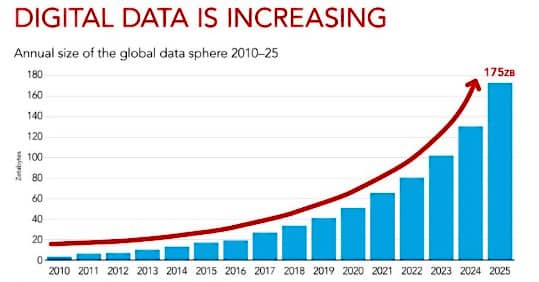
(Source: IDC)
It is estimated that around 90% of all of the digital data in the world has been created since 2016. Since AI requires information to be digital to access, process and use in its decision-making process, this means that unlike the human brain, it doesn’t have access to and isn’t even aware of the vast majority of information that was developed, learned and used over the past 300,000 years.
We agree that the systems can analyze and store far more information than the human brain, but we contend it’s incapable of superintelligence. It’s incapable of accessing the stories, information, data and experiences that have been passed down from generation to generation by word of mouth and analog documents (words and pictures) and connect them in ways that continue to mystify people who study the human brain.
AI that is in use everywhere today provides the right answers to questions that, at some level, we already know the answers to, revisiting the same territory again and again because the response has slipped from our conscious to unconscious memory. But superintelligence can only come from new questions and challenging/questioning concepts/ideas that haven’t been asked. As someone summarized it awhile back, AI isn’t making us stupid but helps us interact with its stupidity.
Despite its name, AI isn’t intelligent but rather carries out statistical pattern matching and autocomplete thought based on trillions of examples. Which, we admit, is very impressive, but even Babbage’s analytic machine could have done that, albeit much more slowly. It doesn’t really improve productivity because time still has to be spent validating and fixing the output. In addition, the process still requires human prompting, reviewing and editing.
Despite these shortcomings, global AI spending could exceed $6T this year, led by tech giants like Meta/Facebook, Alphabet/Google, Microsoft, Amazon, Baidu, Alibaba, along with the processor/storage and data center producers involved in developing and deploying the various flavors of AI technology.
The objective they are all trying to achieve is easy to articulate – develop systems that can plan and think ahead so they can understand and interact with the difficulties of the real world – “reason” through questions, make and learn from their mistakes, and ultimately arrive at a clear, concise and correct answer, all without turning our brains to mush.
Ultimately, AI will be transformative and will/may improve aspects of our lives, but it isn’t the alpha/omega answer for everything. It’s just another tool that needs to be developed and refined, and we have to learn when – and when not – to use it. In the meantime, sit back and actively use the present/evolving tools that will benefit all of us, while being cautiously pessimistic about those overblown promises and uses that can lead to disasters.
It’s time to step back, take a deep breath, throttle the enthusiasm and become more realistic – and cautious – about what you expect from AI. Remember, it can only accurately deal with, process and use data that has been around since 2016, and humans have a rich background of learning, understanding and remembering that stretches back eons. AI is – and hopefully will never – be able to fully automate our world and lives.
Deep questions on how people can and should interact with one another and the new tools require humans to formulate and articulate so AI tools can help develop suggestions, recommendations and answers humans can implement. The current crop of AI tools has limitations and will hit roadblocks the industry – and we – can’t even envision. And it will be up to humans to dig in and define the areas and questions where AI and, later, AGI can help us explore and solve simple and complex questions and problems, including its alignment with human values.
As Mattias said in Total Recall, “The past is just a mental construct. It blinds us. It fools us into believing it.” We can – and will have to – progress beyond that point so we can follow Douglas Quaid’s advice: “Relax. You’ll live longer.”
But it will take time because the tools we’re using today are about as rudimentary as those we used when we first ventured out of Africa. We’ve got a long way to go and a helluva lot of work to do. And don’t let today’s AI tool developers/investors BS you… this isn’t as good as it’s going to be, needs to be.