
The Nvidia GeForce 8800 GTX arrived on November 8, 2006, as a gaming card, and its G80 chip quietly set up the hardware and software stack that deep learning later ran on. G80 replaced separate vertex and pixel pipelines with 128 unified stream processors, added shared memory and global load/store, and became the first CUDA-capable GPU. AlexNet trained on its descendants in 2012. We trace the lineage from G80 to today’s AI accelerators and flag the caveats.
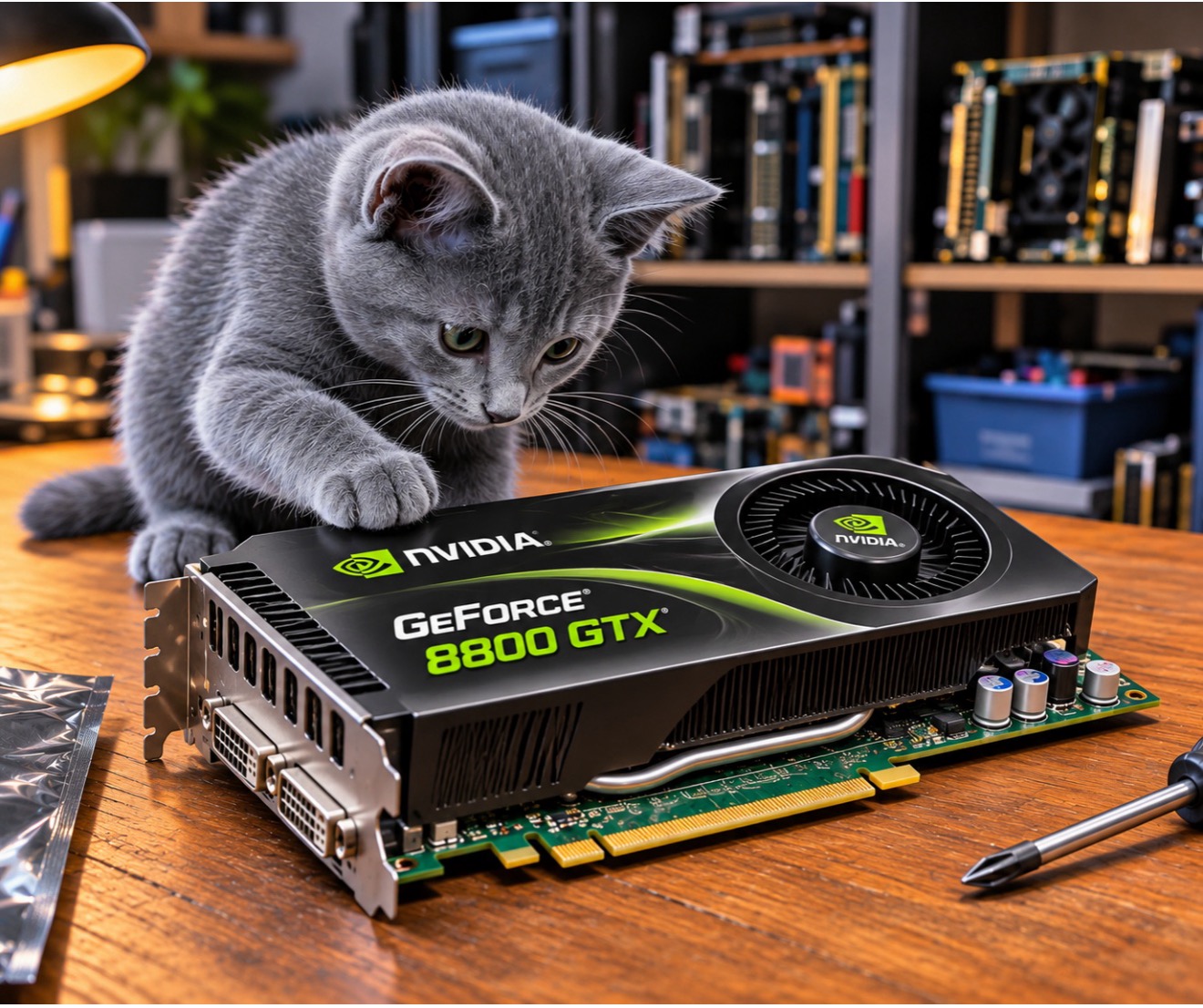
Nvidia launched the GeForce 8800 GTX on November 8, 2006, at $599 as its flagship gaming card. The dual-slot board carried the G80 chip at 575 MHz with shaders at 1,350 MHz, 768 MB of GDDR3 memory on a 384-bit interface, and support for DirectX 10. The card won its gaming contests against ATI’s delayed R600 generation, and it changed the direction of parallel computing at the same time. G80 replaced separate vertex and pixel shader pipelines with 128 scalar stream processors under a unified shader architecture, and it added two features that earlier GPUs lacked: global load/store and shared memory. Those features let threads write anywhere in memory and exchange data through fast on-chip storage, and they made a C-like programming model possible. CUDA, OpenCL, and DirectCompute are all built on that base.
A general-purpose parallel machine
G80 organized its stream processors into streaming multiprocessors (SMs), with eight SMs of 16 processors each. Nvidia’s SIMT execution model grouped threads into 32-thread warps, gave each multiprocessor its own shared memory and a large register file, and scheduled work in hardware. Unified shading also served gaming: The scheduler balanced vertex and pixel work across one pool of processors, and it ran arbitrary parallel math between graphics passes. The design executed the matrix and vector operations that neural networks require at a scale CPUs could not match, and the card carried 32-bit floating-point arithmetic, a requirement for early GPU-based neural network research. The SM remains the programming unit in every Nvidia GPU since, and G80’s warp model survives in today’s Tensor Core parts. Table 1 collects the key specifications.

Table 1. GeForce 8800 GTX and G80 key specifications.
CUDA supplied the software half
The hardware needed software to reach researchers. Before CUDA, researchers pushed scientific code through graphics APIs by disguising math as textures, pixel operations, and geometry, and they wrote that code in graphics shading languages. The term GPGPU dates to 2002, and projects like Brook and ATI’s CTM gave the approach research credibility.
Nvidia released the CUDA SDK in beta in February 2007, shipped CUDA 1.0 in June 2007, and launched its Tesla C870 compute cards on the same G80 silicon. CUDA exposed C with pointers and thread blocks, mapped those blocks onto SMs, and let researchers write ordinary programs for the GPU. The toolchain spread through research labs, and that software layer mattered as much as the hardware.
The best and the qualification
Nvidia’s 2006 bet targeted parallel computing at a moment when CPU scaling was slowing. The power wall had ended the Pentium 4’s clock race, and Intel pivoted to multicore chips. The GPU offered a throughput engine with thousands of threads, and Nvidia positioned it as the parallel processor the industry needed. Nobody at the launch could forecast the deep learning boom, because the commercial AI industry did not exist.
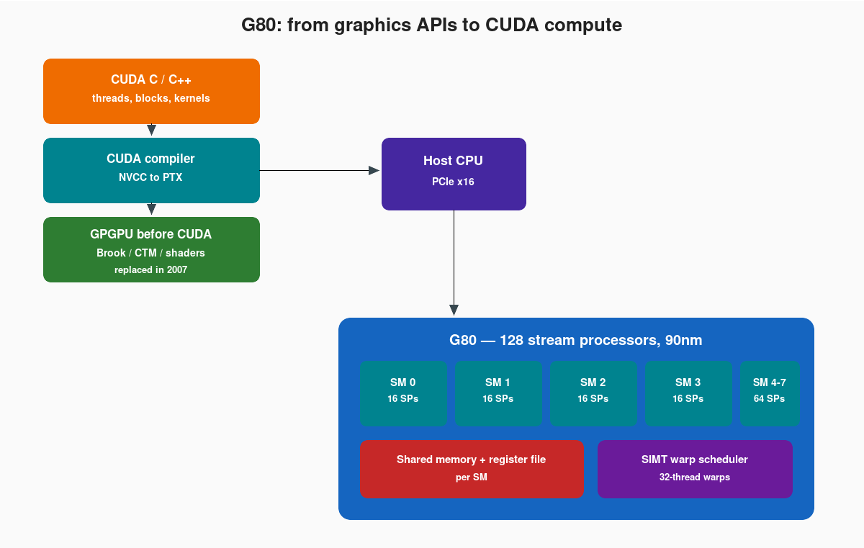
Figure 1. G80: unified shaders plus CUDA launched GPU compute.
The bet paid off through research adoption. Andrew Ng’s Stanford group published large GPU speedups for deep unsupervised learning in 2009, and Alex Krizhevsky, Ilya Sutskever, and Geoffrey Hinton trained AlexNet in 2012 on two GeForce GTX 580 cards, Fermi parts descended from the G80 line. AlexNet’s ImageNet win started the modern deep learning era, and the frameworks that grew from it—PyTorch, TensorFlow, cuDNN—sat on CUDA.
From gaming card to data center product
The Tesla C870 gave the G80 silicon a data center identity in 2007, and Nvidia built a second business on that foundation. The company shipped CUDA-capable parts into workstations and servers through Fermi, added ECC and virtualization, and grew the Tesla line into a data center product family. The gaming-first design carried compute-friendly features at consumer prices, and research labs filled with GeForce cards as a result. That path—consumer hardware, research adoption, data center products—became the template the AI accelerator market still follows.
Caveats
The lineage carries limits. ATI’s Xenos GPU in the Xbox 360 (2005) used unified shaders before G80, and Brook and CTM-era GPGPU work preceded CUDA; G80 combined the hardware and the software at scale. Google’s TPUs descend from the systolic-array tradition, a separate line. Nvidia added Tensor Cores in Volta in 2017, so purpose-built AI hardware in GPUs arrived 11 years after the 8800 GTX. A fair framing: G80 founded programmable GPU compute, Fermi and Kepler carried deep learning’s adoption, and Volta built AI-specific hardware into the GPU. Table 2 traces the architecture line.
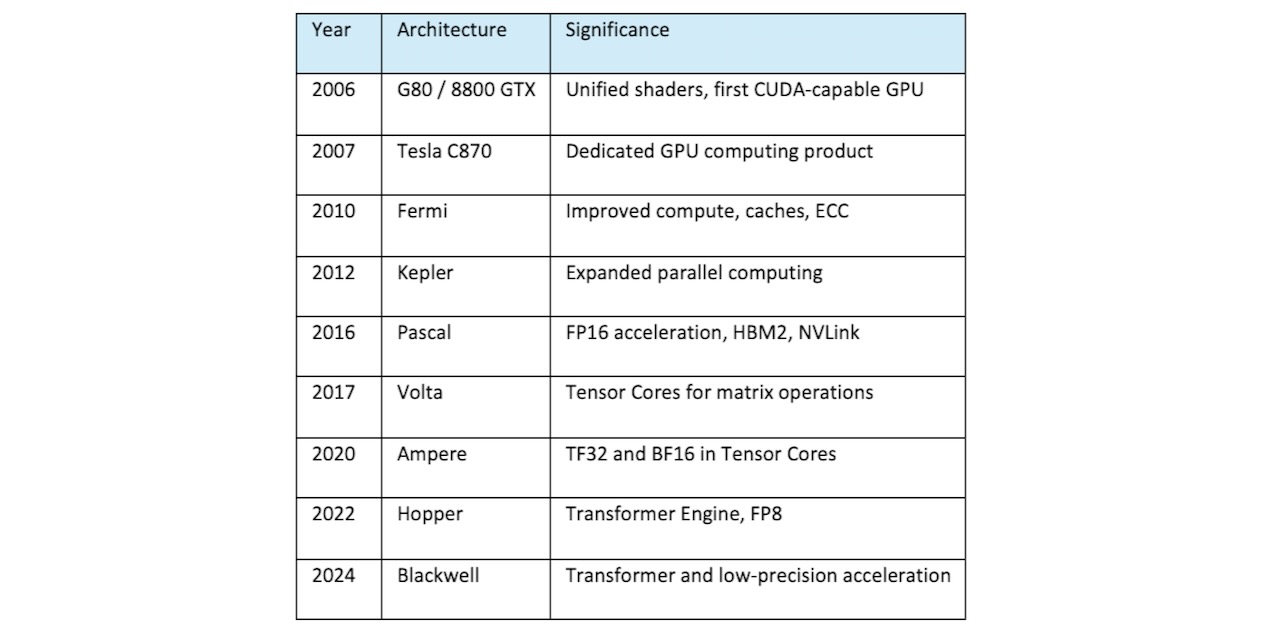
Table 2. G80 to Blackwell: the compute lineage.
What the platform teaches
The 8800 GTX earned its place in AI history as the platform the boom ran on. Its unified architecture and the CUDA toolchain gave researchers a programmable parallel machine, and the developer base became Nvidia’s moat. The lesson generalizes: Hardware and software landed together, adoption compounded through research papers and graduate students, and the platform outlived the chip. Silicon teams can trace today’s Tensor Core designs to the G80 execution model, and ISVs still inherit the CUDA stack with its porting costs and its long software support. CIOs can take the platform view: Ecosystems with 10-year toolchains, documentation, and trained engineers deliver more value over time than peak specifications suggest. The card shows that platforms, more than single chips, decide which architectures win.
What do we think?
The 8800 GTX was a gaming card that happened to carry the features parallel computing needed. The pairing of G80 hardware with the CUDA toolchain created the platform that deep learning adopted. Nvidia’s moat came from software and developers, and it did not come from foresight about AI. We rate the “foundation of AI processors” claim as defensible, with the caveats noted.
Inflection point. In hindsight, the 8800 GTX marks an inflection point in computing hardware. G80 and CUDA crossed the threshold between graphics cards and programmable parallel machines, and the research community walked through it. The inflection point in AI arrived later, in 2012, when AlexNet ran on G80’s descendants. The lesson for silicon teams and CIOs: Platforms create inflection points when hardware and software land together, and the 8800 GTX landed both. Purpose-built AI silicon followed the platform.
WHAT DO YOU THINK? GOOD ENOUGH TO TELL YOUR FRIENDS ABOUT IT? YOU HAVE OUR PERMISSION TO SHARE IT.