
AI is moving quickly into design tools, reshaping how engineers and architects approach their work. Major CAD vendors now embed intelligence directly into applications, combining generative design, copilots, and agent-based systems. These tools use domain-specific data to guide decisions, automate tasks, and improve outcomes. Companies such as Autodesk, Bentley, Dassault, and Siemens are integrating AI in different ways, but all focus on making design faster, more practical, and better aligned with real-world constraints.
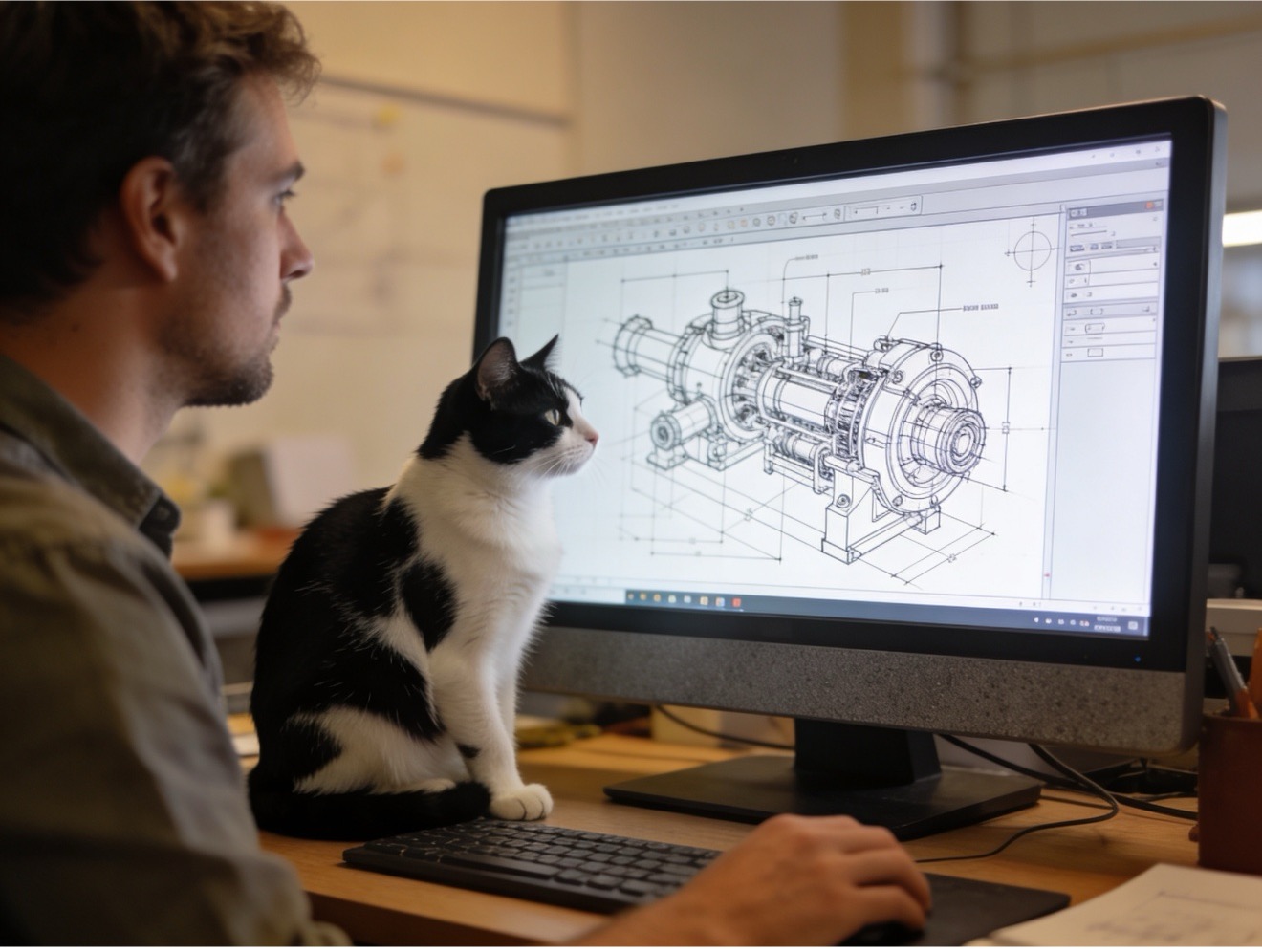
The use of AI is expanding exponentially, and that goes double for the diverse fields of design and engineering. The hundreds of thousands of people working in the CAD fields have very different requirements for their tools, but flexibility and adaptability are key. Rather than describe all the changes being made by the CAD providers, we’re going to look at some the early changes we’re seeing, to identify new trends.
Dassault’s showcase initiative includes three agents with different specialties to offer direct help. Siemens has built copilots for its applications, and Autodesk has a little bit of both, the Autodesk Assistant and copilots for specific applications.
Autodesk first introduced AI tools with generative design tools, and the capability has been incorporated into Fusion and Revit. As most readers probably already know, generative design is not a talky new best friend. Rather, it’s an explorative tool that responds to customer input on goals, constraints, and other specifics, and offers possible design approaches. Autodesk started showing off generative AI tools for Autodesk Fusion 360 Ultimate in 2018. Autodesk Research publicly explored AI approaches through its Project Dreamcatcher tool in 2014–2015.
Actually, Bentley Systems was first out of the gate with GenerativeComponents (GC) in 2003. In general, customers found the tools complicated to use and often time-consuming. For those with whom the tool resonated, GC produced beautiful curved structures and allowed easy iteration. Rebranded as Generative AI, Bentley offered generative design as a companion feature for OpenBuildings Designer. Bentley has also added Generative AI tools to OpenSite+ as a project layout tool to help engineers create and visualize site grading options. More recently, Bentley has introduced Substation+ with AI automation.
As AI use evolves, CAD companies are selectively incorporating LLMs and agentic tools into their apps as they become appropriate. In a 2025 article written for Bentley by Jay Moye, Bentley Product Manager Ian Rosam explains that the company incorporates data where the customer needs it. For example, Bentley embeds large language models trained on specific information, such as building codes and environmental regulations. In the case of OpenSite+, the LLM is trained on Bentley’s core technology for hydraulic modeling acquired with Haestad Methods in 2004. This approach is at the core of their copilot capabilities.
Autodesk’s acquisition of Spacemaker in 2020 allowed it to combine data, including site information around climate, including wind, noise, and sunlight, with environmental requirements, carbon impact, and generative design tools to quickly provide options for site planning. That product, Autodesk Forma, was introduced in 2023 and integrates with Autodesk’s Revit architectural design tool.
What’s changing is that design companies are making specific information available to AI to narrow the range of solutions, giving users faster, more practical solutions. For instance, Autodesk Forma (Spacemaker) uses real-time data on terrain, current wind and solar conditions, as well as local zoning requirements to inform predictive simulations and establish early-stage site conditions. Toronto start-up Augmenta works with Autodesk’s Revit architectural tools with built-in conduit schedules, material characteristics, and NEC (National Electrical Code) to automate the design of complex MEP systems. It can generate electrical and piping routes and evaluate layouts for cost and practicality. Revit’s BIM competitor BricsCAD has concentrated on the space between 2D and 3D architectural CAD by training its product on libraries of BIM data to recognize building elements such as walls, windows, floors, and columns from raw geometry. Its BIMIFY tools enable users to “just draw” and then classify geometry into IFC-standard building components. (IFC, or Industry Foundation Classes, is an industrywide, open-source film format to enable the exchange of data between CAD programs such as Autodesk Revit, Graphisoft Archicad, and Bentley OpenBuildings Designer, without losing data.)
Copilots and agents
Dassault Systèmes rolled out its comprehensive Industrial AI strategy in 2025 with several glitzy meetings to expand the company’s evolving 3D Experience platform.
The headline for Dassault was their agentic approach with its tools, or personalities, Aura, Leo, and Marie. Aura’s job is to orchestrate knowledge across requirements, projects, and changes. Leo is an engineering problem-solver and, apparently, like engineers so often are, is assertive. Its focus is on manufacturability. Marie is the science and materials expert and is described as rigorous, physics/chemistry-focused. Introduced at 3DExperience World in February, they are designed to work across all Dassault Systèmes brands, but they are not yet universally available. Aura is live, but Leo and Marie will roll out gradually. Dassault’s message is that AI is a tool to help their customers do better work.

Dassault is combining agentic AI, agents with specialized expertise, and participating with users as helpers in specific roles such as structural designer, chip designer, or factory manager. Dassault agents are being specialized to plan and verify complex workflows autonomously. For industrial applications agents are trained on world models, large-scale industrial datasets that enable the program to understand physical laws and engineering constraints, Dassault says. The company promises to roll out these tools for users throughout 2026.
Similarly, Siemens has also begun talking about agentic workflows along with its digital twin philosophy, which is core to its philosophy of marrying the digital model to its real-world counterparts. It’s a strategy that makes sense for Siemens, a huge company that sells design tools, industrial products, trains, and factory automation. They are developing copilot options with the help of Microsoft—Copilot being Microsoft’s word for its various AI tools.
Siemens offers users a conversational copilot built in conjunction with Microsoft. Rolled out in 2025, the copilot is incorporated into Designcenter NX CAD. Users can ask questions about their design, examine materials choices, and try out design options interactively. Along the way, the copilot can immediately run compliance checks. Siemens describes it as a conversational AI or generative AI assistant.
So, yes, as defined by the different CAD companies, there is plenty of overlap between descriptions of functions—are they agents, copilots, generative tools, data lookups, or AI friends? It’s confusing, but it’s also evidence of how fast AI tools are evolving. For example, Siemens is also incorporating industry data into its tools. Those resources are not copilots or agents or pals, they are predictors.
NX has had a Performance Predictor since 2023. It provides feedback on material stress and physical characteristics. It lives in the realm of analytics. Since 2019, Siemens NX has included Command Prediction as part of its adaptive AI, built using machine learning to predict the logical next moves users might make, enabling users to work faster.
Siemens reserves the term “agent” for more autonomous, high-level systems. Siemens was part of the multi-company rollout of new AI tools from Nvidia models. The first tools from this alliance include semiconductor and PCB design.
Siemens digital twin technology is set to receive an upgrade in mid-2026, as AI agents are empowered with greater autonomy.
Who’s yer daddy?
It’s probably safe to say there are commonalities in the way CAD companies will incorporate AI. Standard information such as local requirements and conditions will inform AI decisions, common practices will be used to give users a clue to their next move, and overall CAD programs will be faster and smarter.
CAD developers are pioneers in accepting new technology and adapting it for their customers. And, after early hesitation about how AI might affect their jobs, CAD users are embracing it. Computer-aided design upended whole industries when it arrived in the 1970s and 1980s; AI is doing the same again, but much faster.
Note: Recently, Jon Peddie, president of Jon Peddie Research, participated in a roundtable discussion on AI in CAD, along with Bastien Hillen, who heads up Strategy and Alliances at Dassault. Titled “How AI agents change the way we design/learn to work with your AI copilot,” the panelists address the growing and impactful technology on the industry. This DE24/7 podcast, hosted by Digital Engineering Senior Editor Kenneth Wong, can be found here.
WHAT DO YOU THINK? LIKE THIS STORY? TELL YOUR FRIENDS, TELL US.