
Alibaba has expanded its AI strategy from models and cloud services into a vertically integrated computing platform. Its new T-Head Zhenwu V900 accelerator combines 216 GB of memory, 1,200 GB/s inter-chip bandwidth, FP8 and FP4 support, and three times the performance Alibaba claims for its M890 predecessor. The company plans commercial availability in Q1 2027, while preparing clusters containing as many as 500,000 accelerators and expanding Alibaba Cloud beyond 20 GW by 2032.
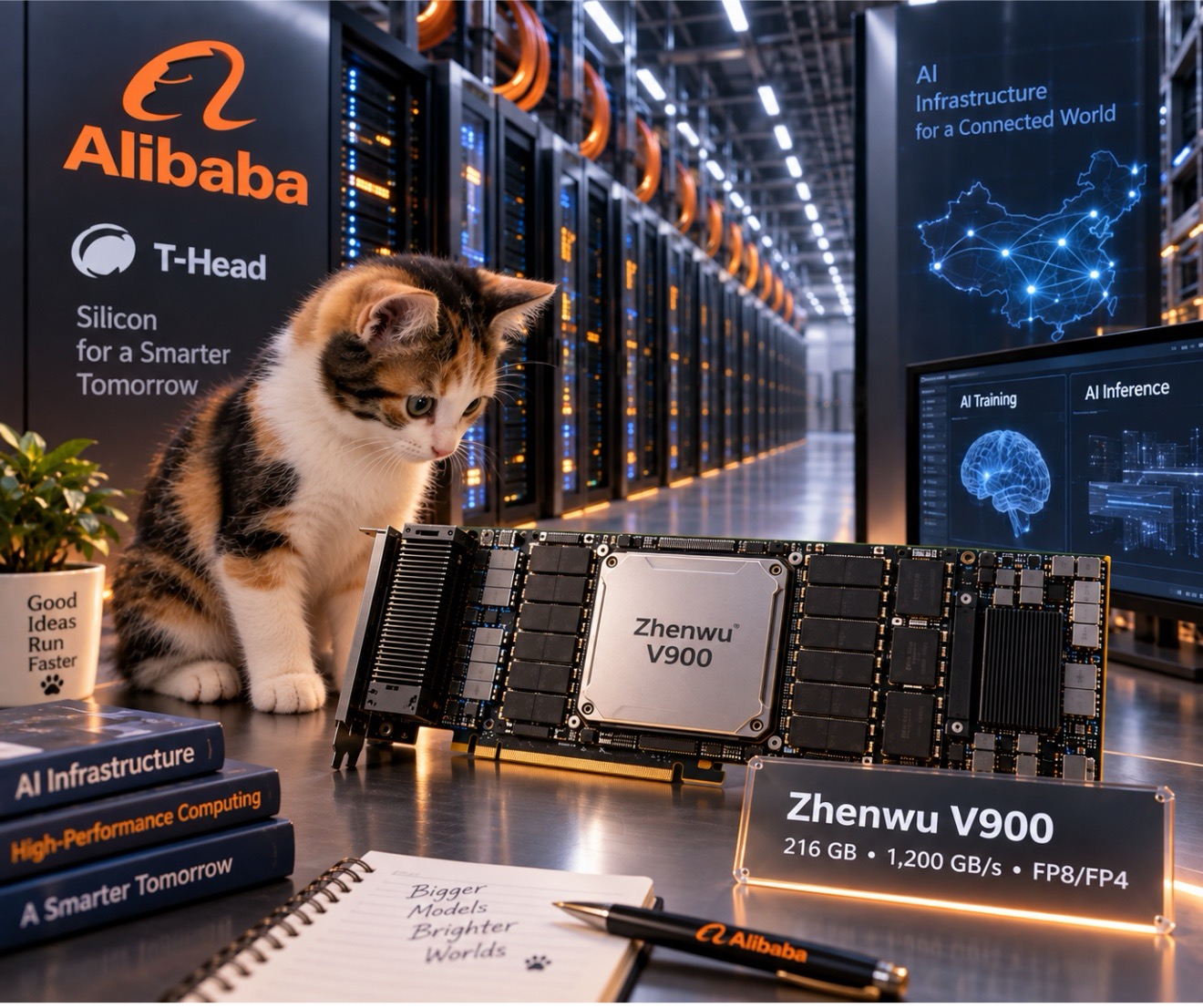
Alibaba introduced its Zhenwu V900 at the 2026 Apsara Conference in Hangzhou, China, as the next step in T-Head’s AI processor roadmap. The company describes the V900 as a unified training and inference accelerator and says it delivers three times the performance of the M890 introduced in May. Alibaba plans mass production and commercial availability during Q1 2027.
The V900 carries 216 GB of memory, provides 1,200 GB/s of inter-chip bandwidth, and supports FP8 and FP4. Alibaba has not disclosed enough architectural information or standardized benchmark results to establish direct chip-for-chip performance against current Nvidia accelerators. That distinction matters when evaluating Alibaba’s claim that the V900 represents China’s most powerful AI chip. The claim comes from Alibaba; independent performance data remains limited.
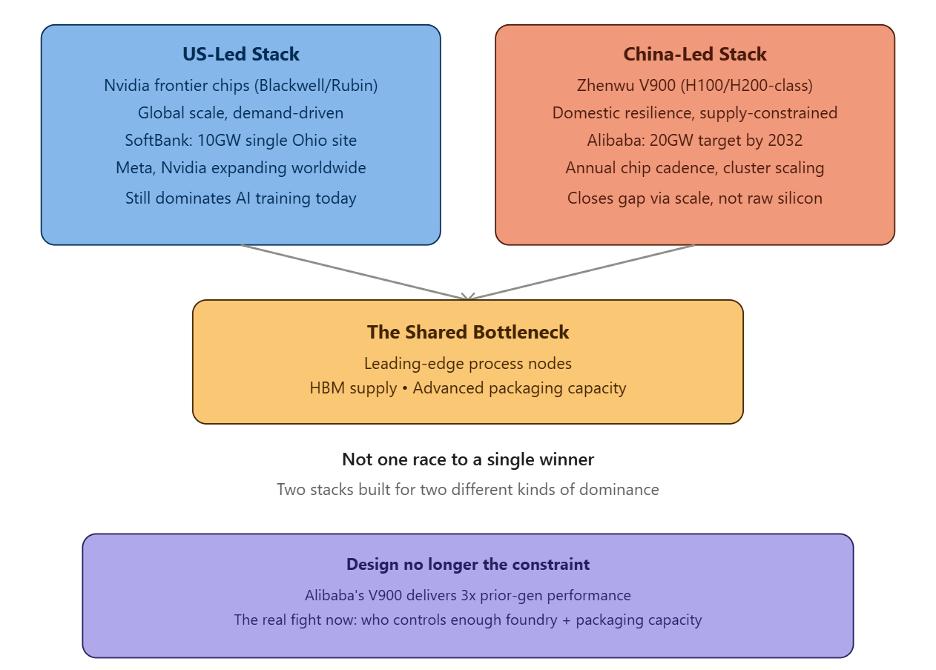
Figure 1. Two AI stacks, two kinds of dominance, one shared foundry bottleneck.
Alibaba’s strategy extends well beyond a single accelerator. T-Head combines the V900 with its ICN Switch interconnect, Panmai SmartNIC, and Zhenyue SSD controller in its next-generation Panjiu supernode server. Alibaba says the architecture can provide full-bandwidth interconnection across thousands of cards and scale an AI cluster to 500,000 accelerators.
That system-level approach provides the more interesting part of the announcement.
Scale compensates for individual processors
Chinese AI infrastructure developers face continuing restrictions on access to advanced US accelerators. That pressure has encouraged Alibaba, Huawei, and other Chinese companies to develop domestic silicon, while investing in networking, software, and cluster architecture.
Alibaba does not need every V900 specification to match the latest Nvidia accelerator to build commercially useful systems. It needs sufficient compute, memory capacity, interconnect bandwidth, and software support to operate efficiently when thousands of processors work together.
T-Head has already established some commercial volume. Alibaba says Zhenwu processors serve more than 650 enterprise customers across automotive, finance, large-model development, embodied intelligence, energy, and manufacturing. The company separately reports delivering 560,000 Zhenwu-family units to more than 400 external customers.
Those deployment numbers carry more significance than a peak-performance comparison because they demonstrate an existing installed base for Alibaba’s silicon.

Table 1. Zhenwu V900 specifications highlight Alibaba’s AI accelerator strategy. (Source: Alibaba)
The V900 moves that strategy forward with considerably more memory and interconnect bandwidth. Alibaba says the processor can handle high-precision training and low-precision inference, giving cloud operators greater flexibility when allocating hardware across changing workloads. FP8 and FP4 support also addresses the industry’s continuing shift toward lower numerical precision to increase effective compute density and reduce inference cost.
The processor is only one layer
Alibaba’s larger objective becomes clearer when the V900 roadmap connects with Qwen and Alibaba Cloud.
The company says it is training Qwen 4 and plans Qwen 4.5 and Qwen 5. Alibaba eventually wants models containing between 5 trillion and 10 trillion parameters. Its current Qwen 3.8 Max contains 2.4 trillion parameters. CEO Eddie Wu says the company wants future systems to tackle longer-horizon and more complex tasks as Alibaba pursues what it calls artificial superintelligence.
Large models create an equally large infrastructure requirement.
Alibaba Cloud now targets more than 20 GW of global data center capacity by 2032. The company has committed roughly $53 billion to AI and cloud infrastructure over three years and raised another $10.2 billion through an August Hong Kong share placement.
The relationship among those investments matters more than any individual announcement.
Alibaba’s expansion also exposes a change occurring in China’s AI processor industry. Processor design represents only one part of the problem. Manufacturing process technology, HBM availability, advanced packaging, networking, and power infrastructure determine how many processors companies can actually deploy.
Alibaba CEO Eddie Wu said customer demand for AI remains exceptionally strong while supply-chain constraints limit expansion.
That distinction helps explain the emphasis on enormous clusters. Alibaba can improve aggregate computing capacity through scale even when individual domestic accelerators trail newer foreign processors in some workloads. Interconnect efficiency, memory architecture, software optimization, and workload scheduling consequently become increasingly important.
Alibaba’s Qwen software gives the company another advantage within its own infrastructure. Engineers can optimize models, compilers, runtime software, networking, and silicon together instead of treating the accelerator as an isolated component.
The approach resembles the vertical integration underway across hyperscale computing. Google develops TPUs around its AI workloads. Amazon designs Trainium and Inferentia. Microsoft and Meta have developed their own accelerators. Alibaba follows the same economic logic while operating under additional semiconductor supply constraints.
An annual Zhenwu cadence
T-Head also appears to be accelerating its processor roadmap. Alibaba introduced the M890 in May 2026 and unveiled the V900 four months later, with commercial V900 systems scheduled for Q1 2027. The company has also previewed the next Zhenwu J900 generation for 2028.
That cadence deserves attention from silicon teams.
Chinese accelerator development increasingly looks less like a collection of isolated domestic alternatives and more like sustained processor roadmaps tied to cloud deployment. Alibaba can use its own data centers as both a customer and proving ground, creating feedback among hardware design, system architecture, and Qwen development.
Commercial economics will determine how far that model scales. Alibaba still needs competitive utilization, reliability, software compatibility, power efficiency, and cost per token. Peak processor specifications reveal little about those variables.
Independent benchmarks will, therefore, matter once V900 systems become commercially available.
The V900 also arrives within a broader US-China technology competition shaped by export controls and China’s drive for domestic semiconductor capability. US restrictions continue limiting Chinese access to some advanced accelerators.
The resulting market increasingly supports two AI infrastructure ecosystems. US companies retain access to leading global semiconductor manufacturing, memory, and accelerator technologies. Chinese companies increasingly combine domestic processors with large clusters and locally developed software.
Alibaba illustrates how quickly the second ecosystem is filling in its missing layers.
The V900 itself does not erase differences in manufacturing technology or processor performance. It demonstrates that Alibaba can combine its own accelerator, networking silicon, storage controllers, servers, cloud infrastructure, and foundation models into a coherent computing stack.
For CIOs, that integration matters because future AI infrastructure competition will increasingly center on systems rather than isolated chips. Accelerator performance remains important. Memory, networking, software, power, availability, and cost per token ultimately determine useful AI capacity.
Alibaba’s V900 represents another step in China’s development of a domestic AI computing infrastructure. The important development extends beyond the processor. T-Head now connects accelerators, interconnects, and supporting silicon with Alibaba Cloud and Qwen. The company plans to scale each layer aggressively through 2032. Manufacturing, HBM, and advanced packaging remain constraints, while commercial deployment will provide the meaningful test. Alibaba now has enough pieces in place to test its vertically integrated strategy at substantial scale.
What do we think?
The V900 matters less as a direct Nvidia comparison than as another piece of Alibaba’s increasingly complete AI stack. T-Head has processors in commercial use, an annual roadmap, supporting interconnect silicon, and a large internal cloud customer. The next measurement should focus on deployments, utilization, and cost per token. Those metrics will show whether vertical integration converts technical capability into competitive computing economics.
Inflection point. Alibaba’s annual processor cadence could signal an inflection point in China’s AI silicon development. The challenge increasingly extends from designing accelerators to manufacturing and deploying them at scale. Foundry capacity, HBM, packaging, networking, and power now determine how quickly domestic systems grow. Alibaba’s combination of Zhenwu processors, Qwen models, and a planned 20 GW cloud infrastructure creates a vertically integrated platform capable of testing that proposition commercially rather than simply demonstrating another AI processor.
YOU LIKE THIS KIND OF STUFF? WE HAVE LOTS MORE. TELL YOUR FRIENDS, WE LOVE MEETING NEW PEOPLE.