
Euclyd has raised more than €200 million, about $231 million, to develop an AI inference platform that attacks memory movement, power consumption, and cost per token. The Eindhoven, Netherlands, semiconductor start-up combines programmable ASIC compute, processor-memory co-design, and system-level optimization, rather than adapting a graphics architecture to AI. Samsung and three investment groups co-led the Series A, while former ASML CEO Peter Wennink joins as chairman. The money gives Euclyd substantial resources to turn its architecture into commercial hardware.
Euclyd (Eindhoven, Netherlands) has secured more than €200 million (US ~$230 million) in Series A financing as it develops a purpose-built architecture for foundation-model inference. Samsung, Somerset Capital Partners, EQT-managed Scaleup Europe Fund, and Innovation Industries co-led the round. EIFO, imec.xpand, Brabant Development Agency, and Quadri also participated. Peter Wennink, former president and CEO of ASML, has joined Euclyd as chairman.
Bernardo Kastrup and Atul Sinha founded Euclyd in 2024 at Eindhoven’s High Tech Campus. The company argues that AI infrastructure increasingly runs into memory-bandwidth, power, and capital constraints as models and inference volumes grow. Its answer combines programmable ASIC compute, processor-memory co-design, and system-level optimization.
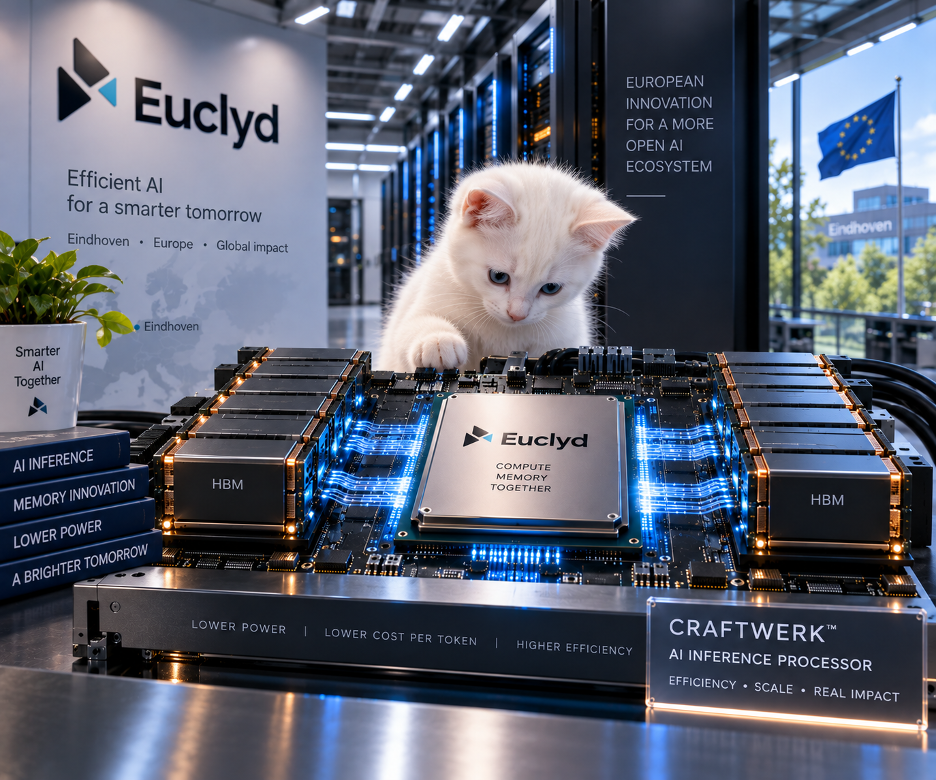
At the center sits craftwerk, Euclyd’s planned AI processor, alongside its craftwerk station CWS system. Euclyd describes craftwerk as agentic AI silicon and says its architecture targets the data-movement and memory-efficiency problems that increase inference power and cost. Those performance and efficiency claims still require validation on production silicon and customer workloads. Commercial hardware reportedly targets 2028.
Kastrup frames the problem around infrastructure rather than simply compute throughput. Euclyd wants to reduce power consumption and cost per token while making large-model inference practical across enterprise, sovereign, and hyperscale deployments. The company will use the new capital to expand engineering, accelerate its silicon and systems roadmap, strengthen ecosystem partnerships, and prepare for commercialization.
Samsung’s participation adds an important semiconductor connection because Euclyd’s approach depends heavily on compute-memory integration. Wennink’s appointment also gives the young company semiconductor manufacturing and supply-chain experience as it moves from architecture toward physical products.
For silicon teams and ISVs, Euclyd represents another attempt to redesign inference around the workload rather than extend a general-purpose GPU architecture. For CIOs, the important measurements will come later: watts per token, tokens per second, memory capacity, latency, system utilization, software support, and total cost of ownership.
The €200 million Series A gives Euclyd enough capital to move beyond an architectural proposal and build silicon, systems, and software. Its central argument—that AI inference increasingly depends on memory and system efficiency as much as raw arithmetic throughput—matches a growing industry concern. Production silicon will determine whether craftwerk can translate that argument into measurable cost, power, and performance advantages. Prior to this round, Euclyd raised €10 million; Peter Wennink was part of that round.
What do we think?
Euclyd has attracted an unusually large early investment around a technically credible problem: Moving model data consumes substantial energy and limits inference economics. Samsung’s involvement and Peter Wennink’s chairmanship strengthen its semiconductor credentials. The architecture remains the central unknown. Production hardware, software maturity, and independent workload testing will determine whether Euclyd can turn its processor-memory approach into a commercially competitive platform.
Inflection point. Euclyd could represent an inflection point in how start-ups approach AI inference silicon. The industry increasingly measures useful performance through tokens, latency, memory bandwidth, and power rather than peak arithmetic alone. Euclyd starts with those system constraints and designs compute and memory around them. If production silicon validates its efficiency claims, the company would add evidence that specialized inference architectures can challenge the economics of adapting increasingly large GPU systems to every AI workload.
LIKE WHAT YOU’RE READING? DON’T KEEP IT A SECRET, TELL YOUR FRIENDS AND FAMILY, AND PEOPLE YOU MEET IN COFFEE SHOPS.