
Biren Technology just posted numbers that would make most chip start-ups blush: revenue up nearly 2,000% year on year, losses narrowing sharply, and a fresh Hong Kong Stock Exchange listing under its belt. The Chinese GPGPU maker built its whole business around domestic substitution, the industrywide push to replace Nvidia hardware as US export restrictions tighten and China’s own AI computing build-out accelerates. We walk through Biren’s actual product lineup, its software strategy, and what analyst coverage now projects for the next three years.
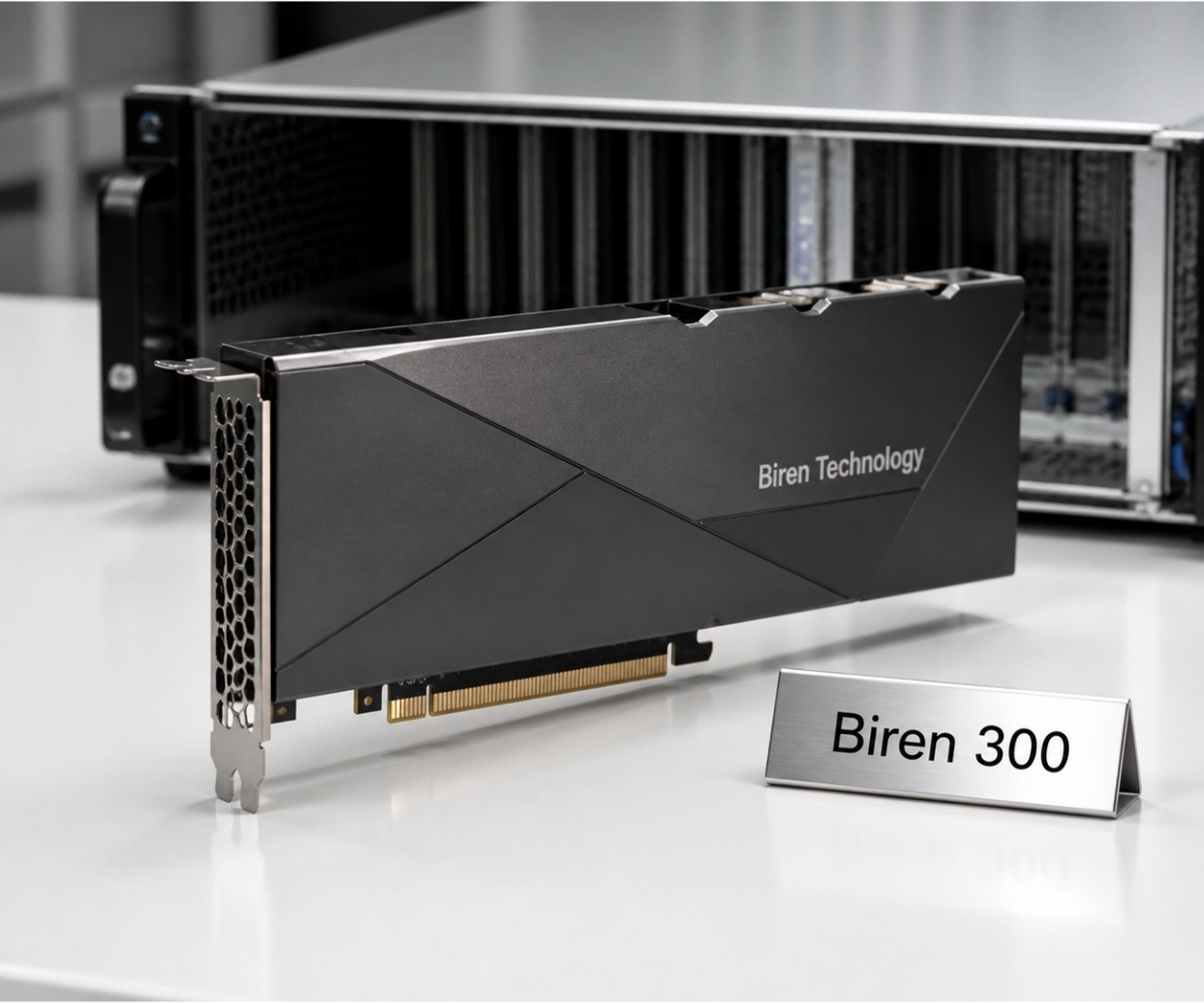
Biren Technology entered 2026 with real momentum. Founded in 2019, the domestic GPGPU maker completed research, tape-out, and mass production on the BR106, BR110, and BR166 chips, then listed on the Hong Kong Stock Exchange this past January. First-half 2026 revenue reached $183.9 million, landing inside the company’s own guided range of $171.1 million to $193.4 million, and marking a year-on-year increase of 1,998%.
Gross margin came in at 42.7%, up 10.8 percentage points year on year, driven mainly by stronger revenue from cloud training products. Net loss narrowed to $56.1 million, inside the guided range of $47.6 million to $59.5 million and 76.4% tighter than a year earlier. Adjusted loss narrowed to $50.1 million, inside the guided range of $43.2 million to $53.6 million and 38.9% tighter year on year.
Demand for AI training and inference keeps expanding, and domestic substitution opens long-term growth room for Chinese GPGPU makers specifically. Growing model parameter counts, rising token usage, and expanding multimodal and inference workloads keep pushing up demand for compute, memory capacity, and cluster scalability together. China’s GPGPU market still depends heavily on overseas suppliers, with Nvidia holding 97.6% share. Tightening US export restrictions on high-end GPUs, accelerated build-out of domestic intelligent computing centers, and supply chain localization together shift domestic substitution from a policy-driven trend toward one backed by actual procurement demand. Biren counts among the few domestic vendors with full-stack GPGPU capability, positioning the company to benefit directly from that shift.
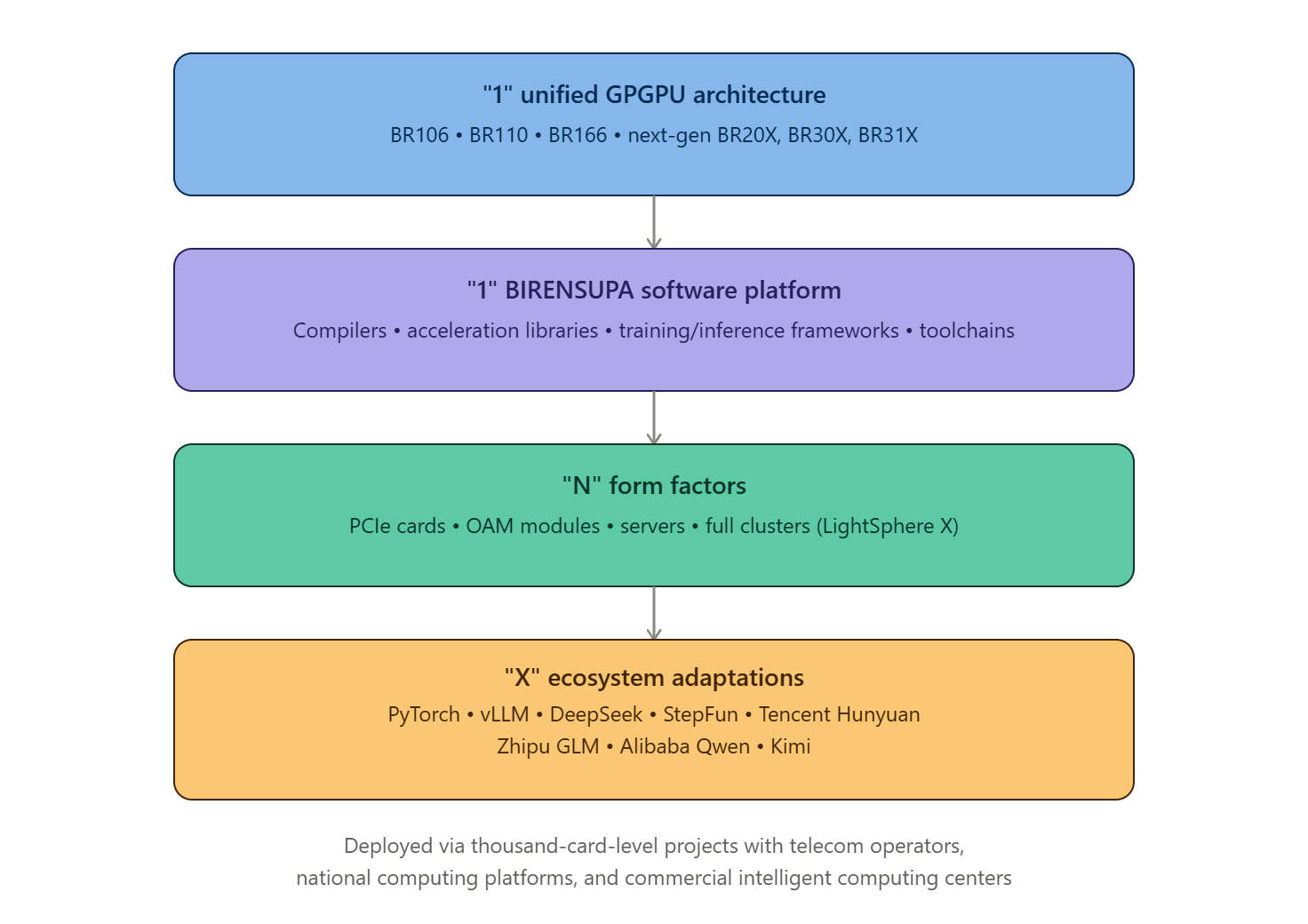
Figure 1. Biren’s “1+1+N+X” platform structure.
Biren runs a “1+1+N+X” platform strategy, building full-stack intelligent computing capabilities through software-hardware interaction. On the hardware side, the company’s unified proprietary GPGPU architecture underpins the BR106, BR110, and BR166, covering data center training, inference, and edge computing within a single product family. That lineup spans PCIe cards, Open Application Model modules, servers, and full clusters. Early adoption of 2.5D chiplet packaging and a dual-compute-die design gives Biren differentiated advantages in performance scalability, energy efficiency, and mass production yield. The next-generation BR20X series is moving toward commercialization, and the BR30X and BR31X series further extend the roadmap across cloud training, inference, and edge products.
The Birensupa software platform, optical interconnection supernodes, and ecosystem adaptation work extend that hardware advantage further. Birensupa covers programming models, compilers, acceleration libraries, training and inference frameworks, and developer toolchains in one stack. It runs compatibly with mainstream AI frameworks including PyTorch and vLLM, and supports major large models including DeepSeek, StepFun, Tencent Hunyuan, Zhipu GLM, Alibaba Qwen, and Kimi, cutting customer migration and development costs directly. Biren’s own LightSphere X supernode solution improves linear scaling efficiency across large GPU clusters. The company has already deployed thousand-card-level projects with telecom operators, national-level computing platforms, and commercial intelligent computing centers, expanding its customer base, reducing customer concentration, and advancing domestic supply chain substitution at the same time.
Financial analysts project operating revenue of $4.09 billion, $13.39 billion, and $27.38 billion across 2026 through 2028, with growth rates of 165%, 228%, and 104%, respectively. Coverage forecasts adjusted net profit at negative $1.15 billion, $1.73 billion, and $5.68 billion across that same window, translating to adjusted net margins of negative 28%, 13%, and 21%. Biren initiated coverage on the back of this trajectory, treating early losses as a function of scale-up costs, not a structural problem with the business. Coverage initiates with an “Outperform” rating.
Biren’s 1H26 results and forward guidance both point toward the same story: a domestic GPGPU vendor scaling fast inside a market that still runs overwhelmingly on foreign silicon. Whether that scaling holds through 2028 depends on execution across the BR20X, BR30X, and BR31X roadmap, not just on the substitution tailwind already in place.
What do we think?
The 1,998% revenue growth number looks dramatic mainly because Biren started from close to zero. The real signal sits in gross margin expansion and shrinking losses running ahead of the company’s own guidance, both suggesting the scale-up is genuinely working, not just growing on subsidized volume. Nvidia’s 97.6% share of China’s GPGPU market means Biren still has enormous room to take, assuming execution holds.
Inflection point. Biren’s results mark a real inflection point in China’s domestic substitution story: Procurement demand, not policy mandate, now drives adoption. A domestic GPGPU vendor posting shrinking losses and expanding margins, still growing off government-linked and telecom customers, signals the technology has crossed from politically motivated purchasing into genuine competitiveness. If Biren’s BR20X-and-beyond roadmap executes on schedule, China’s AI infrastructure will no longer depend on a single foreign supplier for its highest-end training silicon, reshaping global GPU market structure well beyond China’s borders.
LIKE WHAT YOU’RE READING? DON’T KEEP IT A SECRET, TELL YOUR FRIENDS AND FAMILY, AND PEOPLE YOU MEET IN COFFEE SHOPS.