
Arm has announced a series of AI products and ecosystem initiatives spanning mobile devices, cloud infrastructure, developer tools, and robotics. New products include CSS for Mobile 2, the Mali G2-Ultra NX GPU, Neoverse CSS N4, and the Arm AI Portal. Arm is also extending Total Design into physical AI and proposing a Robotics Capability Framework intended to give the robotics industry a more consistent way to describe system capabilities.

(Source: Arm)
Arm has introduced a broad set of products and initiatives aimed at strengthening its position across cloud AI, edge AI, and physical AI.
The company is presenting these markets as parts of a common computing continuum built around Arm CPUs, GPUs, system IP, software, and developer tools. This includes a new mobile compute subsystem, a neural graphics GPU, an updated Neoverse CSS platform, an AI software portal, and a new physical AI ecosystem program.
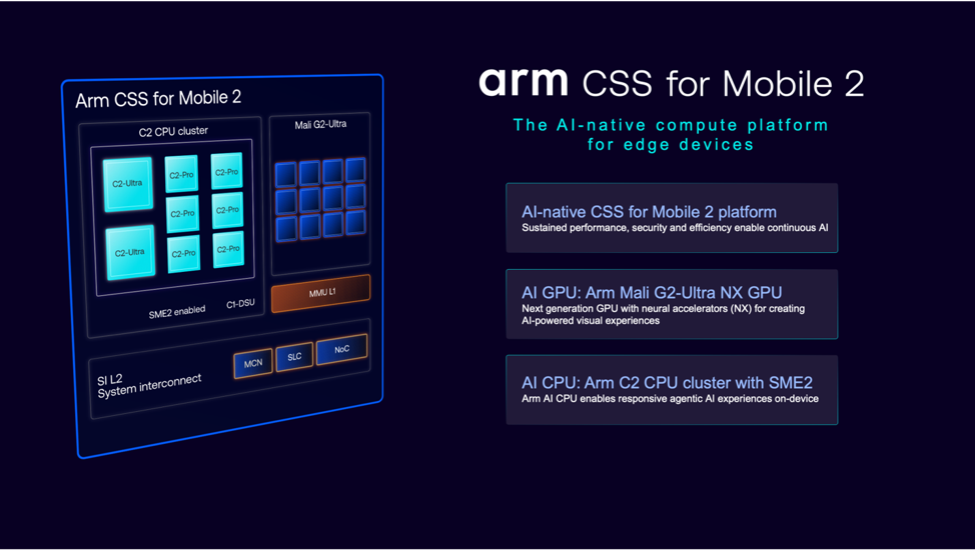
At the edge, Arm is introducing CSS for Mobile 2, a new compute subsystem combining CPU, GPU, system IP, physical implementations, and software for next-generation mobile SoCs.
The new Mali G2-Ultra NX is Arm’s first Mali GPU with dedicated neural accelerators. Arm is targeting neural rendering and graphics reconstruction workloads that combine conventional graphics processing with AI. The company claims up to 4× higher performance per watt for neural graphics and up to 14% higher performance on existing game content compared with the previous generation.
(Source: Arm)
Arm is already working with developers including Sumo Digital, Tencent, NetEase, and Unity China. NetEase’s Where Winds Meet, Tencent Games’ Arena Breakout Infinite, and Infold Games’ Infinity Nikki are among the titles Arm says will use its neural graphics technology.
The CPU component is the C2 CPU cluster, combining C2-Ultra and C2-Pro CPUs with two SME2 units. Arm says the doubled SME2 capability can produce a 70% speedup on recent small language models. The company is positioning the CPU as an important part of agentic AI workloads, where it handles context, scheduling, application execution, and coordination between models and accelerators.
This is also a useful indication of how Arm sees AI developing on mobile devices. Dedicated NPUs remain important, but persistent agents will place additional demands on the CPU, GPU, memory system, and software stack.
Arm is also launching the Arm AI Portal, designed to give developers access to models, optimization information, performance data, and deployment workflows across Arm-based hardware.
At launch, the AI Portal includes pre-optimized models such as Alibaba Qwen and Google Gemma, with support for runtimes including ExecuTorch, LiteRT, and ONNX Runtime. Developers can compare factors such as latency, memory use, model size, and accuracy. Arm-optimized models are also being distributed through Hugging Face.
Arm plans to add tools allowing developers to bring proprietary models for performance analysis and optimization.
The Portal is also being designed for coding agents. Resources can be accessed through MCP, allowing software agents to discover models, optimization data, and deployment information directly. That is a logical extension of Arm’s developer strategy as more software development becomes agent-assisted.
Arm says its software ecosystem now includes more than 22 million developers. AI Portal gives the company a clearer mechanism for connecting that developer base with optimized AI workloads across its hardware platforms.
For the data center, Arm has introduced Neoverse CSS N4, its latest Neoverse Compute Subsystem.
CSS N4 supports up to 128 cores per die, LPDDR6 memory, and PCIe Gen 7. Arm claims up to 2× the performance, 1.25× the performance per watt, and 1.75× the memory bandwidth of Neoverse CSS N3.
Arm describes N4 as its most configurable CSS to date. The objective is to give customers an integrated Neoverse subsystem that can still be adapted for specific system requirements, including custom compute platforms, networking silicon, and DPUs.
Alongside CSS N4, Arm is continuing to promote the Arm AGI CPU as a production-ready option for customers that do not want to develop their own silicon.
Arm says OpenAI, Meta, Cloudflare, Oracle, SAP, Lenovo, Supermicro, and Verda are developing solutions around AGI CPU. It also cites Google Cloud’s use of Axion for agent sandboxes, Microsoft’s Cobalt 200, and Nvidia Vera as evidence of growing Arm adoption for agentic workloads. ByteDance’s Volcano Engine plans to introduce agentic sandboxes based on Arm AGI CPU.
Arm’s argument is that agentic AI increases CPU demand in the data center because agents spend substantial time retrieving data, calling tools, running applications, coordinating accelerators, and communicating with other agents. That gives Arm an opportunity beyond the accelerator itself.
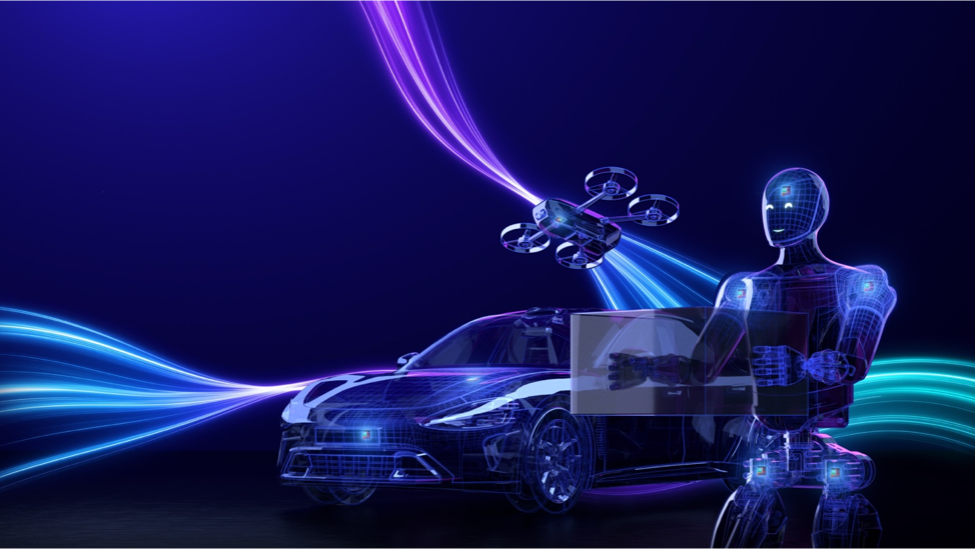
Arm is also extending Arm Total Design into robotics, autonomous vehicles, and other physical AI systems, and over 80 companies have joined Arm Total Design for Physical AI, including AWS, ECARX, Hugging Face, Liquid AI, NXP, PlusAI, Psyonic, QNX, Qwen, Siemens, and Unitree Robotics. The intention is to reduce integration work and allow development and validation to start earlier. The program brings together companies working on AI models, software stacks, compute hardware, sensors, virtual platforms, digital twins, and other parts of the physical AI stack.
(Source: Arm)
Arm points to an automotive collaboration involving Arm, AWS, Google, HERE, RemotiveLabs, and Siemens as an example. The group developed an integrated digital cockpit reference solution that can be tested against Arm Zena CSS before production silicon is available.
Arm estimates physical AI could represent a $200 billion annual compute opportunity in the 2030s. This is Arm’s own estimate, but it explains why the company is investing in the ecosystem now.
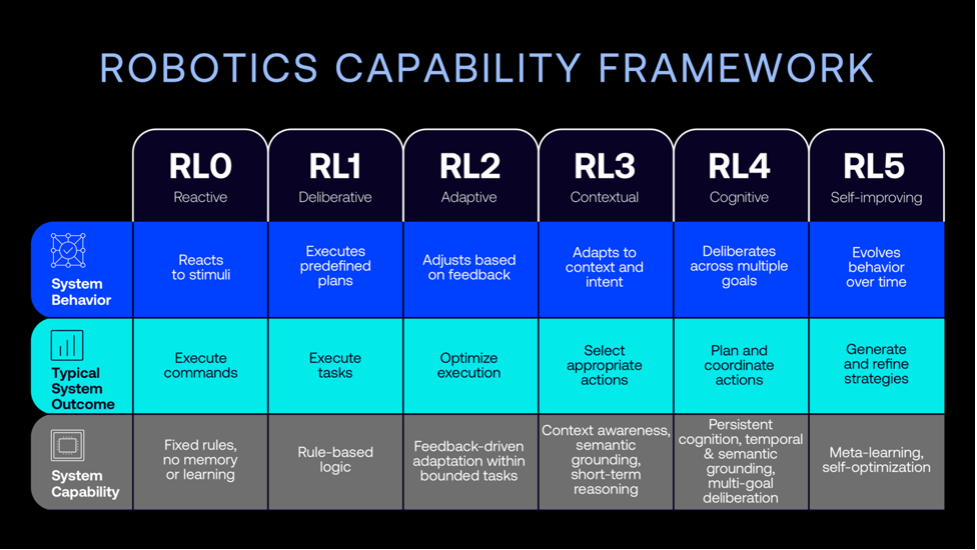
As part of the physical AI initiative, Arm is also introducing a Robotics Capability Framework.
The company argues that terms including autonomous, adaptive, collaborative, intelligent, and self-improving are used inconsistently across robotics. This makes systems harder to compare and can complicate integration, procurement, safety assessment, and regulation.
The proposed framework would describe levels of robotic capability based on factors including operating environment, supervision, behavior, system requirements, latency, compute placement, memory, power, determinism, and safety.
(Source: Arm)
Arm compares the idea with SAE automation levels in automotive, although the Robotics Capability Framework is at a much earlier stage. Arm describes it as a starting point rather than a finished standard and is inviting robotics companies, researchers, regulators, insurers, and standards organizations to contribute.
What do we think?
We identified even before the IPO that Arm would make expanding beyond processor IP into silicon and platforms its main priority. These announcements are variously sized ways of shoring up that strategy.
CSS allows Arm to provide more of the subsystem while leaving silicon companies room to differentiate. CSS for Mobile 2 applies that model to mobile AI, while Neoverse CSS N4 extends it in infrastructure. Overall, the CSS initiative is one of Arm’s stronger recent moves and one likely to be imitated by RISC-V to various extents: GlobalFoundries, for example, provides its own pre-integrated, real-time compute subsystems following its acquisition of MIPS and Synopsys’ processor IP business.
The addition of dedicated neural acceleration to Mali is significant for graphics, an area where we believe Arm has been resting on its laurels of late. Neural rendering is becoming part of the normal graphics workload, particularly where reconstruction can improve image quality or reduce the amount of conventional rendering required. Integrating neural processing directly into the GPU should reduce some of the data movement and scheduling overhead involved in using a separate accelerator.
The physical AI announcements are less mature, and we think selling their taxonomy of robots to the rest of the industry will be a challenge. We can’t really see why Arm thinks it is worth that effort. Maybe Arm plans to just stick to it so much that its own ecosystem must adopt it too. If I were building robots using non-Arm technologies, however, I’d not let Arm take control of the narrative.
This is an impressive flurry of Arm activity. Broadcom software chief, Ram Velaga, recently suggested, via The Register, that Arm servers remain three to five years away from significant enterprise market share, which may prove correct for VMware-heavy traditional IT. The broader server market is moving faster. Mercury Research puts Arm at a record 13.6% of server CPU shipments in Q2 2026, while AWS is already on its fifth Graviton generation, and Microsoft, Google, and Nvidia are all deploying their own Arm-based server CPUs. Arm still has work to do in conventional enterprise infrastructure but assuming it will stay safely in the rearview mirror looks increasingly unwise.
LIKE WHAT YOU’RE READING? INTRODUCE US TO YOUR FRIENDS AND COLLEAGUES.