
Enflame Technology just became the last of China’s “four little dragons” to go public, closing out a historic wave of AI chip IPOs. The Tencent-backed start-up is raising $911 million on Shanghai’s STAR Market, betting its future on a fundamentally different chip architecture than its GPU-focused rivals. We walk through Enflame’s specialized approach, why one analyst calls its Tencent dependence both a strength and a real vulnerability, and what a same-week Moore Threads stock crash reveals about investor sentiment toward this whole sector.
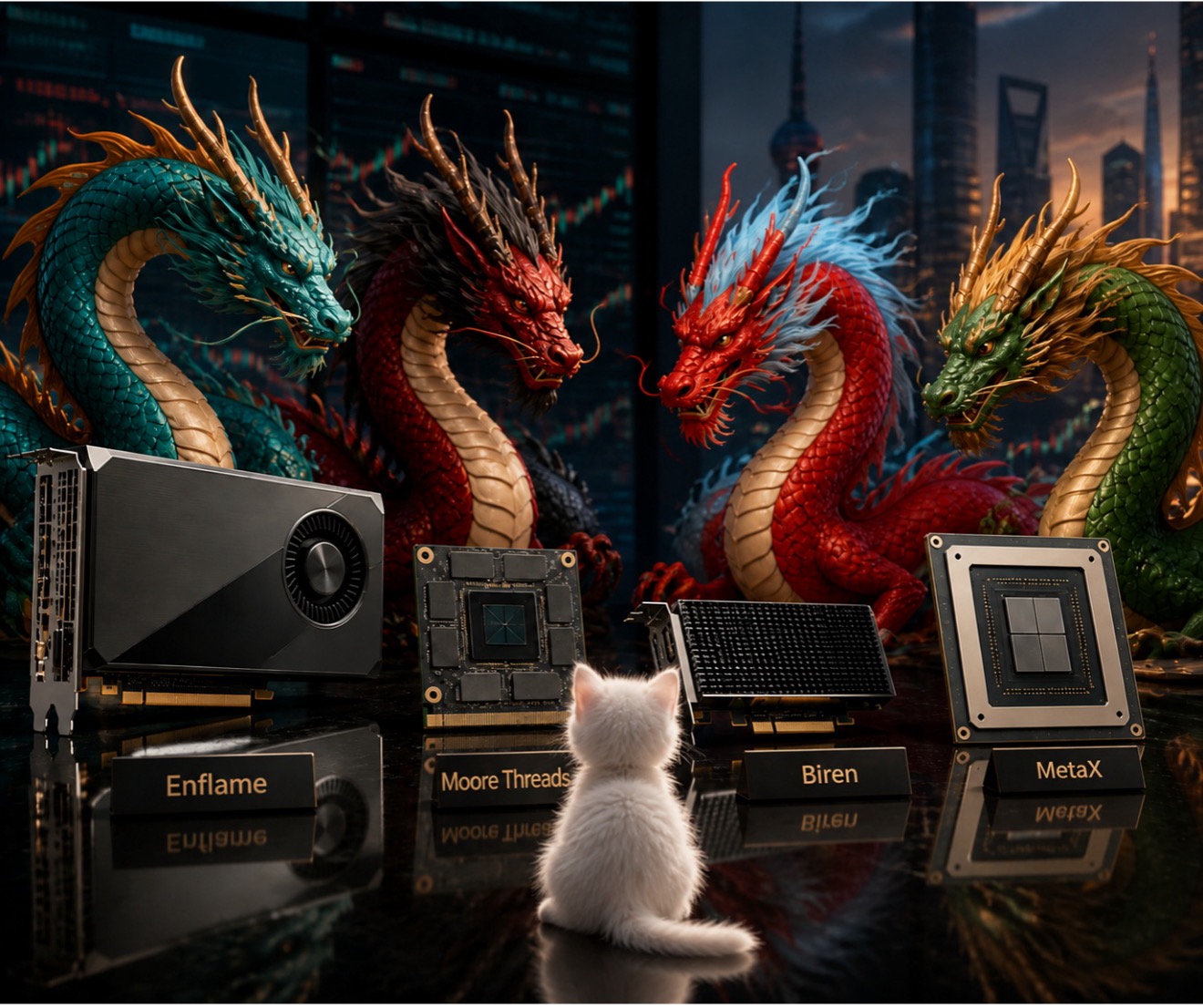
Enflame Technology completes China’s “four little dragons” story this week, becoming the last of the group to reach public markets. The Shanghai-based AI chipmaker priced its STAR Market offering at 142.18 yuan per share ($21.15), targeting roughly $911 million across 43 million shares, about 10% of its enlarged share capital after listing. Subscriptions open Wednesday. Tencent Holdings owns 20% of Enflame and doubles as its largest customer, a relationship that defines much of the company’s growth story and its biggest risk at once.
Founded in 2018, Enflame follows three other domestic AI chipmakers to market: Moore Threads, Biren Technology, and MetaX Integrated Circuits. Moore Threads led the group with a $1.19 billion STAR Market debut in December, surging 425% on its first trading day. MetaX raised $624.9 million late last year. Biren raised $897 million in Hong Kong earlier this year. All four now sell into a market Nvidia still dominates, holding roughly 55% of China’s AI accelerator shipments in 2025 against Enflame’s own estimated 1.7% share, enough to rank among the leading domestic suppliers even at that modest level.
Enflame’s actual strategy sets it apart from all three peers directly. Nvidia and its three domestic rivals build general-purpose GPUs capable of handling wide-ranging workloads. Enflame instead bets on domain-specific architecture, an advanced evolution of application-specific integrated circuits built to maximize efficiency for targeted tasks, including AI inference specifically. Beijing-based angel investor Guo Tao expects domain-specific architecture to capture a real share in standardized enterprise and internet inference tasks. He flags a real trade-off too: More limited flexibility could create bottlenecks during rapid AI model iteration, an advantage for GPUs that stay compatible with Nvidia’s software ecosystem across mixed-workload markets.

Figure 1. China’s four AI chip IPOs, one betting on specialized architecture instead of GPUs.
Guo also expects a broader market shakeout across the next two years, consolidating around vendors capable of stable, large-scale commercial delivery and optimized customer structures. That concentration question already applies directly to Enflame itself. Tencent’s share of Enflame’s total revenue climbed from 33% in 2023 to 38% in 2024, then jumped to 84% in 2025. Guo calls reliance on one major client a standard survival path early on, noting that a client’s own strategic shifts eventually constrain growth. Enflame’s prospectus addresses the risk directly, stating Tencent’s demand for AI accelerator cards already exceeds the chipmaker’s current supply capacity, with plans to expand into broader enterprise markets over time.
Execution depends heavily on supply chain access too. Bottlenecks in China’s computing sector have eased somewhat in recent months. Foundry capacity and component supplies remain genuinely critical regardless, according to Jimmy Yu, head of China technology research at UBS Securities. Foundries alone do not define the constraint: High-bandwidth memory, capacitors, and printed circuit boards can all become bottlenecks in their own right, Yu said.
Enflame has not reached profitability. Net loss narrowed to $178.6 million in 2025, down from $223.2 million a year earlier, and the company projects a first-half 2026 loss around $89.3 million. Revenue tells a different story entirely. Enflame projects first-half 2026 revenue more than tripling year on year, landing between $1.58 billion and $1.71 billion, and revenue grew at a compound annual rate above 80% between 2023 and 2025. First-quarter 2025 sales alone jumped 1,475% year on year, even as first-quarter net loss widened by more than a third to $66 million.
Enflame’s own founders, Zhao Lidong and Zhang Yalin, both came from AMD, distinct from Moore Threads specifically, founded by former Nvidia China executive Zhang Jianzhong. Moore Threads itself just delivered a sharp reminder of how volatile this sector remains. Shares hit the Shanghai exchange’s daily down-limit at $61.82, a 20% drop, after a nine-month lockup expired on 25.8 million shares, just 5.5% of the company that nearly doubled its tradeable float overnight. Investors that bought into that IPO at $17.00 a share still sit on gains above 260% even after the plunge. Maybank Securities analysts describe the company facing insurmountable competitive hurdles over the medium term, citing both software and hardware challenges directly.
Moore Threads is separately pursuing a Hong Kong listing, already approved by shareholders. JP Morgan expects China’s domestic AI compute demand to grow at roughly an 80% compound annual rate, with local chips potentially meeting 80% of the country’s AI infrastructure demand by 2028, up from 40% in 2025. Nvidia’s own position illustrates the stakes: The company still commands a $5.6 trillion valuation and roughly 55% of China’s AI accelerator shipments, competing directly against a $90 billion domestic AI semiconductor market that four little dragons plus state-designated national champion Huawei are working together to capture.
Enflame’s IPO closes one chapter of China’s AI chip financing story and opens a harder one: proving domain-specific architecture can win real enterprise share, Tencent dependence eases, foundry access holds, and the broader sector navigates the exact kind of volatility Moore Threads just demonstrated firsthand.
What do we think?
Enflame’s domain-specific bet is the more interesting story than the IPO price itself: It’s the only one of the four dragons not chasing Nvidia’s general-purpose GPU model directly. The 84% Tencent revenue concentration is a real vulnerability, not a footnote, and Moore Threads’ lockup-driven crash this same week shows how quickly sentiment can turn on this entire sector, IPO enthusiasm aside.
Inflection point. China’s four little dragons completing their IPO cycle together marks a real inflection point. The significance isn’t any one company beating Nvidia, it’s capital markets now funding an entire domestic alternative ecosystem at once, betting on architectural diversity instead of a single GPU clone strategy. If JP Morgan’s forecast holds, and local chips meet 80% of China’s AI infrastructure demand by 2028, Nvidia’s China business shrinks from a dominant position to a genuinely contested one within two years, not a decade.

WHAT DO YOU THINK? GOOD ENOUGH TO TELL YOUR FRIENDS ABOUT IT? YOU HAVE OUR PERMISSION TO SHARE IT.