
In Part I of this story, we follow the precarious journey of Microsoft’s Xbox, as it eventually won an internal struggle that led Microsoft to place a heavy bet on this game machine. Bungie also bet the farm, or rather, the future of Halo and Master Chief, on the Xbox’s success, when the game developer turned away from Apple and the Mac platform and was acquired by Microsoft, becoming part of Microsoft’s big bet on Xbox, which we chronicle here in Part II.

Part II
Time was running out, and both Microsoft and Bungie were under pressure to prepare picture-perfect products. There was this mad scramble to get both Xbox and Halo fully functioning by their fated launch date: November 15, 2001. For Xbox, the sailing was anything but smooth. The console case went through design purgatory, with one iteration being a giant metal X with the hardware stuffed haphazardly inside. Edges of the motherboard had to be shaved down so everything could fit. This would be the model that Seamus Blackley, Microsoft program manager, would use to demo at the Game Developers Conference on March 20, 2000 (a model that Blackley had to solder back together after it, along with the other two backups they had brought, had failed to boot up before the presentation).
The final design would be boxier, while keeping the X shape molded into the case, and an eye-grabbing green circle in the center. There were also criticisms with the controller. Nicknamed “the Duke,” it was comically colossal for a console controller. It was very much made for users with larger hands. By that point, however, there was no turning back on the design. A newer, slimmer model known as “Controller S” would ship in 2002 in response to the criticism.
The Xbox was equipped with a plethora of custom hardware, including an Intel Pentium 3 CPU (clocked at 733 MHz), an Nvidia NV2A GeForce 3 (clocked at 233 MHz), 64 MB of SDRAM, and 8–10 GB of HDD storage. Of these components, the NV2A is what brought the graphical fidelity Microsoft needed to compete with the PlayStation 2’s Emotion Engine. Built with four pixel-pipelines, eight texture mapping units (TMUs), two VPUs, and four Render Output Units (ROPs), the NV2A was a rendering powerhouse. This allowed the Xbox to perform at an astounding 932 million pixels per second, 1.86 Gtexel per second, and 20 GFLOPS. With all of these specs, real-time lighting and rendering worked in tandem with bump mapping and shaders to bring Xbox’s graphics to the clarity required to compete with PS2’s Emotion Engine. Microsoft was ready to go on the offense.
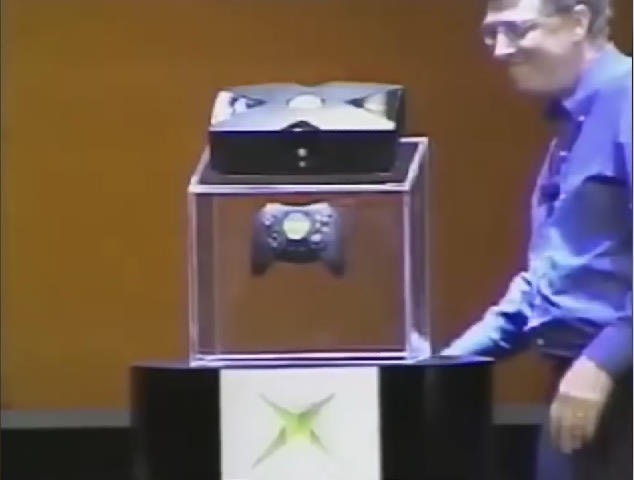
Bill Gates reveals the Xbox at CES 2001 in Las Vegas. (Source: Wikimedia.org)
On January 6, 2001, Microsoft CEO Bill Gates took the stage at the Consumer Electronics Show (CES) in Las Vegas. The Xbox needed some good press, and with the final iteration solidified, CES was the ideal place to unveil it. Dwayne “the Rock” Johnson joined Gates to help generate hype for the upcoming console. Together, the pair pulled off a persuasive performance, praising each other for their personal and professional accomplishments, all while highlighting the technical specs of the Xbox. E3 2001 was around the corner, and whatever Microsoft had prepared was what they had to work with. And despite the console itself refusing to power on at the E3 demo, interest for the Xbox was still prevalent—not because of the hardware, but because of the games it promised to play.
If Xbox was in development purgatory, development hell wouldn’t even begin to describe what the Halo devs endured. Bungie was on the same timetable as Microsoft now, under the same immense pressure. Significant progress had been made on the game, but during the E3 demo, it was clear there were still kinks to work out. The game suffered from abysmal frame rates. Characters would clip through the floor or T-pose in the heat of the moment. Bungie had six months to iron out the wrinkles, or the killer app would kill any hope Microsoft had for the Xbox.
Microsoft’s Ed Fries kept the team on task, essentially ordering a studio-wide lockdown so Bungie could complete Haloon time. It was the mother of all crunch times, and Bungie knew the stakes. If their game was not in a stable state, then everything they had worked toward would be for nothing. For the final two months, the team made their new Redmond, Washington, office their home. Takeout was always being delivered, and people were sleeping under their desks. There was no time to waste. Much of what they wanted to fit into the game had to be cut, a full-fledged story needed to be finished, and characters needed to be finely crafted. There was an urgency to trim what wasn’t needed and flesh out what was necessary.
Against all odds, Halo was released with the Xbox on November 15, 2001. By the end of the year, Microsoft had sold over 1.5 million consoles. Halo would reach its millionth sale by April 2002. The killer app had indeed killed it. Blackley and Kevin Bachus, Microsoft marketing manager, would resign from Microsoft, wanting to branch out and bring what they had learned from their experience into an industry that they had helped change. For some, the storm had passed and the war was over, but for others, especially the players and the game developers, they were just getting started.
Taking control
Before Halo, first-person shooters (FPS) were made for personal computers. The idea of aiming and moving with anything other than mouse and keyboard seemed counterintuitive. There were some notable attempts, however, atbringing FPS games into the console world (particularly for the N64), namely Perfect Dark, GoldenEye, Doom 64, and Turok: Dinosaur Hunter. The controls just didn’t work. Aiming with the controller’s D-pad and moving with the joystick was manageable but unwieldy.
While not record setters in their own rights, all of these games helped pave the way for what Halo and Xbox made possible: seamlessly merging the FPS genre with console controller compatibility. The secret? Two joysticks. One joystick manages movement, while the other controls the camera. Bungie and Microsoft worked together to emulate the feeling of aiming on a PC and brought that to the console, resulting in Halo’s crack-shot controls. Split-screen, campaign co-op was also a defining feature for the game, giving players more opportunity to enjoy the story and gameplay together. The Xbox came with four controller ports, allowing four friends to spend countless hours slaying one another in cyberspace.
What would ultimately solidify Halo as “the killer app” would be its multiplayer capability. This was the original DirectX team’s secret silver bullet: LAN capability. With the option to connect multiple Xbox devices to one another, LAN parties had become a core part of Halo’s identity. Being able to link up multiple devices and enjoy hours upon hours of campaign and multiplayer matches with friends and family is what put the Xbox at the center of countless living rooms and bedrooms across the globe.
“Halo was the kind of game that we wanted to play, but no one had made it yet. It blossomed from being this cool game concept, to this really amazing set of characters, stories, and history, to a final game that blends good storytelling with cutting-edge gameplay and graphics. It was simply amazing to watch it all unfold, to be a part of it,” stated Marcus Lehto, Bungie art director, in The Art of Halo: Creating A Virtual World.
Why Halo?
One thing that elevates Halo is its art direction and narrative. The sights and sounds of Halo are timeless. Hum the chorus of the main menu to any gamer and they will harmonize with you. Kids born a decade after Halo was released can easily recognize Master Chief. How? Halo embodies “less is more.”
From the beginning of the game, the player is put in the middle of space, with nothing but the stars to fill in the gaps of the void. A rhythmic, throbbing sound slowly shifts from one ear to the other as the black screen fades away, revealing an unknown planet framing a mysterious ring world. All the while, an orchestra of violins and otherworldly sounds gently greet the gigantic spaceship floating into view in a fashion similar to Star Wars. The shot cuts to the front of the vessel, and as the camera flies closer to the bridge, we see her name along the bow, Pillar of Autumn. Then, her captain and crew speak for the first time, “Cortana, all I need to know is did we lose them?” That, followed by, “I think we both know the answer to that.” The captain of the vessel is revealed, along with the rest of the crew. There’s tension in the air on the bridge.
Dialog continues between the captain and a disembodied voice. They’re discussing the events that led them to this uncharted sector of space and whether or not the odds are in their favor. Needless to say, chances of survival are slim, but that does not deter the captain from making what could be their final stand. Marines are marching into defensive positions, and one enthusiastic sergeant gives a riveting speech to boost troop morale. The stage is almost set to repel this invasion. One final piece is all that remains: the introduction of the playable character. The camera fades to a monitor in a separate part of the ship, with two commands staring the crewmen in the face: “Priority alpha. Unseal the hushed casket….” After confirming with his comrade, the recruit initiates the thawing sequence to the cryochamber below them. Steam spills from the opening vents, and as the door swings open, out steps the Master Chief, ready for the player to take control.
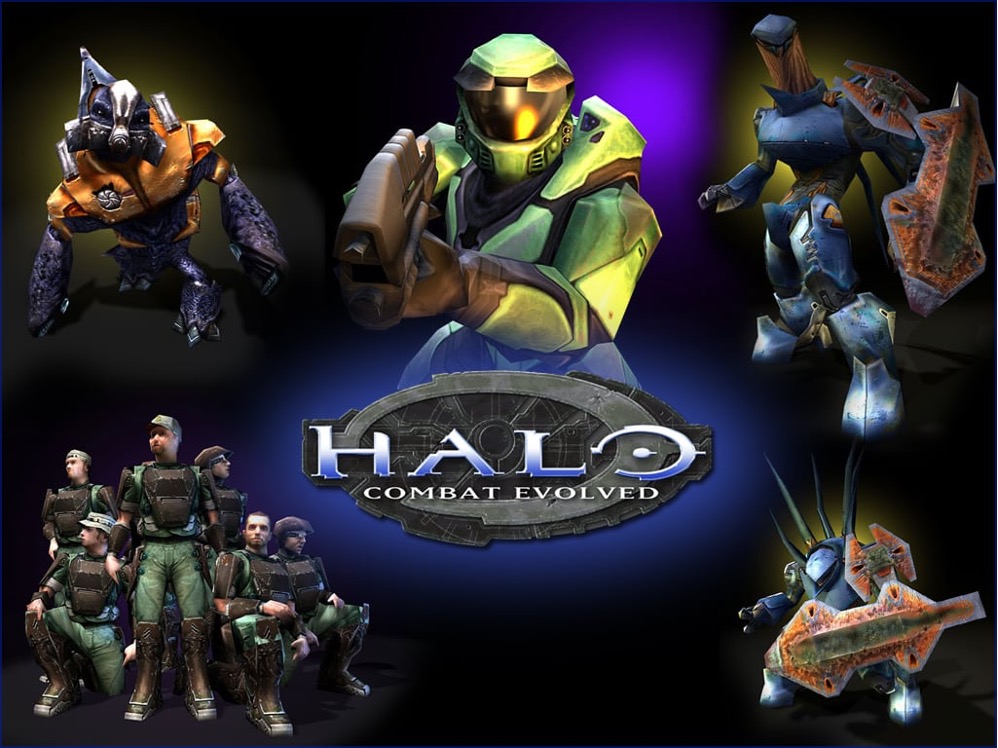
Promotional art of Master Chief, a Grunt, a pair of Hunters, and a squad of Marines. (Source: Halopedia)
What makes a character memorable? Is it their unique design or their irresistible charm? Their acts of heroism or their villainous deeds? Or perhaps it’s our ability to relate to them, to see ourselves in their shoes? Whatever the case, it is clear that Halo is packed to the brim with characters that have stood the test of time. From the ever-clever Cortana to the stalwart Captain Keyes, and even the legendary Sgt. Johnson, there is something memorable about every character Halohas to offer, especially the calm, collected, and capable Master Chief.
The Chief was designed to be a suit of armor that the player inhabits while traversing the enigmatic ring world, but he evolved into so much more. While Master Chief does not speak during gameplay, his subtle characteristics are sprinkled throughout the game. Though most cutscenes have the character standing at attention or walking down hallways, there are others that display the way he observes his environment, making mental notes of his surroundings or memorizing a holographic map.
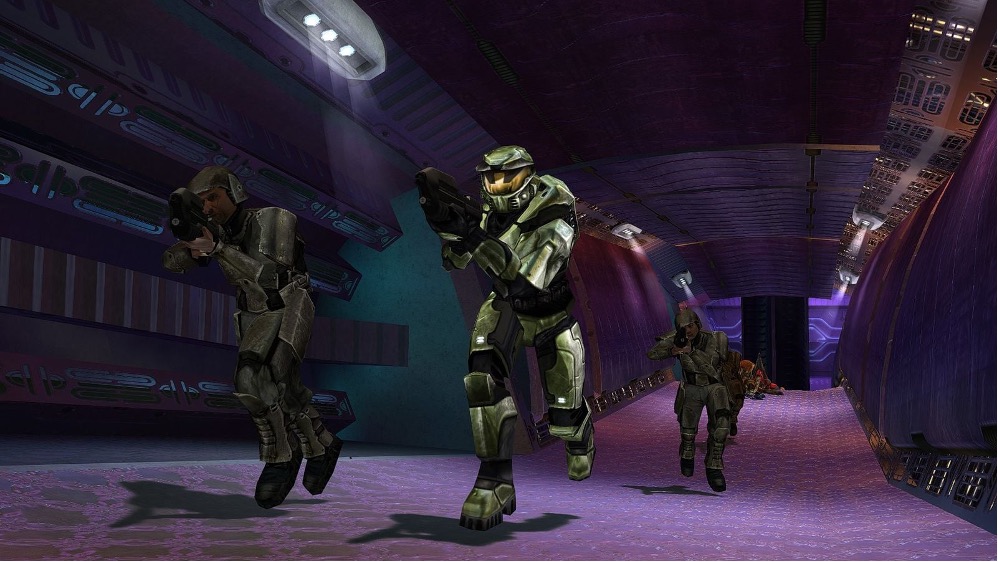
Master Chief and a squad of Marines fighting through the halls of a Covenant cruiser, the Truth and Reconciliation. (Source: Halopedia)
The way the Chief places a reassuring hand on a trembling Marine, or how he holds a fallen comrade and gently sets their body down before proceeding with the rest of his mission, shows thought and care behind the golden visor. Subtle head nods when receiving orders or even idle animations while wielding his weapons all play a part in creating the character fans have come to admire across generations. What wraps up the entire package is the voice-over talent by Steve Downes. Downes brings a calm, charismatic charm to the character. His cadence and delivery are simple and effective, and while the Master Chief may not have much to say, every time he does speak gives the audience another peek beneath the armor of the galaxy’s greatest hero. Of course, a hero is only as impressive as the villains they face in combat and the allies they make along the way.
At the time, Halo’s artificial intelligence was considered the pinnacle of what could be achieved in a video game. The enemies that the player faces are vast and full of variety. Grunts are small, easy targets, efficiently dispatched with precise headshots, but are deadly in numbers and can chuck plasma grenades that stick onto their intended targets. They also tend to flee when their superiors are slain. Jackals sport Spartan-esque energy shields and specialize in phalanx tactics. Hunters are hulking units that operate in pairs, wielding arm-mounted cannons and heavy armor, with an easily exploitable weak spot. Elites rank the highest among the antagonistic Covenant, and appear in five different categories (minor, major, zealot, spec ops, and stealth) with stronger shields and different weapons. They act as the Master Chief’s equal in combat and will actively pursue the player across the battlefield. While these are not the only enemies that players can find on Halo, they are some of the most formidable.
Whether on foot or piloting alien vehicles, the Covenant will stop at nothing to eliminate all human life from the face of the ring world they so heavily revere. But humanity won’t give up without a fight. The player has companions as well, in the form of the UNSC Marines. These combatants bear a striking resemblance to the colonial Marines depicted in Ridley Scott’s Aliens, a homage more than welcomed in this sci-fi adventure military shooter. They are full of character, calling out enemies, shouting for victory, wailing in defeat, and even apologizing for friendly fire. They are battle-hardened and more than ready to take the fight to the Covenant. And each one bears the visage of a different Bungie team member.
Of course, your AI companion, Cortana, is also with you throughout almost the entire campaign. Voiced by Jen Taylor, Cortana makes up for all the dialog the Chief doesn’t say, commenting on the environment, mapping out battle plans, or accessing the Covenant BattleNet. She also has a tendency to state the obvious, but that’s just her way of reminding Master Chief to pay attention before going in guns blazing or doing something crazy. Fortunately for them both, she likes crazy. Cortana is the brains behind the operation, and without her, Halo’s mysteries would never have been solved.
Another quintessential part of Halo: Combat Evolved is the art of the environment and the creative exploration that comes with it. Many modern games have taken this element away in favor of unnecessary invisible barriers and/or kill timers. If the new Halo: Campaign Evolved wants to succeed, it has to steer clear of this unfortunate pitfall. Halo is rich with environmental storytelling. It is made to be explored.
Back in 2001, players could travel almost anywhere on any level, in any way they could concoct, whether it be by design or an unexpected glitch in the matrix. The Silent Cartographer, the fourth mission of the campaign, is known for its explosive opening as well as its expansive environment. Players could take their Warthog and drive it into the ocean for up to 30 seconds before hitting the edge of the map. They could also launch themselves into low orbit with a few well-placed grenades and some power-ups, or bring vehicles into locations that seemed impossible to squeeze through.
This is the kind of freedom that Halo gave to their audience 25 years ago, the freedom that the upcoming Campaign Evolved edition needs to bring back. Evolution is about keeping what worked and revising what didn’t. When discussing the design philosophy behind much of Halo’s environments, Marcus Lehto refers to the “Three Schools of Halo Architecture,” originally coined by fellow Bungie artist Paul Russel. This is in reference to the aesthetics of the three main factions within the Halo lore: the retro ’80s, industrialized, sci-fi military of humanity, the bulbous blue and violet alien technology of the overzealous Covenant, and the ancient, brutalist constructs of those that created the Halo rings, the Forerunners. The unity of this trio is a crucial part of what propels the environmental storytelling, making thisfranchise more than a video game: an environment made for players to explore and experience.
The bow that ties all of Halo together in one immersive package is its music. Martin O’Donnel and Michael Salvatori were given three descriptors by Joseph Staten to compose the soundtrack, which we described earlier as “ancient, epic, mysterious”. They followed this formula and used it for every game since Halo: Combat Evolved. Its cinematic feel implies it was meant for more than just a video game. The drums and brass instruments in Truth and Reconciliation Suite chant as the Master Chief drives a Warthog through canyons and valleys, rescuing stranded Marines to form a resistance against the Covenant. Brothers in Arms provides a sense of camaraderie, with drums, violins, and trumpets following the footsteps of marching Marines prepared to fight till the last. “A Walk in the Woods and Under Cover of Night gives off a calm, collected confidence to the player, cooling them off with a gentle bass after a heated battle or preparing them for a stealthy insertion.
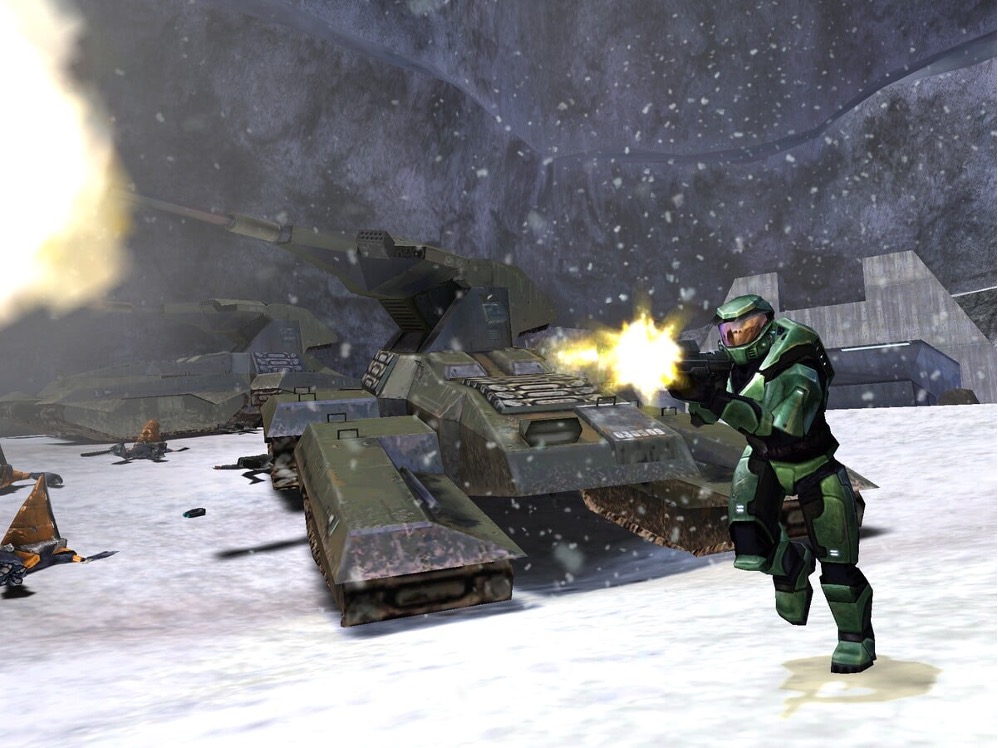
Master Chief battling alongside a pair of tanks within Assault on the Control Room. (Source: Halopedia)
The variety in Halo’s soundtrack is what keeps it fresh upon every replay. And while the music is imperative, the game does not have the soundtrack playing at every possible second. Sometimes the player is left in silence, with just the howling of the wind, the grumbling of the Grunts, the quiet of a canyon, or the thunder of an assault rifle to keep the player company. So when the music does return, it does so with an impact. The soundtrack certainly fits the criteria of ancient, epic, and mysterious. And if that wasn’t enough to emphasize the music’s importance, back at Macworld 1999, the Halo demo had no sound built into it. A separate CD had to be played alongside the gameplay, a three-minute track of an orchestra with some Gregorian chanting to back it up. And that CD had to be flown to New York in time for Macworld. Someone stepped on that CD in transit, destroying it. As luck would have it, composer Martin O’Donnell was on-site with a backup.
Halo now
Halo: Combat Evolved, the killer app, the game that put Xbox on the map and in countless homes across the globe, is once again being brought back into the public eye. It has been remastered before by Sabre Interactive and Certain Affinity in the form of Halo: Combat Evolved Anniversary. Utilizing assets from previous Halo titles (namely Halo 3 and Halo: Reach), in addition to altering and enhancing the graphics/sound effects to bring it to mid-2010 standards, the game was met with polarizing reactions.
It was a divisive remaster. While the game gained a score of 82 on Metacritic, many Halo enthusiasts believe the anniversary edition missed the mark at attempting to recapture the core themes and tone of what the original brought. Stiff animations and misshapen geometry in the environments made for an awkward and lackluster campaign experience. Where the remaster does shine is in the sound effects department. Weapons sound much more powerful, like proper mini explosions are going off in the players’ hands. The Warthog’s rear-mounted chain-gun roars as it mows down Covenant forces, and there is a bulky weight in the Master Chief’s movements. With every melee attack and reload animation, the suit of armor that protects the player sounds like it has heft. The skyboxes in Anniversary also deserve praise. While not always aligned with the original’s vision, Anniversary’s skyboxes are visually stunning. Sunsets on a ring world come to life, and the vast expanse of space shines brightest at night. However, the lack of any meaningful multiplayer action means the entire package winds up being dust and echoes of what came before.
Halo: Campaign Evolved appears to be heading in a similar direction.
What do we think?
While the upcoming Halo: Campaign Evolved is an Unreal Engine 5 remaster, instead of pursuing an art style that suits the early 2000s’ tone of Combat Evolved, Halo Studios has elected to utilize assets from Halo: Infinite. Campaign Evolved will also not feature any multiplayer play, taking away a crucial part of what defined Halo from the beginning. The game will also be released on the PlayStation 5. This removes the exclusivity Halo had with the Xbox, while reaching out to a broader audience. Microsoft is attempting something new while simultaneously repeating past patterns already met with criticism.
If Halo: Campaign Evolved is to succeed, Halo Studios and Microsoft have to recall what made the original game so successful in the first place. People are passionate about this IP. It deserves to be re-created from the ground up, not plastered with copy and pasted assets from past properties. If Halo Studios and Microsoft go the easy route, it will keep Halo from truly evolving. But if they remember their roots, be the heroes the fans know they can be, then what they deliver will be nothing short of legendary.
“There is still time to stop the key from turning… but first it must be found.” –Gravemind, Halo 2
LIKE WHAT YOU’RE READING? INTRODUCE US TO YOUR FRIENDS AND COLLEAGUES.