
Professional audio and video systems are moving toward standard IP networks, and Matrox Video wants to make that transition easier. Working with AMD, the company has developed products that combine programmable silicon, low-latency processing, and open networking standards. Its Avio 2 KVM extenders, ConvertIP converters, and Vion gateways target broadcast facilities, control rooms, and enterprise AV installations. The collaboration illustrates how adaptive SoCs and FPGAs can improve interoperability while giving system designers greater control over performance, cost, and expansion.

Professional AV and broadcast systems have traditionally relied on dedicated interfaces, specialized switching equipment, and proprietary transport protocols. Those approaches support demanding applications, although they complicate integration when organizations expand their installations or connect equipment from multiple suppliers.
The transition toward Ethernet-based audio and video transport creates opportunities to consolidate infrastructure, improve resource sharing, and simplify system management. It also introduces requirements that conventional IT networks do not always address. Live video, remote keyboard and mouse control, and production audio require predictable latency, synchronization, sufficient bandwidth, and continuous operation.
Matrox Video identified protocol fragmentation, interoperability, and expansion costs as obstacles to broader AV-over-IP adoption. Proprietary systems can restrict equipment choices and require additional conversion hardware when organizations introduce new products or extend their networks.
“The biggest issue we saw in the market was fragmentation,” said Ron Rundell, director of sales for the Americas region at Matrox Video. “That model simply doesn’t scale, especially in today’s hybrid AV/IT environments where flexibility is everything.”
The company worked with AMD to address these requirements through programmable hardware and established media transport standards.
Adaptive silicon supports open standards
Matrox Video selected AMD Zynq UltraScale+ adaptive SoCs and Kintex UltraScale+ FPGAs for a range of IP-based AV products. Zynq UltraScale+ combines Arm processing resources with programmable logic, allowing developers to distribute control, networking, and media-processing functions across hardware and software. Kintex UltraScale+ FPGAs provide configurable data paths for video transport, signal conversion, and protocol processing. Developers can implement timing-sensitive functions in programmable logic and use software for configuration, management, and system control.
This approach gives Matrox Video control over the processing pipeline, including packet handling, synchronization, and media conversion.
The company focuses on two standards families. SMPTE ST 2110 defines the transport of professional video, audio, and ancillary data across managed IP networks. IPMX extends professional media-over-IP concepts toward a broader range of AV applications, including equipment interoperability and system management.
The standards provide a common technical foundation for connecting devices from different manufacturers. Practical interoperability still depends on supported profiles, implementation details, network configuration, and conformance testing.
Matrox expands its IP product portfolio
Matrox Video has developed several product families using AMD adaptive computing technology.
The Avio 2 IP KVM extender supports remote keyboard, video, and mouse operation across IP networks. Matrox describes it as the industry’s first IPMX/ST 2110 IP KVM extender.
KVM applications place particular demands on latency because users expect immediate visual feedback when interacting with remote workstations. Hardware processing can reduce packet-handling overhead and support consistent response times.
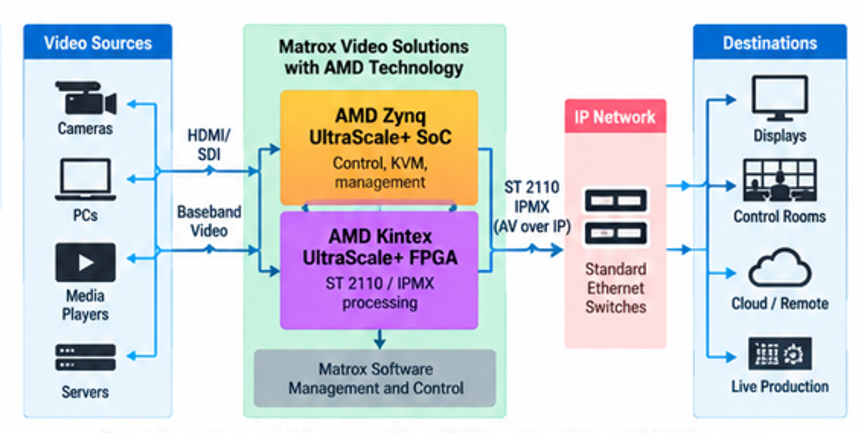
Figure 1. AMD adaptive silicon connects Matrox products through open AV standards.
The ConvertIP family handles video conversion and encoding or decoding across compressed and uncompressed AV-over-IP workflows. These capabilities help integrators connect equipment that uses different signal formats or transport environments.
The Vion IP video gateway provides additional media transport and protocol conversion capabilities for hybrid installations.
Matrox also offers developer boards that allow OEMs and system manufacturers to incorporate professional media processing into their own products.
Matrox Video products using AMD technology
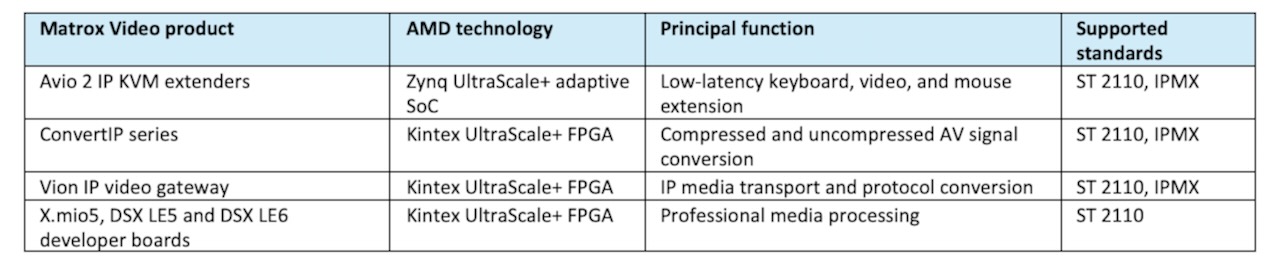
Table 1. Matrox Video uses AMD adaptive silicon across its professional AV and broadcast portfolio. (Source: AMD and Matrox Video)
The product range addresses different stages of an IP-based AV installation, from signal acquisition and conversion to transport, remote operation, and integration into larger systems.
For system integrators, a common standards framework can reduce the need for proprietary gateways and simplify the selection of compatible equipment.
Hardware and software share the workload
Matrox Video and AMD adopted a hardware-software co-design approach to optimize media processing, firmware, and system integration.
The engineering teams implemented timing-sensitive protocol functions in programmable hardware, allowing the devices to handle media traffic with predictable processing characteristics.
FPGA logic can process packet streams through parallel data paths, avoiding some of the scheduling overhead associated with general-purpose processors. This matters when systems transport high-resolution video, multiple synchronized media streams, or interactive KVM traffic.
The approach also supports configurable protocol handling. Developers can revise programmable logic and firmware as standards evolve or customers introduce new equipment requirements.
AMD’s adaptive SoCs contribute integrated processing and programmable resources within a compact device architecture. Matrox identifies power efficiency, gate density, memory management, and long product availability as important selection criteria.
“AMD was available at the right time with the right technology,” said Rundell. “Its components provide the low latency, reliable performance essential for media transport over IP.”
The companies have not supplied numerical latency, throughput, or power comparisons in the source material. Consequently, the reported performance benefits establish the design objectives and vendor experience without providing an independent benchmark against competing implementations.
Implications for AV and IT infrastructure
The collaboration reflects the growing overlap between professional media systems and enterprise networking.
Broadcast studios, control rooms, educational facilities, and corporate AV installations increasingly rely on network infrastructure to distribute high-resolution video and audio.
Open transport standards allow organizations to evaluate equipment from multiple suppliers and develop expansion plans around common network technologies. For CIOs, this creates opportunities to coordinate AV and IT infrastructure planning, including network capacity, traffic management, monitoring, and security. For ISVs and OEMs, programmable silicon offers a way to implement specialized media functions while retaining flexibility for future protocol revisions.
The economic benefits depend on installation scale, network design, integration costs, and operational requirements. Organizations must still evaluate switching capacity, synchronization, multicast management, redundancy, and maintenance.
AMD’s contribution illustrates the continuing relevance of adaptive computing in applications that demand deterministic processing and specialized I/O.
Results and continuing development
Matrox Video reports improvements in interoperability, latency, power efficiency, and scalability across its AMD-based product portfolio. The company also emphasizes long-term maintenance and support, an important consideration for broadcast and professional AV installations that frequently remain in service for many years.
Its products support the integration of IP media transport with existing production environments and provide options for facilities moving toward network-based operations.
Matrox continues developing IPMX and ST 2110 products with AMD technology.
The broader opportunity involves creating AV systems that support multiple equipment suppliers while maintaining the timing, reliability, and operational characteristics that professional media applications require.
The transition will depend on standards adoption, interoperability testing, and the ability of manufacturers to deliver consistent performance across increasingly complex networks.
What do we think?
Matrox Video and AMD demonstrate how programmable hardware supports the transition toward standards-based AV infrastructure. FPGA acceleration addresses latency-sensitive media processing, while IPMX and ST 2110 improve equipment interoperability. The commercial opportunity extends across broadcasting, enterprise AV, and remote production. Independent latency measurements, conformance testing, and deployment economics will determine the advantages for integrators and customers.
Inflection point. The collaboration points toward a potential inflection point in professional AV and broadcast infrastructure. Open standards increasingly allow media equipment to share conventional IP networks, while adaptive silicon provides the specialized processing these applications require. The significance extends to AI-assisted production, automated media management, and remote collaboration, where interoperable infrastructure simplifies integration. Broader IPMX adoption, demonstrated multivendor compatibility, and measurable operating-cost reductions will determine whether this transition becomes an industry-wide inflection point over the next several years.
WHAT DO YOU THINK? GOOD ENOUGH TO TELL YOUR FRIENDS ABOUT IT? YOU HAVE OUR PERMISSION TO SHARE IT.