
AMD’s Epyc updates give infrastructure teams plenty to evaluate, from server upgrades to confidential cloud computing and embedded systems. Sixth-generation processors bring Zen 6 to servers, and the Embedded 9006 family adds memory and connectivity options for test equipment, firewalls, and storage. Google’s TPU 8tx pairs fifth-generation Epyc hosts with confidential acceleration. We look at the technical roles, deployment questions, and commercial disclosures that matter when developers qualify software and technology leaders decide where to spend their infrastructure budgets next.
AMD expanded Epyc’s infrastructure role through announcements on November 9 and 10, 2026. Google Cloud’s TPU 8tx pairs fifth-generation Epyc hosts with confidential acceleration. Sixth-generation Epyc server platforms enter general availability, and Embedded 9006 brings the SP7 platform to test equipment, network appliances, and storage controllers.
These products address distinct deployment requirements. Hosts prepare data, coordinate execution, and manage accelerator communication. Embedded processors handle device testing, network policies, and storage services. AMD says more than 10 hyperscalers and frontier AI laboratories use Epyc hosts across systems containing Instinct accelerators, Nvidia processors, and custom silicon.
For procurement, processor generation alone supplies an incomplete specification. Teams need the host configuration, accelerator interface, memory topology, security implementation, and software versions. The same x86 instruction-set foundation can support multiple roles, and each system needs workload-specific qualification.
Software teams should profile host utilization alongside accelerator activity. Include data preparation, request admission, database calls, and background services in the test. Measure queue growth and response times as demand increases. That exercise helps establish the host configuration each application needs and gives operators a basis for capacity reservations.

Table 1. Epyc deployment roles across server, embedded, and confidential cloud systems.
The host’s contribution depends on its place in the complete system. Google’s confidential accelerator configuration illustrates how processor selection also shapes the security architecture.
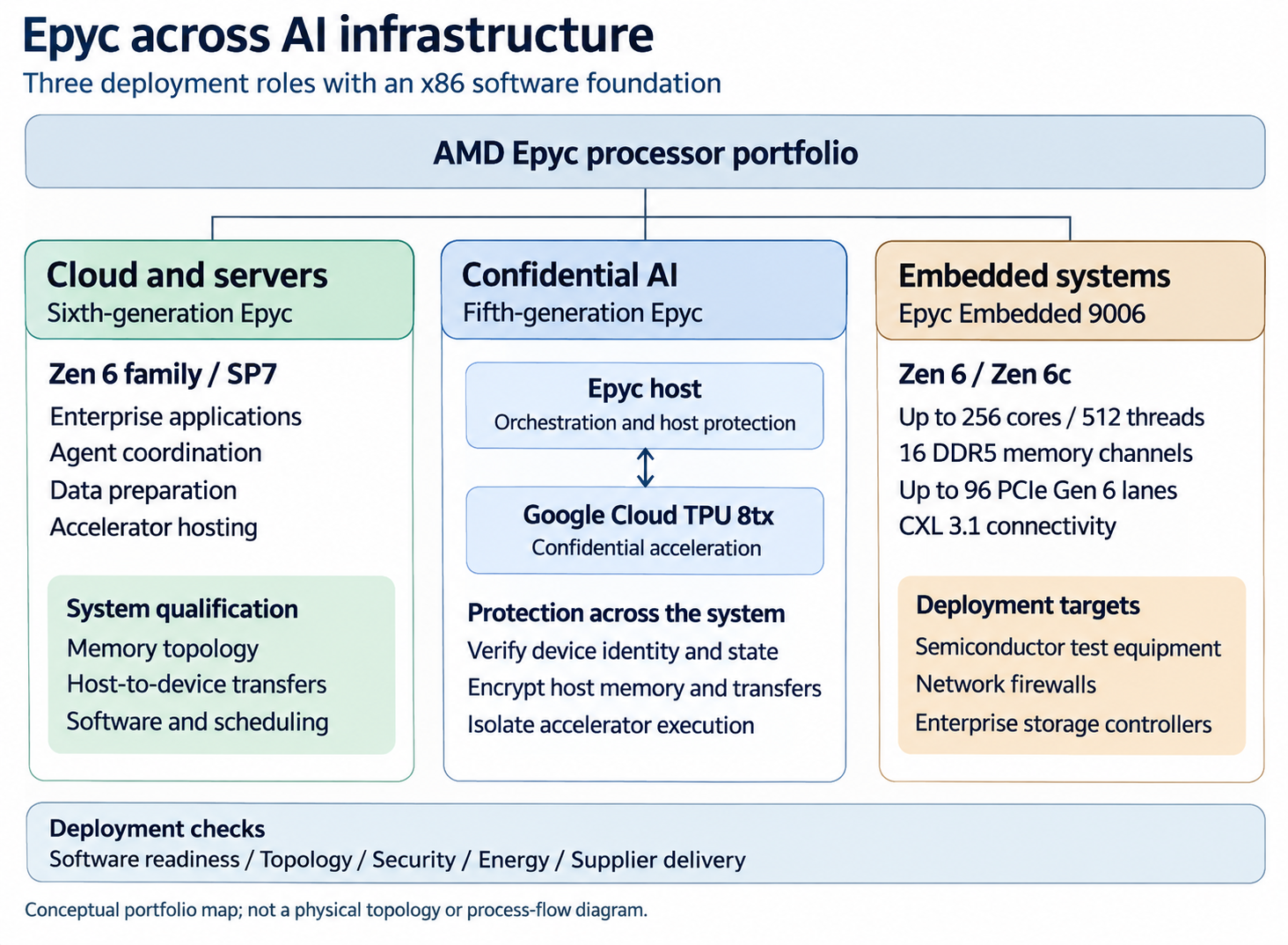
Figure 1. Epyc serves three infrastructure roles: sixth-generation server platforms, fifth-generation confidential TPU hosts, and Embedded 9006 systems for testing, networking, and storage.
Each deployment places different demands on the processor and its surrounding platform. Google’s confidential accelerator configuration shows how host selection also shapes the security architecture.
Confidential computing crosses the host interface
In TPU 8tx systems, Epyc manages orchestration, data preparation, and accelerator communication. Google uses TPU 8t silicon with fifth-generation Epyc hosts and the Boardfly network. Google targets confidential inference and also describes support for fine-tuning, distillation, reinforcement learning, and small-scale training.
AMD describes a security sequence that verifies accelerator identity and configuration before granting access to protected memory. Secure Encrypted Virtualization contributes host protection. Encryption protects prompts, weights, and intermediate data in host memory and during transfers; hardware isolation protects accelerator execution.
That description requires careful interpretation during qualification. Buyers should request the threat model, attestation process, key ownership, firmware policy, and recovery procedures. Security teams should examine administrative access and the boundaries around logs, storage, networking, and application services.

Table 2. Google Cloud offerings that AMD identifies within its confidential-computing collaboration.
Each service carries its own configuration and support requirements. Developers should verify the protections available for their selected region, machine type, and accelerator environment before committing sensitive workloads.
Embedded infrastructure needs balanced resources
AMD announced the Epyc Embedded 9006 on November 10. The preliminary product brief lists six configurations with 64 to 256 cores. The 256-core 9976 uses Zen 6c cores, while the 64-core 9556 uses Zen 6. Buyers should preserve that distinction when comparing frequency, density, cache, and power.
Sixteen DDR5 channels support registered and multiplexed-rank memory. AMD specifies registered modules at up to 8,000 megatransfers per second and multiplexed-rank modules at up to 12,800. Connectivity includes up to 96 PCIe Gen 6 lanes and CXL 3.1. Board topology and link allocation determine available device connectivity.
Test equipment designers can use the platform to coordinate parallel memory and storage validation. Firewall designers need policy handling, session management, and communication with data-plane accelerators. Storage developers need NVMe device access alongside compression, caching, and RAID processing. Qualification should reflect these separate execution paths.
Benchmark labels need workload context
AMD claims up to 1.8 times generational throughput and 1.5 times ISA-l storage performance. Its announcement describes up to 1.3 times firewall throughput; the supporting disclosure identifies a packet-forwarding benchmark. That distinction matters when estimating performance with encryption, inspection, and complete security policies.
The throughput comparison also changes core counts, memory configurations, and compiler versions. Treat these figures as platform-level vendor claims. Require application measurements for the intended configuration and record packet sizes, traffic mix, storage operations, concurrency, and power boundaries.

Table 3. Embedded platform capabilities and the tests buyers should request.
The specifications identify resources for system design. Completed application tests establish how those resources serve a particular appliance or deployment.
Security and lifecycle require implementation
AMD’s root of trust authenticates boot firmware and supports post-quantum firmware signatures. The Security Processor provides runtime security services and authorized diagnostics. Caliptra supports device identity and remote integrity verification. Appliance vendors must integrate these capabilities into update, provisioning, and support processes.
Procurement contracts should specify the availability window’s starting date, update cadence, replacement arrangements, and end-of-life notice period. Ask the system supplier to identify responsibility for each firmware component. Exercise an update and recovery cycle during acceptance testing, and retain the resulting configuration record for future maintenance and compliance reviews.
Shipments and pricing need precise labels
AMD announced sixth-generation server general availability on November 10 and reported server-vendor shipments by that date. Its release supplies no date for the first customer shipment. The embedded announcement scheduled its 128-core model for November 15 and the remaining models for year-end. Those dates establish announced availability; the reviewed material supplies no confirmation of individual embedded customer deliveries.
Fifth-generation Epyc reached general availability on October 10, 2024. The November 2026 TPU announcement identifies a deployment role and supplies no customer-service start date. The announcements disclose no generation-specific unit sales or realized average selling prices. AMD cites $14,904 for the server Epyc 9996 in 1,000-unit quantities. Actual transaction averages remain undisclosed.
For software vendors, qualification should cover scheduling, memory placement, accelerator transfers, and security interfaces. Silicon teams should document topology and firmware dependencies. Technology leaders should require delivery commitments, support ownership, and complete configuration quotations before approving deployment budgets.
What do we think?
We see a coherent infrastructure strategy: AMD supplies host compute, embedded processing, and security integration around accelerated workloads. The commercial value depends on application performance, support, and delivery. Buyers should evaluate each role separately and carry the results into system purchasing. We would track production deployments, software qualification, and supplier commitments as evidence that the portfolio delivers repeatable customer value.
Inflection point. These announcements signal continued infrastructure development. We would recognize an inflection point if confidential host and accelerator protection becomes a routine purchasing requirement and materially expands production adoption of sensitive AI workloads. Evidence should include repeat deployments, customer-controlled attestation, documented performance overhead, and procurement specifications that require protection during execution. Embedded design wins would provide another adoption measure. The announcements establish technical direction; deployment scale, operating economics, and sustained demand will determine the pace of any broader industry transition ahead.
LIKE WHAT YOU’RE READING? TELL YOUR FRIENDS; WE DO THIS EVERY DAY, ALL DAY.