
AMD expanded its Instinct MI400 lineup on November 12, 2026, and this article covers the full menu. The MI450X adds a 288 GB HBM4 memory tier to Helios racks. The MI455X posts 21,333 tokens per second on Deepseek-R1, and AMD claims up to 30% more throughput than Nvidia’s Vera Rubin. The MI430X pairs native FP64 with 432 GB for science. We sort the specifications, the benchmark caveats, and the commercial facts: what ships, what sells, and what it costs.
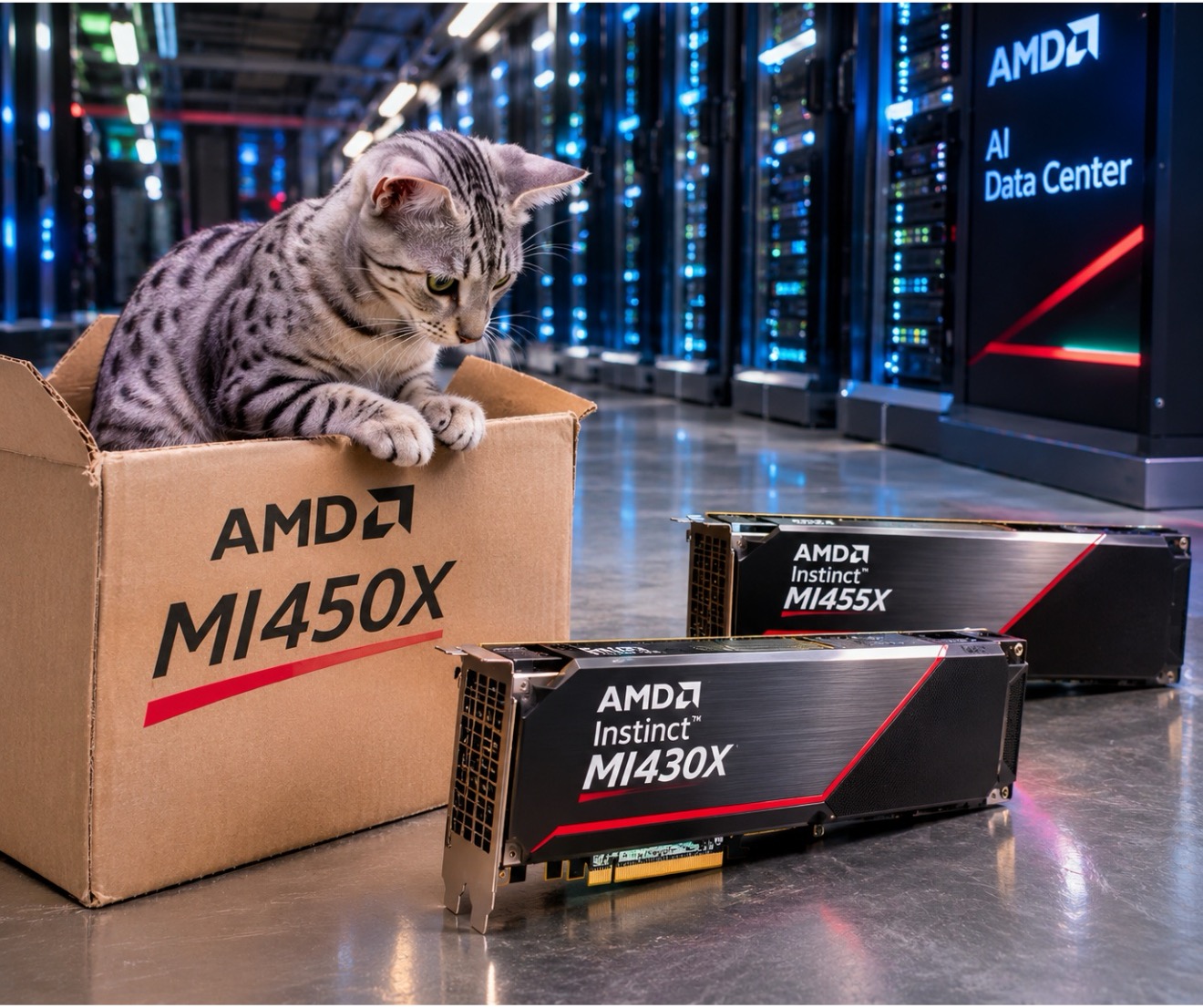
AMD advanced its Instinct MI400 portfolio on November 12, 2026, with technical updates for the MI430X, measured inference results for the MI455X, and the introduction of the MI450X. Andrew Dieckmann, corporate vice president and general manager of AMD’s data center GPU business, frames the expansion as workload matching: Buyers pair memory capacity and numeric precision with each deployment. The three parts share the CDNA 5 architecture and the ROCm software stack, so teams move models among configurations without rewriting code. Helios racks host the MI450X and MI455X; scientific systems host the MI430X.
Three parts, one software stack
AMD launched the MI400 family on July 23, 2026, at its Advancing AI event, and the November update refines that lineup into three memory and precision profiles. Silicon teams can read the three parts as one die family with three memory dressings; ISVs can read them as one software target; CIOs can read them as a procurement menu.
MI455X sets an inference mark
AMD Performance Labs measured the MI455X at 21,333 tokens per second per GPU on Deepseek-R1 in an MLPerf Inference Offline configuration, with testing in October 2026. AMD compares that figure against Nvidia’s published MLPerf Inference v6.1 result for Vera Rubin NVL72 in the Closed Division, entry 6.1-0106, and claims up to 30% higher throughput. Three caveats bound the claim: AMD ran the test itself, the result is a lab measurement and not an AMD MLPerf submission, and the Offline scenario measures aggregate throughput, not interactive latency. Buyers should examine precision settings, system configurations, and software versions in both submissions before extending the comparison to production serving. AMD also claims Helios carries up to 20% more HBM bandwidth than the Vera Rubin configuration it references.
Interactive inference adds its own metrics: time to first token, inter-token latency, scheduling, context length, and concurrent users. The MLPerf Offline number establishes a throughput reference; application-specific tests will set procurement economics.
MI450X trades capacity for cost
AMD introduced the MI450X as a second Helios option with 288 GB of HBM4 across eight stacks. It keeps the MI455X core compute, 23.3 TB/s of memory bandwidth, and the scale-up and scale-out fabric links, so a model that fits inside 288 GB runs on either part. The MI455X carries 432 GB across 12 stacks for larger models, longer contexts, and higher concurrency. A Helios rack in the MI455X configuration holds 72 GPUs, 31 TB of HBM4, and 1.67 PB/s of aggregate bandwidth, so tiering memory at the GPU level sets rack-level capacity steps. AMD’s product page lists a November 12, 2026, launch date and discloses no price or availability date.

Table 1. AMD Instinct MI450X specifications.
The specification sheet marks the MI450X as a low-precision AI part with token FP64. Memory capacity governs GPU count per model, and communication drops when a model fits inside one tier. Workloads above 288 GB need the MI455X; workloads below it run on the MI450X at lower capital cost.
MI430X keeps native FP64
The MI430X serves scientific computing and sovereign AI. It pairs up to 288 TFLOPS of native FP64 with 432 GB of HBM4 and 9.2 PFLOPS of FP4 compute. AMD researchers profiled 47 workload configurations across 11 scientific applications and benchmarks, and concluded that core physics and engineering codes rely on native double-precision hardware; emulation helps selected dense matrix operations and adds memory pressure. That finding explains the positioning: Multiphysics simulation and scientific foundation models share one converged node.
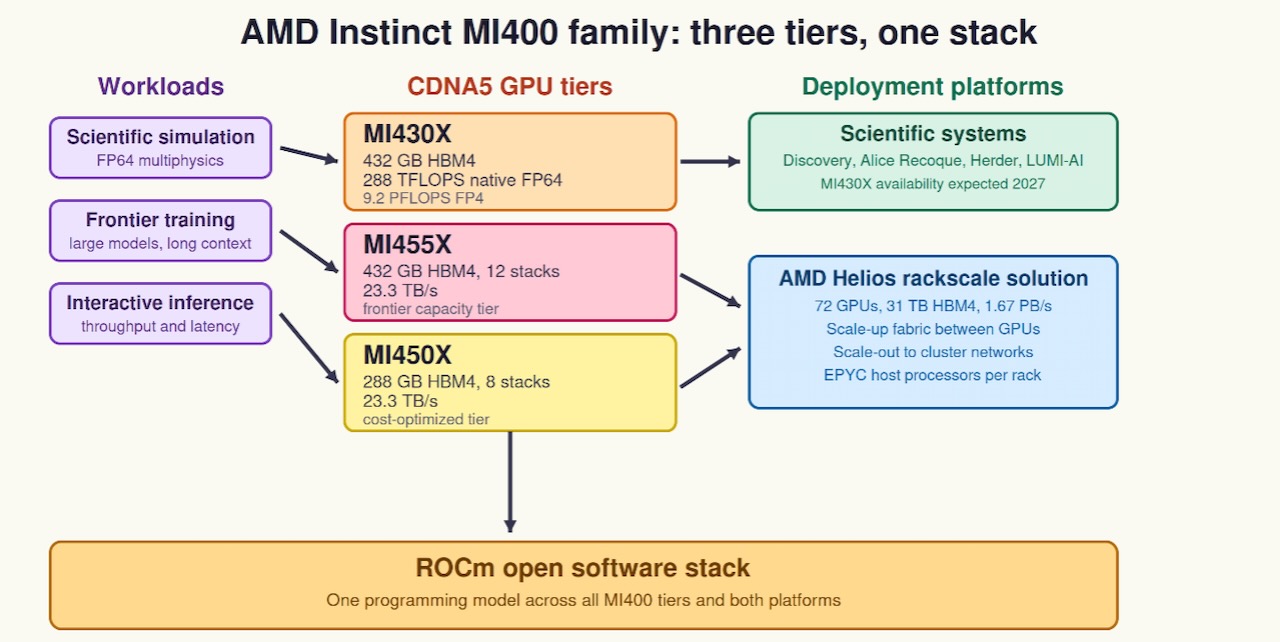
Figure 1. MI400 tiers share Helios racks and ROCM software.
Four systems name the MI430X: Discovery at Oak Ridge, Alice Recoque in France, Herder at HLRS in Germany, and LUMI-AI in Finland. AMD expects availability in 2027.
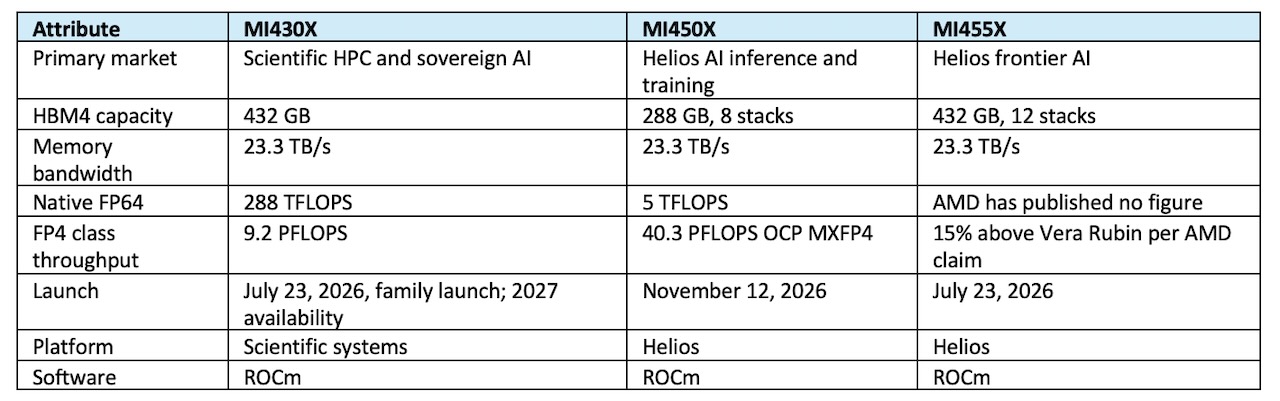
Table 2. MI400 family positioning.
Shipments, sales, and price
The MI400 family reached the market on July 23, 2026, and Helios systems began shipping through Supermicro in early November 2026. AMD discloses no first commercial shipment date for the MI450X and provides no unit sales or per-GPU average selling price for any Instinct part; its data center segment revenue mixes Instinct GPUs with Epyc server processors. The LUMI-AI contract provides the sole public price anchor: EuroHPC and Bull signed a €387.8 million (US $427.14) contract on August 31, 2026, covering the acquisition, delivery, installation, and maintenance of an MI430X system, and the contract does not specify an accelerator count. That figure cannot yield a per-GPU price. Table 3 summarizes the tracker entries.

Table 3. Commercial status for the AI processor tracker.
Silicon teams should map model memory footprints to the 288 GB and 432 GB tiers and verify FP64 requirements before the MI430X window. ISVs can treat Helios plus ROCm as a single target and validate offline throughput and interactive latency on their own serving stacks. CIOs should plan MI400 capacity through reserved agreements, cover near-term needs with MI355X, MI350X, Mi325x, and MiI00X parts, and request delivery dates and power figures in writing.
AMD’s announcement figure gathers those pieces into one picture.

Figure 2. AMD’s figure maps three MI400 tiers onto one CDNA 5 foundation.
The picture carries one message: Three memory and precision dressings share one architecture, one fabric, and one software stack. Buyers choose a tier and avoid re-architecting the rack. That choice is the point of the November update.
What do we think?
The MI400 expansion aligns with real enterprise buying patterns: FP64 simulation on the MI430X, capacity on the MI455X, and a cost-optimized tier on the MI450X. The 30% inference claim remains AMD’s own until an independent body reproduces it. We want delivery dates, unit counts, per-GPU prices, and power figures; those four disclosures will determine whether the menu converts into share.
Inflection point. Does the MI400 expansion signal an inflection point in AI hardware? The three-part split marks a commercial inflection point in how enterprises buy rackscale AI: Memory capacity and precision, not a single flagship part, now drive selection. AMD gives buyers a second vendor with an open software stack across three profiles. The announcement alone creates no inflection point in algorithms or market share; shipments, independent benchmarks, and pricing will determine the timing and the share. The procurement menu is the signal.

Figure 3. AMD covers all segments of AIPs.
See our companion articles on AMD MI400 series use in training and cloud inferencing, and our comparison of the AMD MI400 series versus Nvidia’s Vera Rubin. All of those products and more are covered in our AIP quarterly update report and our packed AIP MIS tracker.
WHAT DO YOU THINK? GOOD ENOUGH TO TELL YOUR FRIENDS ABOUT IT? YOU HAVE OUR PERMISSION TO SHARE IT.