
Bitmain is the world’s dominant Bitcoin mining ASIC company—but it also built a genuine edge AI chip family called Sophon, and those chips ship in real products today. The story splits into three parts: the chips, which are technically credible; the company, which is primarily a crypto mining operation; and Sophgo, the AI chip spin-off that got placed on the US Entity List in December 2024 after a Huawei sanctions probe. Understanding all three is essential before specifying any Sophon silicon.
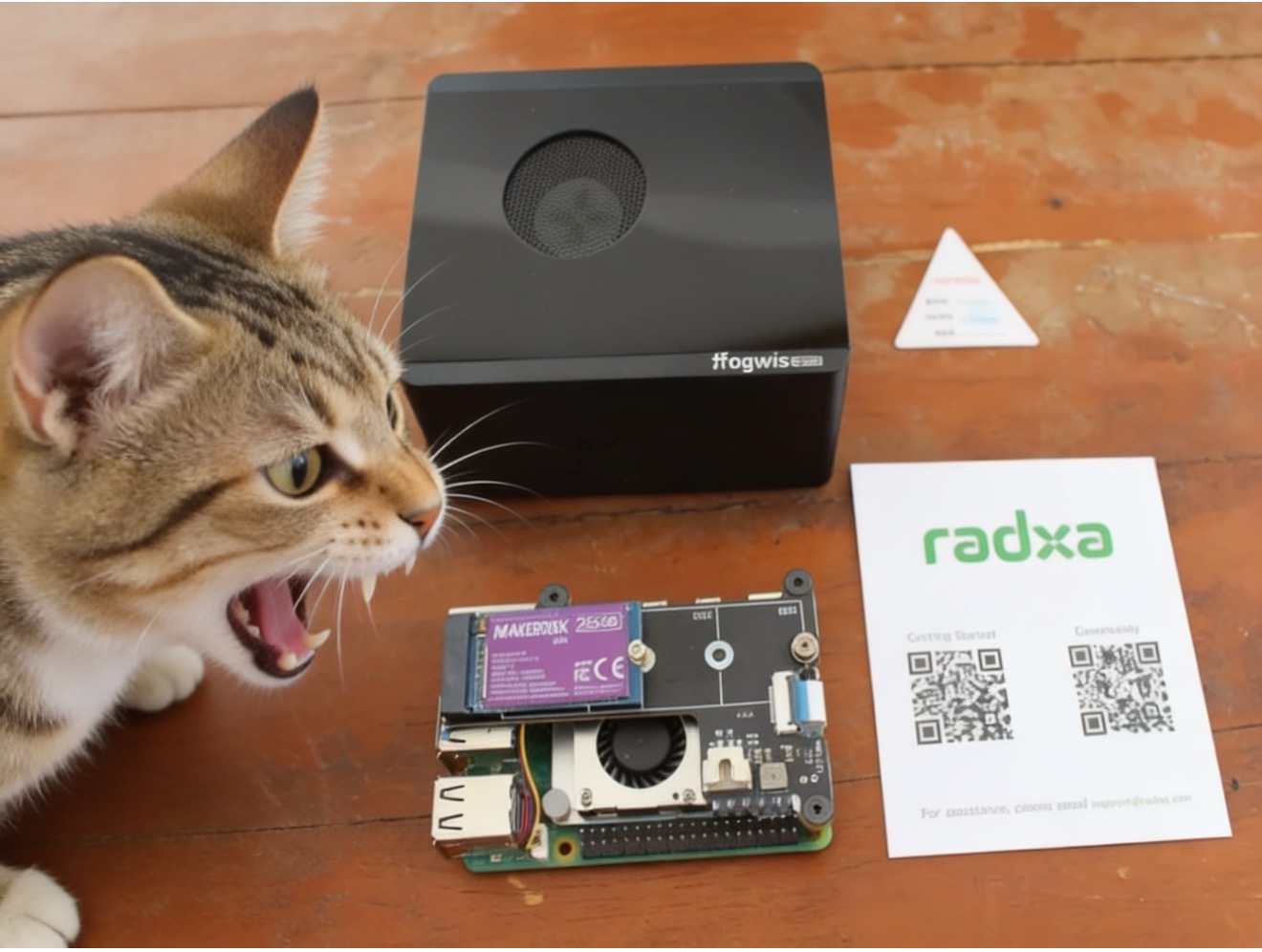
Bitmain’s AI chips are real—and radioactive.
Jihan Wu discovered Bitcoin in 2011 and translated Satoshi Nakamoto’s whitepaper from English to Chinese. In 2013, he persuaded Micree Zhan—an electronics engineer who had previously built set-top box chips and worked at Tsinghua University’s IT Research Institute—to co-found Bitmain in Beijing. Zhan took 36% of the company; Wu took 20%. Zhan led chip development. Wu handled the market.
The Antminer S1 shipped six months later, in November 2013. Bitmain grew to $2.5 billion in revenue by 2017, controlling approximately 70% of the global Bitcoin mining ASIC market. The company raised $765 million across a Series A ($50M, September 2017, led by Sequoia Capital China), a Series B ($400M, August 2018, IDG Capital and Coatue Management co-led), and a B+ round in 2019. Bitmain filed for IPO in Hong Kong in 2018—valuation reached $15 billion at peak—and withdrew when the Bitcoin price collapsed. A second IPO attempt on Nasdaq in 2021 also failed. The company remains private. Current employee count is approximately 3,100, down significantly from peak head count.
The co-founder war
In October 2019, Wu ousted Zhan from all positions at a closed board meeting. Zhan filed lawsuits to reclaim his stake. In January 2021, Wu stepped down as CEO in a cryptic letter posted to Twitter. Zhan regained control of the company through the legal process and resumed as CEO. Wu departed to found Bitdeer (Nasdaq: BTDR), a Bitcoin mining spin-off. The dispute lasted nearly two years and destabilized the company’s management during what would have been a critical period for the Sophon AI program.
The AI chip story
Bitmain started developing the Sophon AI chip family in 2017–2018 under Zhan’s direction. The product line is technically genuine—BM1680, BM1682, BM1684, BM1684X, BM1688. The BM1680 appeared at the AI World conference in Beijing in November 2017, fabricated on TSMC 28 nm. The BM1882 was the second chip—a server-class tensor processor. The BM1880, launched October 2018 on TSMC 28 nm, was the first edge-targeted Sophon device: a dual-core Cortex-A53 at 1.5 GHz plus a RISC-V MCU at 1 GHz, with a dedicated TPU scheduling engine delivering 1 TOPS base and 2 TOPS with Winograd convolution acceleration. It shipped on 96Boards EDB form factor at $129 and found limited commercial deployment. The crypto market collapse in 2019 took most of the oxygen out of the Sophon program.
The BM1684, fabricated on TSMC 12 nm, represented a substantial step: 17.6 TOPS INT8, eight-core Cortex-A53 at 2.3 GHz, 12 GB LPDDR4X, and 32-channel H.264/H.265 1080p decode. It runs PyTorch, ONNX, TensorFlow, PaddlePaddle, Caffe, and Darknet through a unified SDK. The BM1684X extends that with 32 TOPS INT8 on the same 12 nm process, 16 GB LPDDR4X, and the same framework support. The current BM1688 (also branded SG2300X through Sophgo) delivers 32T INT4 / 16T INT8 / 4T FP16/BF16 at 0.5T FP32.
These chips ship in real products. The Radxa Fogwise Airbox runs the BM1684X with 16 GB LPDDR4X and dual Gigabit Ethernet, actively reviewed and sold in 2024–2025. Firefly’s AIBOX-1684X and AIBOX1688 use the same silicon. The open-source SDK is on GitHub. Third-party support from the Chinese developer community is active. The technology works.
The Sophgo complication
In 2019, Micree Zhan founded Sophgo (Xiamen Sophgo Technologies) to commercialize the Sophon AI chips. Zhan owns approximately 22% of Sophgo. Sophgo and Bitmain share domain registries and email contacts—Sophgo communicated with the US Federal Communications Commission in 2023 using a Bitmain email address.
In October 2024, TSMC cut off chip supply to Sophgo. TechInsights had analyzed Huawei’s HiSilicon Ascend 910B and found it was manufactured on TSMC’s 7 nm process—a chip that Huawei, as a sanctioned entity, is not supposed to be obtaining. Sophgo was identified as the suspected cutout. TSMC stopped shipments immediately. The US Department of Commerce added Sophgo to the Entity List in December 2024. Sophgo denied any business relationship with Huawei. Bitmain formally distanced itself from the investigation.
The Bitmain-Sophgo-Zhan connection is documented, and the US government has acted on it. Whether or not Sophgo’s denial holds up, the supply chain consequence is real: Sophon chip production through TSMC is disrupted. BM1684X and BM1688 chips currently in distribution in China and via Chinese OEMs continue to sell, but new wafer starts through TSMC are blocked. Future production is uncertain.
Separately, Bitmain has been repositioning toward the US market, partnering with the Trump family through American Bitcoin to establish US-based Bitcoin mining operations. J.P. Morgan listed Bitmain as one of TSMC’s top Chinese clients as recently as June 2025.
Company viability
Bitmain as a Bitcoin mining company is viable. At peak, it controlled 70–75% of the global Bitcoin mining ASIC market and generated $2.5 billion in annual revenue. The AI chip business is real but secondary—and now geopolitically complicated. For anyone evaluating Sophon silicon for an edge AI design, three things need to be clear: the chips qualify as legitimate AI processors; the commercial entity selling them is on the US Entity List; and the TSMC supply chain has been disrupted. None of that changes the architectural quality of the BM1684X. All of it changes the procurement calculus.
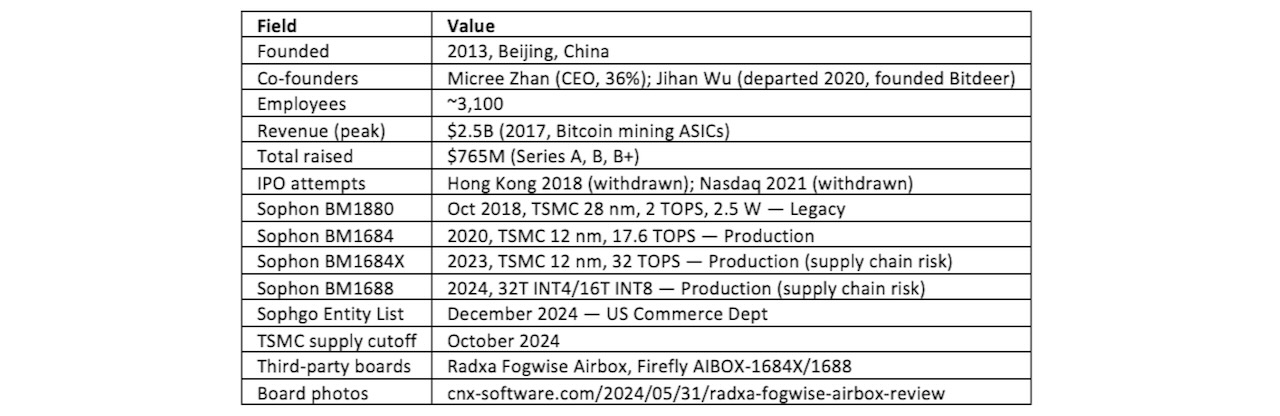
Table 1. Bitmain Sophon overview.
The Sophon chip line is one of those situations where the silicon is ahead of the company situation. The BM1684X at 32 TOPS INT8 with a full open-source SDK, active third-party board support, and real industrial deployment is a credible edge AI processor. Everything surrounding it—the Sophgo Entity List designation, the TSMC supply cutoff, the Zhan-Wu co-founder war, the failed IPOs, the Huawei probe—complicates a straightforward procurement decision into a geopolitical risk assessment. For US-based companies and companies doing business in US-regulated markets, the Entity List designation is not a footnote. It’s a showstopper. For others, the chips are available and the SDK works. Know which category you’re in before you specify.
What do we think?
The technology is real, and the chips work. Radxa and Firefly wouldn’t be building commercial products on the BM1684X if the silicon and SDK weren’t solid. The Sophgo Entity List designation is a separate issue from the chip quality, but procurement teams can’t separate them in practice. For US-connected supply chains, avoid new design commitments on Sophon silicon until the supply chain situation resolves—or doesn’t. That answer isn’t coming soon.
Bitmain’s Sophon program marks an inflection point in how Bitcoin ASIC expertise transferred into AI silicon. The computational architecture of a Bitcoin mining ASIC—massive parallel integer arithmetic, custom memory hierarchies, high throughput at constrained power—maps directly onto edge AI inference requirements. Bitmain recognized that inflection point before most Western semiconductor companies did. They built real AI chips and found real customers. The geopolitical entanglement with Huawei and the resulting Entity List designation is the outcome of that same aggressive engineering culture colliding with US export control law. The silicon is the story. The sanctions are the consequence.
Know your regulatory exposure before specifying this silicon. The Sophon chips are in a category of their own: technically qualified, commercially available in China, and legally problematic for US-connected supply chains.
So far JPR has identified 152 AI processors in our AI Processor Tracking Service, which also lists performance and other specifications for 291 products.
LIKE WHAT YOU’RE READING? INTRODUCE US TO YOUR FRIENDS AND COLLEAGUES.