
Nvidia’s GeForce Now introduces RTX 5080 GPUs with the Blackwell architecture, marking its biggest leap in cloud gaming. Players gain 5K/120 fps streaming, DLSS 4 Multi Frame Generation, Reflex support, and under-30 ms latency. Install-to-Play doubles the library to 4,500-plus titles, while cinematic streaming improves visuals with HDR and advanced encoding. Hardware upgrades include 60-plus TFLOPS GPUs, 48GB memory, and Zen 5 CPUs. Expanded device support covers Steam Deck, LG TVs, and macOS. Pricing starts at $9.99 per month, with Ultimate at $19.99 per month.
If you own a AAA photorealistic FPS game but can’t afford the powerhouse GPU needed to make it sing, sign up for Nvidia’s GeForce Now and avail yourself of an RTX 5080 for just a few dollars a month.
(Source: Nvidia)
With bandwidth speeds improved all over the world, and especially in the industrialized world, and things like Starlink for areas where high-speed interconnect can’t reach, the ability to run AAA games from the cloud has become a reality.
This is a big leap forward for GeForce Now cloud gaming in performance, capabilities, image quality, latency, and game availability.
Nvidia is currently installing the RTX 5080s at a rate of roughly three data centers per week, starting this month. The company expects to complete this initial phase by November with a total of around 20,000 GPUs.
These GPUs can be virtualized for less demanding games using the Blackwell Multi-Instance GPU (MIG) feature, which, for the first time, allows for spatial separation of partitions. Nvidia told us they are excited to try this new feature, as they’ve previously used time slicing.
Initially, the company doesn’t expect to utilize much GPU sharing on the RTX 5080s, as it anticipates the demand for the Ultimate 5080 (1:1) tier will consume its available capacity. However, later in the life of the GPUs and as they deploy more, the company said it will definitely be using a 2:1 mode for its Performance tier and a 4:1 mode for its Basic tier.
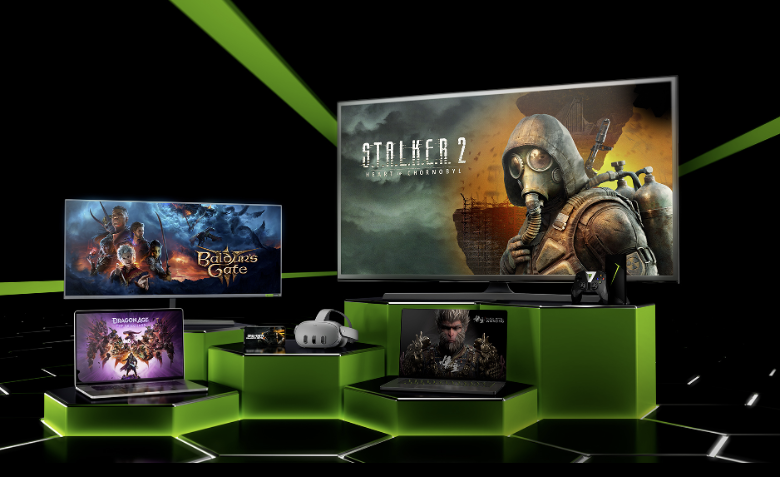
At Gamescom, Nvidia introduced the Blackwell architecture to GeForce Now, marking the most significant step forward for the service since its launch. With this update, members can access GeForce RTX 5080-class GPUs in the cloud, unlocking higher performance levels along with AI-driven features designed to refine gameplay. DLSS 4 Multi Frame Generation now allows streaming at up to 5K resolution and 120 frames per second, a milestone once limited to high-end gaming PCs. The system also supports frame rates up to 360 fps at 1080p, paired with Nvidia Reflex technology for rapid response times. By drawing on a worldwide network of Nvidia SuperPods, most regions achieve network latency under 30 ms, giving players a responsive and fluid experience.
The update expands the GeForce Now library in a way that reshapes how members interact with their PC game collections. Install-to-Play introduces direct cloud storage integration, doubling the available catalog to more than 4,500 titles. This expansion not only adds upcoming blockbusters like Borderlands 4, Call of Duty: Black Ops 7, and The Outer Worlds 2, but also brings thousands of existing Steam titles into reach without local downloads. Members can store these games in the cloud, ensuring that each session begins immediately, rather than requiring repeated installation. The new storage system also offers persistent add-ons, letting players keep their libraries ready at different capacity tiers.
Cinematic Quality Streaming arrives alongside the Blackwell upgrade, bringing sharper visuals, higher color accuracy, and improved adaptation to network conditions. By incorporating support for advanced encoding, high dynamic range, and refined sharpness controls, this mode elevates the clarity of text, foliage, and fine details in fast-paced action scenes. Automatic detection of display resolution allows laptops and monitors to present the highest stream quality possible, while bit rates up to 100 Mbps ensure strong performance on modern Internet connections.
Hardware advancements support these visual gains. RTX 5080-class GPUs deliver over 60 TFLOPS of compute performance and a 48GB frame buffer. These specifications, combined with AMD Zen 5 CPUs and Nvidia ConnectX-7 SmartNICs, enable demanding games to run smoothly in the cloud. Frame rates show significant gains over earlier servers, while integration with partner networks such as Comcast and Deutsche Telekom enhances performance across broadband and 5G environments.
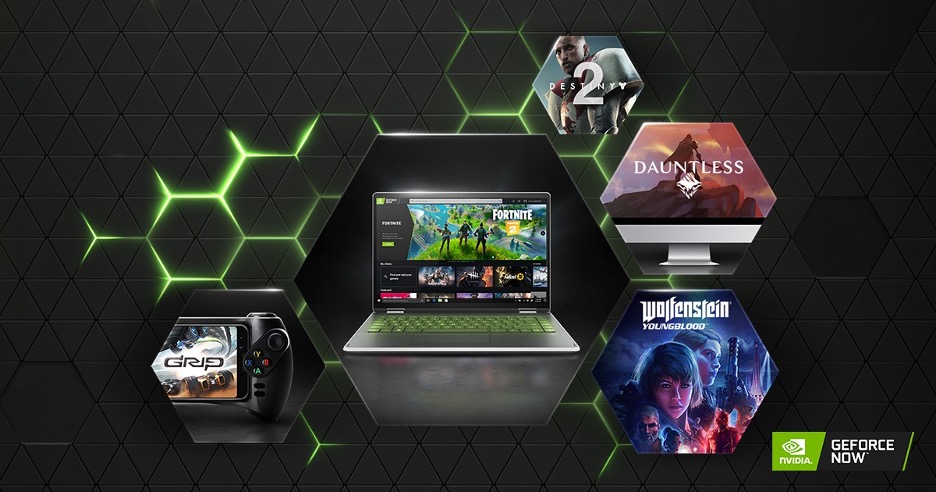
The benefits extend to more devices than ever. Steam Deck users can now enjoy gameplay at 90 fps, while LG OLED displays can stream at 5K resolution on Windows and macOS machines without extra hardware. LG televisions also support 4K at 120 Hz directly through a native application. GeForce Now on macOS incorporates the same Blackwell-powered features, bringing advanced graphics performance to Apple systems. Support for gaming peripherals, including popular racing wheels, further broadens the reach of the platform.
Finally, Nvidia has joined with Discord and Epic to reshape how players discover and share games. Through a trial integration, Discord users can stream titles like Fortnite instantly without installation, bridging social interaction with accessible cloud gameplay. This partnership allows players to move seamlessly from conversation to play, while giving developers new opportunities to reach audiences within active gaming communities.
Together, these developments create a broader, faster, and more connected experience for GeForce Now members, setting the stage for cloud gaming to feel closer to traditional PC performance, while reaching across more screens and networks.
(Source: Nvidia)
GeForce Now Ultimate remains available for $19.99 per month or $99.99 for six months, and includes access to RTX 5080 servers. Performance memberships remain available at $9.99 per month or $49.99 for six months. Daily, monthly, and annual membership will be available starting at launch. Annual memberships will be available for $199.99 and $99.99, respectively.
LIKE IT? THINK YOUR FRIENDS AND ASSOCIATES MIGHT? PLEASE SEND IT TO THEM WITH OUR BEST WISHES.