
Jensen Huang personally delivered a DGX Spark supercomputer to Elon Musk at SpaceX. Powered by Nvidia’s GB10 Grace-Blackwell superchip, it combines an Arm CPU, Blackwell GPU, and 128 GB unified LPDDR5x memory. Priced at $3,999, it runs massive AI models beyond the capability of consumer GPUs, despite slower memory than GDDR7-equipped RTX cards.
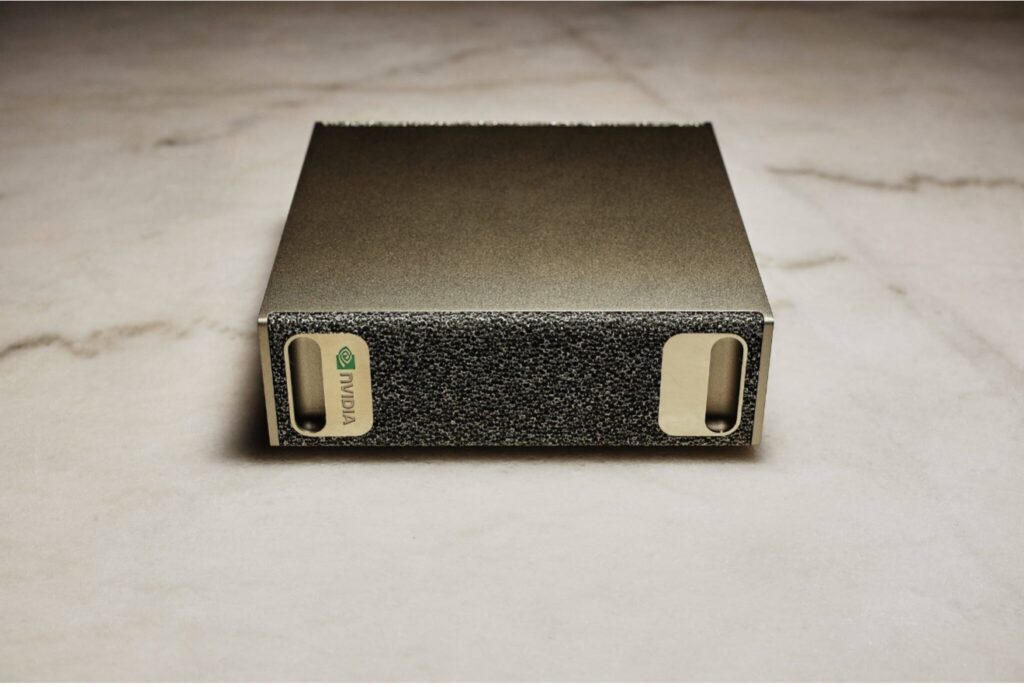
A few days ago, Jensen Huang took some time off from dealing with politicians and personally delivered a brand-spanking-new little DGX Spark supercomputer to Elon Musk at SpaceX. It’s a single GB10 Grace-Blackwell superchip-based system consisting of an ARM CPU plus a Blackwell-generation GPU equipped with an astounding 128 GB unified memory.
The DGX Spark is a full-stack Nvidia platform with a petaflop of performance, integrating the Nvidia GB10 Grace Blackwell Superchip, Nvidia ConnectX-7 high-speed networking, and the Nvidia AI Software stack.
If Elon wants another one, he can get a Founder’s Edition system for $3,999. Some partner listings have shown higher preorder prices (e.g., ~$4,299 from PNY), but Nvidia and multiple outlets list it at $3,999.
The DGX Spark does not lead Nvidia’s GPU lineup. It cannot outperform the RTX 5090 in large language model inference, fine-tuning, image generation, or gaming. Instead, the DGX Spark and other GB10-based systems can execute models that the RTX5090 and other consumer GPUs cannot load.
In local AI development, insufficient VRAM, not compute power, limits performance. The Spark includes 128 GB of LPDDR5x memory—slower than GDDR7 but adequate to run inference on 200-billion-parameter models or fine-tune 70-billion-parameter models at 4-bit precision.