
Microsoft is expanding Advanced Shader Delivery across Windows 11, giving more PC gamers a way around lengthy first-run shader compilation. ASD delivers precompiled shaders with a game instead of asking every PC to compile them locally. Microsoft says Gears of War: E-Day cuts first-launch shader compilation by about 95%, from several minutes to seconds. AMD and Qualcomm hardware support ASD now, while Intel and Nvidia support arrives later in October, substantially widening the available PC hardware base.

Shader compilation has become an irritating side effect of increasingly complex PC graphics. Modern games contain large numbers of shaders that tell GPUs how to process materials, lighting, shadows, reflections, textures, and other rendering operations. The game must prepare those programs for the player’s hardware before the GPU can execute them.
Developers have several ways to handle that work. A game can compile shaders during its first launch, cache them for subsequent sessions, or compile some shaders just in time as the player encounters new rendering workloads. First-launch compilation creates a wait before playing. Runtime compilation can create frame-time spikes and visible stutter.
Microsoft’s Advanced Shader Delivery (ASD) changes where much of that work occurs. Instead of treating every player’s PC as a shader compilation machine, Microsoft and GPU vendors can prepare hardware-specific shaders ahead of time and deliver them alongside the game. The player’s system receives the appropriate precompiled shaders rather than starting from source every time.
ASD does more than download a conventional shader cache. DirectX collects pipeline state objects (PSOs) and state objects, including ray-tracing state, into a standardized State Object Database (SODB). Microsoft defines the SODB as a SQLite3 database containing shaders plus the information needed to group them into PSOs and state objects. An IHV-supplied offline compiler combines that information with the target GPU requirements and creates a Precompiled Shader Database (PSDB). Windows registers the PSDB as another source for the driver’s shader cache.
The distinction matters. The SODB carries the game’s shader and pipeline information in a standardized form; the PSDB contains output compiled for a specific hardware and driver configuration. Microsoft, therefore, does not need one universal shader binary for AMD, Intel, Nvidia, and Qualcomm GPUs. Each IHV supplies the compiler that converts the common SODB input into hardware-specific output.
The change sounds modest. Architecturally, it moves another graphics task from local execution into a coordinated workflow across the cloud, storefront, driver, and hardware.
Driver churn creates another problem that ASD has to solve. Conventional shader caches can become invalid after a graphics-driver update. Windows can detect the change and refresh the shader cache, an important requirement for a cloud-delivery system operating across a PC ecosystem where drivers change frequently.
The longer-term plan moves SODB creation into the game engine and development pipeline. A sufficiently complete database can approach a 100% first-run shader-cache hit rate. Developers can submit SODBs with a game package, and the same process can accompany DLC and updates, so shader data evolves with the title.
ASD began with the ROG Xbox Ally handhelds in October 2025. Microsoft expanded the technology to Windows 11 PCs with AMD discrete GPUs and gaming-laptop integrated GPUs this year, eventually extending support across the RDNA architecture family. Microsoft says ASD has now moved beyond its Xbox Insider preview into general availability through the Xbox PC app.
AMD’s developer software shows the IHV side of the arrangement. AMD added Advanced Shader Delivery support to its AgilitySDK Developer Preview and lets developers target AMD’s compiler plug-in DLL directly. AMD’s developer preview identifies Radeon RX 7000- and RX 9000-series products for this tooling, while Microsoft’s production ASD support now spans RDNA 1, RDNA 2, RDNA 3, RDNA 3.5, and RDNA 4. DirectX supplies the common infrastructure; AMD supplies the architecture-specific compiler.
Forza Horizon 6 provided an early measurement. Microsoft reports that a system with an AMD Radeon RX 7600 and Ryzen 7 5800 reduced loading from almost 90 seconds to four seconds, a 95% reduction. ASD also bypassed just-in-time shader compilation during gameplay, addressing shader-related stutter as well as the initial wait. Those numbers represent Microsoft’s test rather than an independent cross-platform benchmark.
Gears of War: E-Day moves the technology into its next stage. Microsoft says shader compilation at first launch falls from several minutes on a typical PC to a few seconds with ASD, again reporting approximately a 95% reduction. When the system has successfully installed the shader package, the launch window displays “Precompiled shaders installed.”
GPU coverage matters
ASD becomes more interesting when it stops depending on one GPU architecture.
Microsoft currently lists AMD RDNA 1 through RDNA 4 hardware and Qualcomm Snapdragon X2-series systems among supported devices. Later in October, Microsoft plans support for Intel Arc B570 and B580 GPUs, Core Ultra Series 2 and Series 3 graphics, all Nvidia RTX GPUs, and RTX Spark. Gears of War: E-Day serves as the first title designed to demonstrate ASD across that expanded Windows ecosystem.
Intel plugs into the common DirectX workflow with its own offline compilation path. Developers package collections of PSOs into an SODB, and Intel’s offline compiler converts the SODB into a PSDB. Intel says PSDBs accelerate loading and reduce shader-compilation stutter. Intel also operates a Precompiled Shaders Distribution Service for select Steam titles, so it was already pursuing cloud-delivered shader compilation before Microsoft’s broader Windows rollout. ASD gives that idea a common DirectX framework that can extend across game stores and GPU vendors.
Nvidia is working with Microsoft to extend ASD across GeForce RTX systems. Its role follows the same division of labor: compile shaders for Nvidia hardware before the game reaches the player’s machine, then let Windows and the driver consume the prepared cache at runtime. Nvidia also lists ASD among its DirectX developer capabilities. Microsoft’s plan to support all RTX GPUs gives the service access to a broad installed base once the supporting driver reaches users.

Table 1. Advanced Shader Delivery support expands across major Windows GPU architectures.
That vendor coverage matters to developers and ISVs. A graphics optimization that serves only one GPU family adds another platform-specific path to an already complicated PC development matrix. Support spanning AMD, Intel, Nvidia, and Qualcomm gives studios a reason to consider ASD as part of their Windows deployment process rather than another vendor-specific optimization.
Qualcomm’s implementation also illustrates how the pieces connect. Qualcomm provides a DirectX 12 compiler plug-in that converts State Object Database files into Precompiled Shader Database files for Snapdragon X2 hardware. Microsoft similarly tells developers to collect SODBs and upload them to game storefronts, while IHV compiler plug-ins create the hardware-specific compiled output.
That arrangement keeps the GPU vendor involved. A shader compiled for one architecture does not simply become a universal binary for every GPU. ASD provides an infrastructure for distributing the appropriate precompiled shader data for the target hardware.
ASD also changes the relationship between the game engine and driver. D3D12 already gave applications explicit control over pipeline state and allowed compiled results to persist. Adoption remained inconsistent, so graphics drivers continued maintaining implicit shader caches. Microsoft notes that this could leave two copies of compiled shaders on disk. ASD builds on the driver’s existing cache mechanism: A registered PSDB gives the driver another source for an already compiled shader rather than creating a separate runtime path.
Microsoft has also addressed games with very large PSO populations. Partial graphics programs split pipeline creation into reusable pre-rasterization and pixel-shader programs that DirectX can link with another state later. The approach can reduce duplicate compilation work and make precompilation more practical for engines that cannot efficiently enumerate every complete PSO across every hardware configuration.
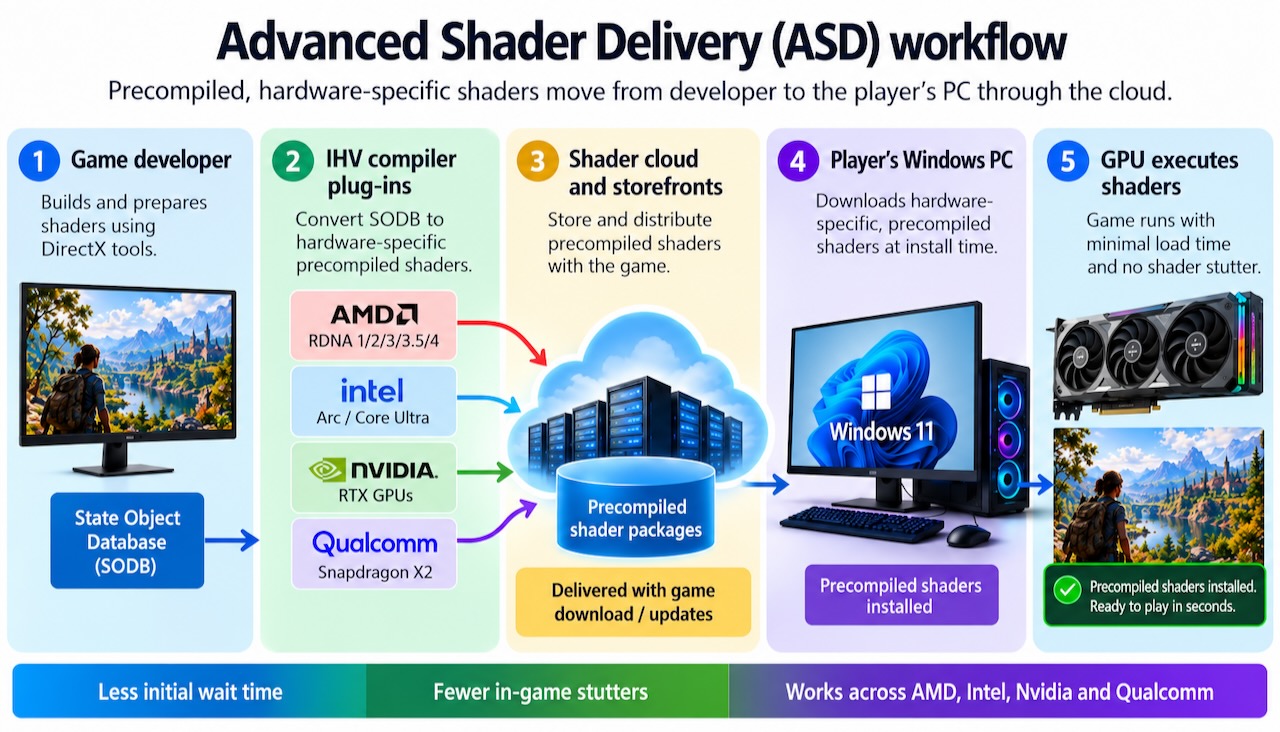
Figure 1. ASD moves shader preparation upstream from the gaming PC.
This is infrastructure, not a driver trick.
ASD’s long-term model requires developer and engine participation, although Microsoft’s initial ROG Xbox Ally implementation required no game-studio integration. Microsoft now wants engines to collect SODBs programmatically so new games, DLC, and updates can ship with sufficiently complete shader information from day one. GPU vendors supply offline compiler support, storefront infrastructure distributes the resulting data, and Windows and the driver match the precompiled shader packages to the target system.
That means ASD cannot suddenly eliminate shader compilation problems from the Windows game library. Existing games do not automatically gain support, and developers can continue using their own caching and compilation strategies.
Microsoft has added tools to measure whether developers captured enough shaders. AgilitySDK 1.619 adds an application-identity API that lets a title identify itself consistently to D3D12 and the graphics driver, plus a statistics API that reports PSDB effectiveness for a particular hardware configuration. PIX can expose shader-cache hit-rate information as real-time counters. Developers can, therefore, measure SODB coverage instead of assuming that precompilation captured every shader path.
Microsoft already has a meaningful list of ASD-enabled titles, including Forza Horizon 6, Starfield, Microsoft Flight Simulator 2024, Final Fantasy XVI, Hogwarts Legacy, Grand Theft Auto V Enhanced, and others. Microsoft also says Call of Duty: Modern Warfare 4 will gain ASD support following Gears of War: E-Day.
The underlying capability is not inherently an Xbox PC app feature. Microsoft says the functionality resides in Windows 11 and DirectX, and its AgilitySDK provides game studios and storefronts with the tools and APIs needed to use the system. That opens a path for other Windows game stores to compile SODBs into PSDBs and distribute hardware-specific shader packages. If other storefronts adopt the infrastructure, ASD can become a Windows platform service rather than an Xbox-store optimization.
The approach also has implications beyond gaming convenience. Shader compilation consumes CPU time, creates duplicated work across millions of PCs, complicates first-run performance, and makes benchmarking less predictable. Precompilation shifts more of that work toward controlled infrastructure where developers and IHVs can prepare known shader configurations before users need them.
For silicon teams, that could create another place to optimize the relationship among compiler, driver, GPU architecture, and software distribution. For ISVs, it creates a deployment mechanism that can reduce one source of inconsistent user experience. CIOs evaluating Windows graphics workstations may eventually see similar principles applied beyond games as cloud-assisted software distribution becomes more hardware-aware.
The broader question involves scale. PC hardware remains heterogeneous. GPUs, drivers, game versions, graphics settings, patches, and rendering paths change continuously. Microsoft needs ASD to keep the correct shader packages synchronized with those combinations without creating a new maintenance problem for developers.
The early results justify watching that work. Cutting a roughly 90-second Forza Horizon 6 load to four seconds and reducing Gears of War: E-Day shader compilation by about 95% represents measurable user-facing improvements under Microsoft’s reported test conditions.
ASD also shows Microsoft treating the Windows gaming stack as a coordinated system. The GPU still executes the shaders locally. Microsoft has moved part of the preparation process from the player’s CPU to infrastructure that can do the work before the game arrives.
ASD represents more than another Windows caching feature. Microsoft has created a standardized handoff among the game engine, DirectX, the storefront, the IHV compiler, Windows, the graphics driver, and the GPU. The game supplies shader and pipeline-state information. Microsoft supplies the common database formats and distribution framework. AMD, Intel, Nvidia, and Qualcomm supply hardware-specific compilation. The storefront distributes the resulting PSDB, Windows registers it, and the GPU driver consumes it through its existing cache mechanism. The GPU still renders everything locally. Much of the repetitive compilation work that prepared rendering code on each user’s PC moves upstream.
Advanced Shader Delivery will not eliminate every source of PC game stutter, and it needs developer and hardware-vendor support to work. Its expansion across AMD, Intel, Nvidia, and Qualcomm gives the technology a much larger addressable base. If Microsoft can make ASD routine rather than exceptional, waiting several minutes for a newly installed game to compile shaders could become an increasingly uncommon part of Windows gaming.
What do we think?
ASD attacks a visible PC gaming problem without requiring faster GPUs or CPUs. Microsoft instead changes where the work occurs. The 95% reductions reported for Forza Horizon 6 and Gears of War: E-Day make the approach worth attention. Broad GPU support now matters more than peak results because developer adoption will determine whether ASD becomes normal Windows infrastructure.
Inflection point. Advanced Shader Delivery may mark a small inflection point in how Windows divides work between local hardware and cloud infrastructure. Microsoft is not moving rendering into the cloud; the GPU still executes shaders locally. It is moving repetitive hardware-specific preparation upstream. If developers adopt ASD broadly, PC graphics optimization will increasingly span cloud services, storefronts, compiler infrastructure, drivers, and silicon. That model could influence other workloads where distributing hardware-ready code proves more efficient than preparing it independently on every endpoint.
We wish MS would put similar effort into DirectStorage to leverage fast SSDs to accelerate game loading times and asset streaming, which we believe is far more important than ASD.
LIKE WHAT YOU’RE READING? INTRODUCE US TO YOUR FRIENDS AND COLLEAGUES.