
Nvidia and Perplexity have announced Portable Computer, based on Qwen midsize (27B and 35B)–parameter AI models designed to run locally on Nvidia hardware, including the DGX Spark, RTX Pro for workstation GPUs, and even GeForce RTX GPUs, either one with at least 24 GB of memory. Users need a Perplexity Pro (or Max) subscription to be able to download and run Portable Computer on a local workstation.
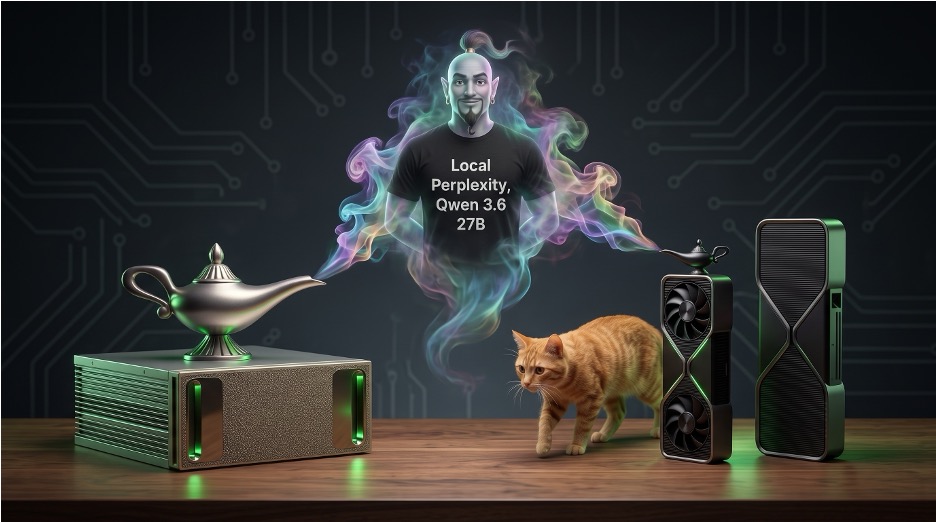
Nvidia and Perplexity bring Qwen midsize models to your local AI workstation. (Source: JPR)
Nvidia and Perplexity are partnering in the launch of Portable Computer, a Perplexity feature to run models on local AI workstations. At release, Qwen 3.8 27B or Qwen 3.6 35B are supported (for the rest of the article, we will refer to them as Qwen midsize models, for better readability). The Perplexity team worked to also have a post-trained version available at launch, which is called Qwen 3.8 PPLX 27B. Nvidia Nemotron 3.5 Lightning is coming soon. Perplexity creates post-trained versions of both Qwen models specifically for its Portable Computer in order to increase accuracy compared to the stock models. JPR analyst Hernán Quijano attended a briefing Nvidia held with Perplexity ahead of the announcement, while the companies revealed the model on August 25. The model used for the demo was Qwen 3.8 27B DFlash2 (GB10), as shown on Figure 1 later in this article.
The headline number behind the model is not its parameter count on its own, but why that number was chosen. Nvidia and Perplexity sized the models so they fit within 24 GB of GPU memory. That threshold matters because it is the minimum memory footprint found across a wide range of Nvidia hardware, from the DGX Spark, Nvidia’s compact AI supercomputer built on the Grace Blackwell architecture and GB10 superchip, and Nvidia’s RTX Pro workstation cards and even one consumer RTX GPU, the GeForce RTX 5090 (32 GB), the only consumer card from the Nvidia product line that meets the 24 GB memory requirement.
Supported hardware (JPR’s analysis based on described requirements)
The midsize model design choice means the same model can run on a data-center-adjacent personal supercomputer or a gaming-class RTX card, as long as the GPU clears the 24 GB bar. It is a deliberate bet by Perplexity to reach the widest possible pool of local hardware with a single release, rather than tuning separate models for separate tiers of hardware. Having said that, the 35B option running on 24 GB implies high quantization and limited working cache. Our JPR observation is that users with the minimum 24 GB GPUs should start with the 27B models and, if necessary, scale up to the right balance for an optimal experience.

Table 1: Nvidia RTX Pro and GeForce RTX in desktops with 24 GB or more GPU memory. (Source: Nvidia)
Beyond the great performance and memory bandwidth of the discrete GPUs in Table 1, this announcement is centered around the Nvidia DGX Spark and, therefore, its PC OEM variants, as listed on Table 2 below.
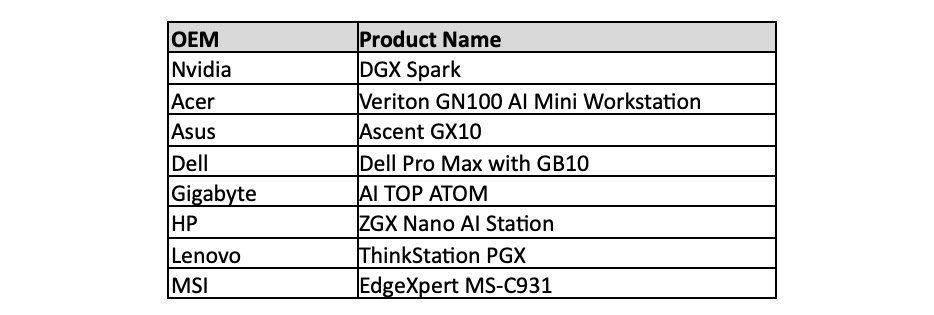
Table 2: Nvidia DGX Spark and PC OEM variants. (Source: Nvidia)
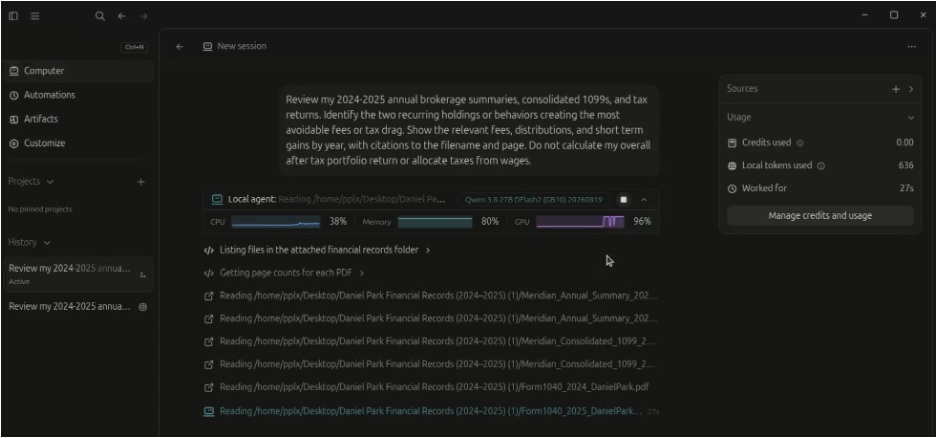
Figure 1: Qwen 3.8 27B DFlash2 (GB10) showcased running locally on DGX Spark during the Nvidia and Perplexity briefing August 24, 2026). (Source: From briefing)
Centered on simplicity
Nvidia and Perplexity also put considerable effort into the installation experience itself. Starting August 25, users can download and install the Qwen midsize models (27B and 35B) into DGX Spark. The new installation process is designed to be simple and transparent, aimed at industry experts in many fields who are not necessarily programmers or AI specialists. Lowering that technical barrier is a meaningful decision on its own and one we address further below.
A hybrid future, today
Because Qwen midsize models cannot match the capability of much larger frontier models running in the cloud, Nvidia and Perplexity built a hybrid system around it. Users get full control over how much they run locally versus when they reach out to the cloud. A Perplexity Pro subscription is required regardless of whether a user runs the model locally or taps the cloud fallback to full-size frontier models. As of this writing, Perplexity Pro costs $20 a month, while its higher-end Max tier costs $200 a month with expanded limits; Perplexity also offers Enterprise Pro and Enterprise Max tiers for organizations.
A closer look at a balanced user experience and hardware trade-offs
Beyond the confirmed facts from the briefing, it is worth examining what this means in practice across Nvidia’s hardware lineup, and the analysis in Table 1 and Table 2 above is JPR’s interpretation, not Nvidia’s official list. We only included cards based on the Blackwell architecture, although it’s possible that Portable Computer could work on previous architectures too, at different performance levels, of course.
The DGX Spark’s spare memory capacity, well beyond what Qwen midsize models (27B and 35B) need, positions it as more than a single-model machine. With roughly five times the memory the model requires, it’s prudent to give the model plenty of room for a big context window. In the demo we witnessed, as evident in Figure 1, the DGX Spark was using 80% of its 128 GB memory, so fitting the model is only half the equation; what you ask the model to do also requires resources, and users often underestimate this. The DGX Spark looks well-suited to loading multiple models at once and running them together in an agentic workflow, where multiple models interact to complete more complex tasks. A single discrete GPU at the 24 GB floor, by contrast, is better suited to running Qwen midsize models (27B and 35B) on its own. Higher-memory discrete GPUs sit in between, offering both room for additional models and higher raw performance, depending on how much memory is available above that baseline.
One detail from the briefing stood out as a deliberate performance decision rather than a limitation: Perplexity emphasized that Qwen midsize models (27B and 35B) reflect a balance between capability and responsiveness, not just a memory ceiling. Loading a larger model, even one that technically fits in the DGX Spark’s 128 GB of memory, does not guarantee a faster or more responsive experience in terms of tokens per second. Available memory headroom does not automatically mean the biggest model is the right model.
Potential for future scaling
Perplexity is not currently working on scaling this setup across a cluster of multiple DGX Spark units, though it did not rule out that possibility in the future.
For now, Portable Computer is supported on DGX OS, Linux, with Windows support coming in September, which will open the door for RTX Spark laptops.
Multi-GPU workstation configurations from Nvidia’s OEM partners could support larger models or multiple simultaneous models today, but Perplexity is not pursuing that path yet. Instead, the company appears focused on learning from real-world use of Qwen midsize models (27B and 35B)’s 24 GB configuration before deciding how to expand. Any future push toward multi-model workflows on discrete GPU workstations is likely to be driven by the complexity of what users actually want to do locally, rather than a roadmap decision Perplexity is making in advance.
It is also worth noting what this announcement is not. Perplexity’s Portable Computer does not require anything close to the power of Nvidia DGX Station, Nvidia’s higher-end AI workstation. That said, larger models from Perplexity down the road could make fuller use of both the DGX Spark and multi-GPU RTX or DGX Station configurations at different throughput and cost levels.
Perplexity’s Portable Computer and the models are available now. For more information, go here and here. Also, Perplexity has published more a demo, technical information, and benchmarks supporting that claim on the following marketing and research sites here and here.
What do we think?
At JPR, we are big believers in local AI, not only for the lower total cost of ownership and the privacy it provides, but also for the control and consistent performance it offers. The model, your files, and prompts stay on your machine. The user controls what information leaves it, when the cloud gets involved, and when cloud usage costs begin. We also believe that hybrid AI—running everyday needs locally and privately with predictable costs while reaching out to frontier models in the cloud only for high-complexity tasks—is the direction the industry is heading, and this announcement is a meaningful step in that direction.
We are pleased to see this kind of enablement, even recognizing that the number of people with a 24 GB or larger Nvidia GPU or a DGX Spark is not yet massive. This is the right way to start, but we would like to see Nvidia and Perplexity keep pushing the ceiling higher over time, toward larger, more capable models that can run locally, initially on the DGX Spark even at lower throughput, and eventually on higher-end hardware such as multi-GPU RTX workstations and the DGX Station.
We also want to specifically credit Nvidia and Perplexity for prioritizing installation simplicity. Reducing the friction of downloading, installing, and maintaining a local AI model matters as much as the model itself. It opens this technology to a far larger group of power users across industries who are experts in their own fields but not in AI or software, and it makes hardware like the DGX Spark far more attractive to a much bigger addressable market.
We also applaud Nvidia for working with partners like Perplexity, since this kind of enablement is key to supporting the PC OEM partners in creating demand for their own variations of the DGX Spark. This creates a perfect cycle where the winner is the end user.
JPR Labs has been experimenting with the DGX Spark and plans to explore this model now that it is available. Stay tuned for our follow-up coverage of the installation, download, and hands-on experience running it.
– The Workstation Cavalry
AND IF YOU LIKED WHAT YOU READ HERE, DON’T BE STINGY, SHARE IT WITH YOUR FRIENDS.
Disclaimer: This article is not financial advice. The content is for informational purposes only. The author may own shares in companies mentioned, and readers should not consider this article a recommendation to buy, sell, or hold any assets.