
Nvidia came to Siggraph ready to show its latest technologies and how they can benefit computer graphics creators as they move into the next phase of CG: using AI to advance their workflows. Nvidia’s presence at the conference was widespread, both on and off the show floor, announcing the ability of NemoClaw to run deskside on the DGX Station, opening up a pathway to having super agents run locally. More and more, creative apps are becoming agent-ready, resulting in a hybrid model. Nvidia is enabling users to implement this workflow locally on the same RTX Pro workstations they currently use or on DGX Spark or DGX Station systems. The company also said it had made Omniverse fully disaggregated and open source with Omniverse libraries becoming agent tools, making it easy to integrate the tech into existing applications for building sim-ready worlds inside existing 3D applications. Also, the company announced the Synthetic Video Detector NIM microservice, bringing an AI-assisted detection signal into editorial and media workflows, and presented papers on new tech including MotionBricks and ArtiFixer.

During a pre-brief for Siggraph 2026, Rev Lebaredian, VP of physical AI simulation at Nvidia, stated what should be well-known to the industry: that computer graphics is very important to Nvidia, and always has been. History backs up that statement, as the company has been attending Siggraph for going on three decades, bolstering itself as a computer graphics company. And while today the company carries the title of a leading AI company, Lebaredian emphasizes that even during this age of AI, the conference is more important than ever—to Nvidia and CG.
To this end, Nvidia had a busy week at the annual computer graphics conference last week in Los Angeles, hosting three days of sessions, workshops, labs, and tutorials. On Monday, a group from Nvidia Research and Engineering discussed developments in neural rendering, world models, and simulation at a sponsored keynote. The company also hosted a “Build-a-Claw,” a hands-on event where participants could customize and deploy AI agents using OpenClaw and NemoClaw technologies, and a hands-on developer hackathon, where developers and creators could collaborate and discuss groundbreaking AI and graphics projects. Of course, the show gave Nvidia the chance to announce and showcase some new technology, and above all, to demonstrate it is poised to provide users vital pathways to reaping the benefits presented by the latest AI trends relating to computer graphics.
NemoClaw on DGX Station
Let’s start with Nvidia’s announcement that its NemoClaw is now running on the deskside DGX Station AI supercomputer, extending the hardware needed to run it efficiently beyond GeForce RTX PCs and laptops and RTX Pro workstations, and specialized DGX Spark systems; it also runs on compatible cloud servers. NemoClaw is an open blueprint for building custom autonomous agents, packaging the model, harness, and runtime together, serving as a starting point for specialized, domain-specific agents locally.
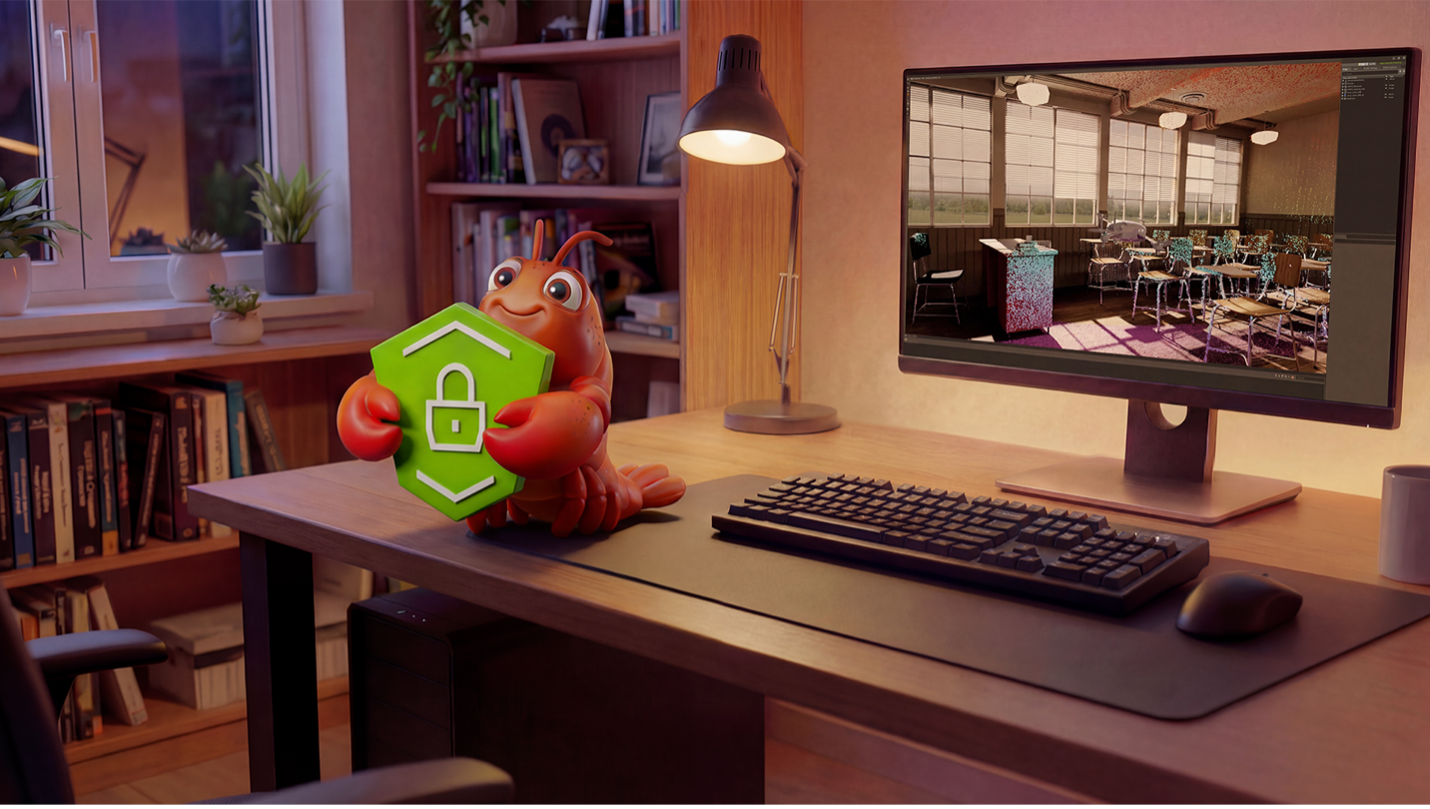
Super agents arrive on the desktop with NemoClaw on DGX Station. (Source: Nvidia)
Super agents arrive on the desktop with NemoClaw on DGX Station. (Source: Nvidia)

The company says that with its Agent Toolkit, setup involves just a trio of steps to get the system up and running, which takes about a half hour, bringing together NemoClaw, Nemotron 3 Ultra open model, and Omniverse libraries as agent-accessible tools in a single local system. As workloads scale, multiple systems can be connected together to handle even larger models and more agents.
A big advantage that NemoClaw on the DGX Station offers comes from it running locally, so data does not have to leave the user’s locale, which is an important consideration when dealing with sensitive information. Also, once the system is purchased, the user no longer has to worry about paying for tokens, although a user is capped by the total amount of compute available, unlike when NemoClaw runs in the cloud.
Perhaps one of its more important features is that the system is completely open, giving users total control: The NemoClaw blueprint uses an open agent harness that connects the models, tools, memory, and workflows. The NemoClaw agent also uses all the Omniverse libraries, giving it direct access to physics simulation, sensor simulation, and 3D asset creation, generating 3D worlds that are editable and can be proven physically-accurate.
Relatedly, Nvidia launched a blueprint for integrating Omniverse libraries in Blender, giving NemoClaw agents callable RTX sensor simulation and physics tools when crafting 3D scenes for physical AI workflows.
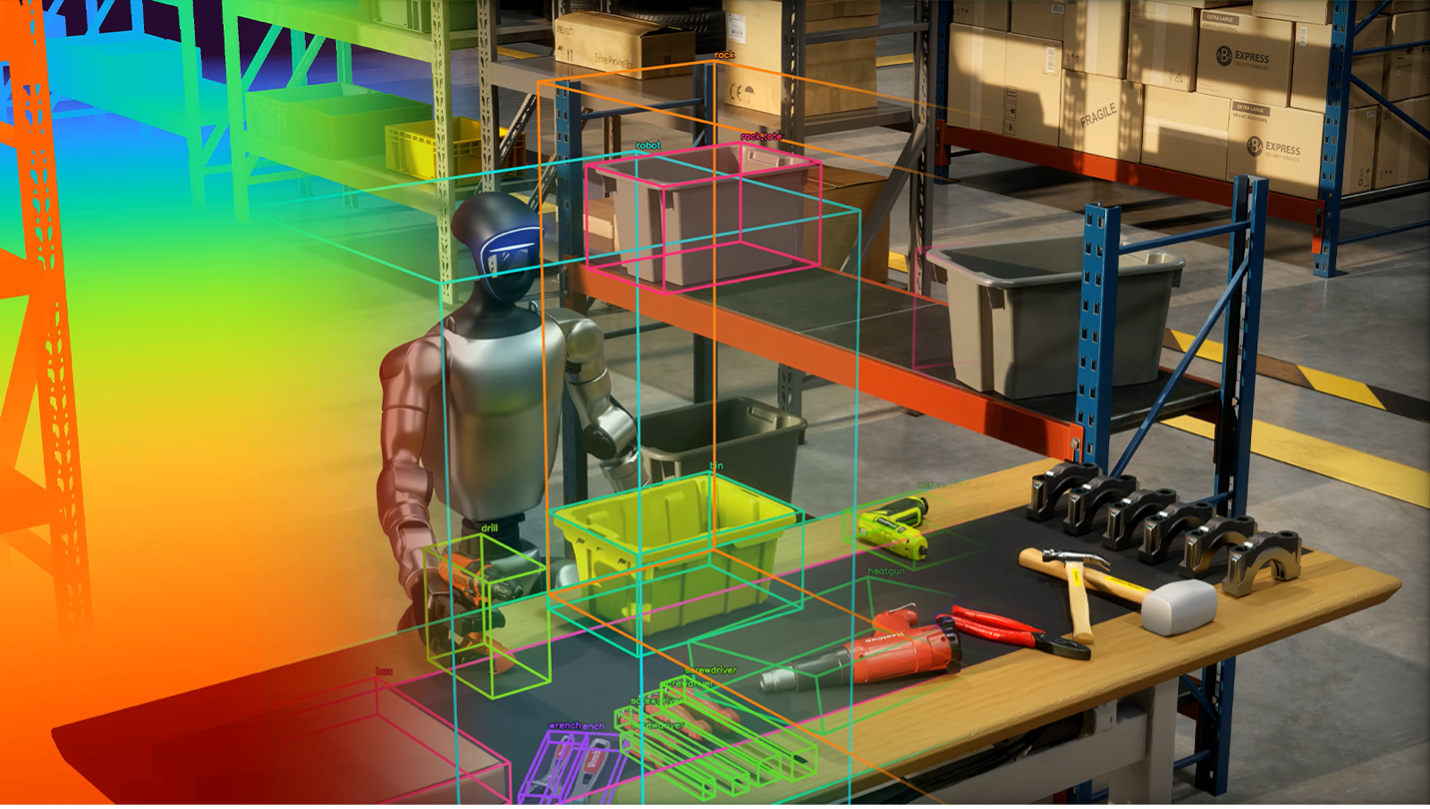
Omniverse libraries in Blender: a blueprint for sim-ready scenes. (Source: Nvidia)
The DGX Stations are now available through Asus, Dell, Exxact, Gigabyte, HP, MSI, and Supermicro.
Accelerating AI agents and creative tools
Speaking of AI agents… In recent years, the content-creation industry has been witnessing the rise of neural graphics, with AI generating images and video. With just a few prompts, a person can now create images in seconds that before would have required large teams spending many hours to create. While this method enables the creation of an infinite number of images at will, there is a problem: The technique is not controllable. This becomes problematic for a creator with a specific vision.
Enter agents, a new era of AI that allows creators to have their cake and eat it too, and Nvidia is providing local systems to power this hybrid workflow.
Popular DCC toolsets are being brought into the AI era through Model Context Protocol (MCP), an open standard for connecting AI applications to external systems. With an MCP connection, AI works seamlessly inside traditional DCC apps that artists already use, as opposed to separate AI tools. Since a custom AI plug-in for each tool is no longer necessary, data can easily move among the apps in the pipeline. And, by having the creation apps MCP-connected, human operators can take advantage of the tools’ fullest capabilities—knowledge that typically would have taken a decade or longer to accumulate.
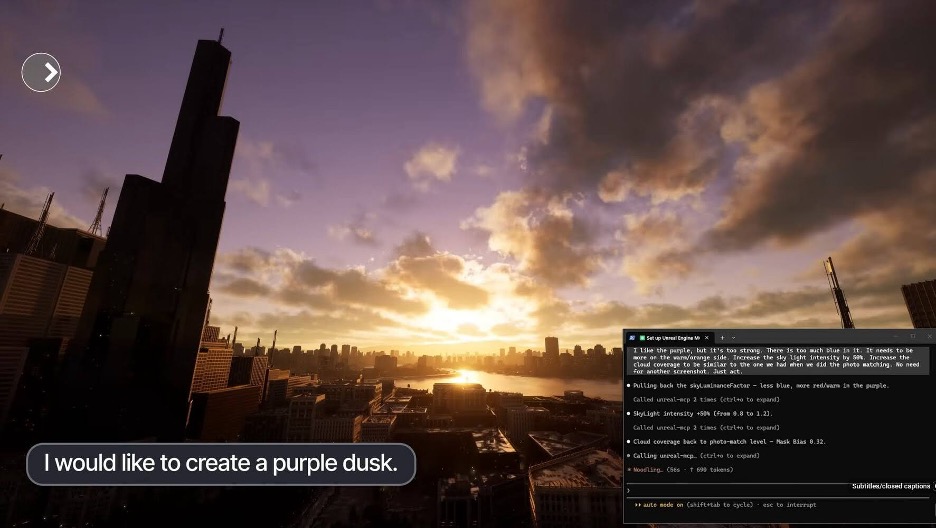
Among the companies readying their toolsets with MCP-ready workflows and connections across the creative ecosystem is Epic Games, shown here with its connection in Unreal Engine. (Source: Epic Games)
There are myriad advantages to having MCP-connected tools. For instance, an agent can inspect a scene for missing textures, flag inconsistent color management, prepare export variants, generate playblasts for dailies, and more, with the final creative decisions resting with the human artists or TD.
Just as this workflow involves pro creator tools running locally, Nvidia is providing pro creator systems to power these agents, model inference, and multi-application workflows locally as well. Users can run this workflow on the same RTX Pro workstations they currently use or on DGX Spark or DGX Station systems. Nvidia points out that running models and agents locally helps improve responsiveness, reduce reliance on external services, and keep sensitive creative data in controlled environments.
Nvidia also offers its Agent Toolkit, which further supports MCP integration, including an MCP client for connecting to remote MCP servers and an MCP server for publishing tools to any MCP client.
Widening Omniverse availability
Nvidia has called its Omniverse “the most consequential platform that’s at the intersection of computer graphics, physics simulation, and AI.” The company started working on Omniverse about a decade ago with the goal of building a platform that allows the simulation of the physical world accurately enough so it could build AIs that would operate in the real world. Omniverse development began in 2018 and continued, despite the constraints posed at the time by then-available technologies. Next came another obstacle to widespread deployment: the need for specialized Nvidia workstations.
In 2022, the company began working to disaggregate the Omniverse platform into microservices and transitioning its availability through the cloud, making it easier to integrate into existing applications through partners. At this year’s Siggraph, the company announced that it had made Omniverse fully disaggregated and open source as Omniverse libraries became agent tools, making it easy and nearly automatic to integrate the tech into existing applications.
Omniverse libraries are a collection of software components that give physical AI capabilities to existing applications and prep 3D content for simulation, enabling developers to move much faster from 3D content to simulation-ready environments, notes Nvidia. These Omniverse libraries give developers and AI agents rendering, physics, sensor simulation, and validation tools to build sim-ready worlds inside existing 3D applications.
At Siggraph, Nvidia showed some examples of integrations with the new Omniverse libraries: PTC integrating CAD-to-sim-ready asset-generation libraries so a user can build sim-ready USD objects and assets that will work in Nvidia robot simulators. Other examples were illustrated on the M&E side with SideFX Houdini for procedural world generation and Blender for sim-ready scenes (see related story on Houdini here).
The new Omniverse libraries, such as ovrtx, ovphysx, and CAD-to-SimReady skills, are openly available on GitHub and give AI agents tools to build workflows for inspecting scenes, testing changes, and preparing 3D assets for simulation. A new blueprint for integrating Omniverse libraries in Blender is also available, as noted earlier.
AI video detection
Is the video real or synthetic? Advancements in AI video generation have made it more and more difficult for us to make that determination. This can be especially problematic for videos presented as news. As a solution, Nvidia offers the Synthetic Video Detector NIM microservice, which brings an AI-assisted detection signal into editorial and media workflows for identifying videos generated by diffusion models.
The NIM, which Nvidia says is easy to deploy, analyzes video frame by frame, and even works for compressed videos. Assisted by AI, the NIM produces a classifier score of whether the video contains synthetic content.
Nvidia says the NIM microservice has proven to be 92% accurate in its assessment on uncompressed video, and 87% accuracy at 15% compression and 82% accuracy at 50% compression. The company notes it can process 1080p video in as little as 22 ms on RTX systems and about 30 ms on Nvidia L40 GPUs.
Nvidia notes that the offering is not positioned to replace established verification practices, but instead provides an extra means of identification.
Wowza, an early access developer, is embedding the microservice through the Wowza Video Intelligence Framework, bringing the capability to livestreaming across 35,000-plus deployments in over 170 countries.
Papers and research
At Siggraph, Nvidia presented 20-plus papers on groundbreaking research focused on the use of AI to help build real-time systems for generating physically and aesthetically accurate virtual worlds. The various research is grounded in 3D with physics capabilities but keeps the human creator in the driver’s seat.
Particularly notable is a paper on MotionBricks, a real-time motion model that generates lifelike character motion that’s seamless and smooth, at game engine speeds. Trained on more than 350,000 motion clips, MotionBricks lets creators direct and connect character movements, driving an animated character inside a virtual world or in a virtual experience.
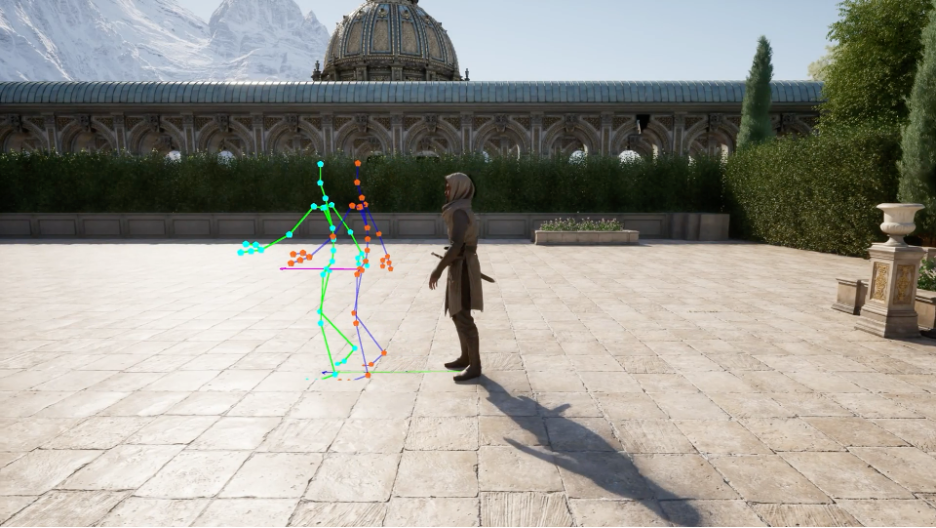
MotionBricks (Source: Nvidia)
It can also drive a Unitree G1 humanoid robot using CG and simulation to accelerate physical AI development.
More on MotionBricks can be found here.
The subject of another intriguing research paper is ArtiFixer, a model that can take a rough, incomplete noisy 3D scan of the real world and turn it into a clean and complete 3D scene, filling in areas that have gaps. It is an example of how the process used in the creation of fantasy worlds can be applied to simulating the actual physical world, and vice versa.
Nvidia describes ArtiFixer as an AI cleaner of sorts, and as such, is a complement to Gaussian splats, fixing noise and missing input data when making a splat. ArtiFixer also includes a new method for predicting photoreal global illumination directly from a scene’s geometry, without tracing a single ray, says Nvidia.
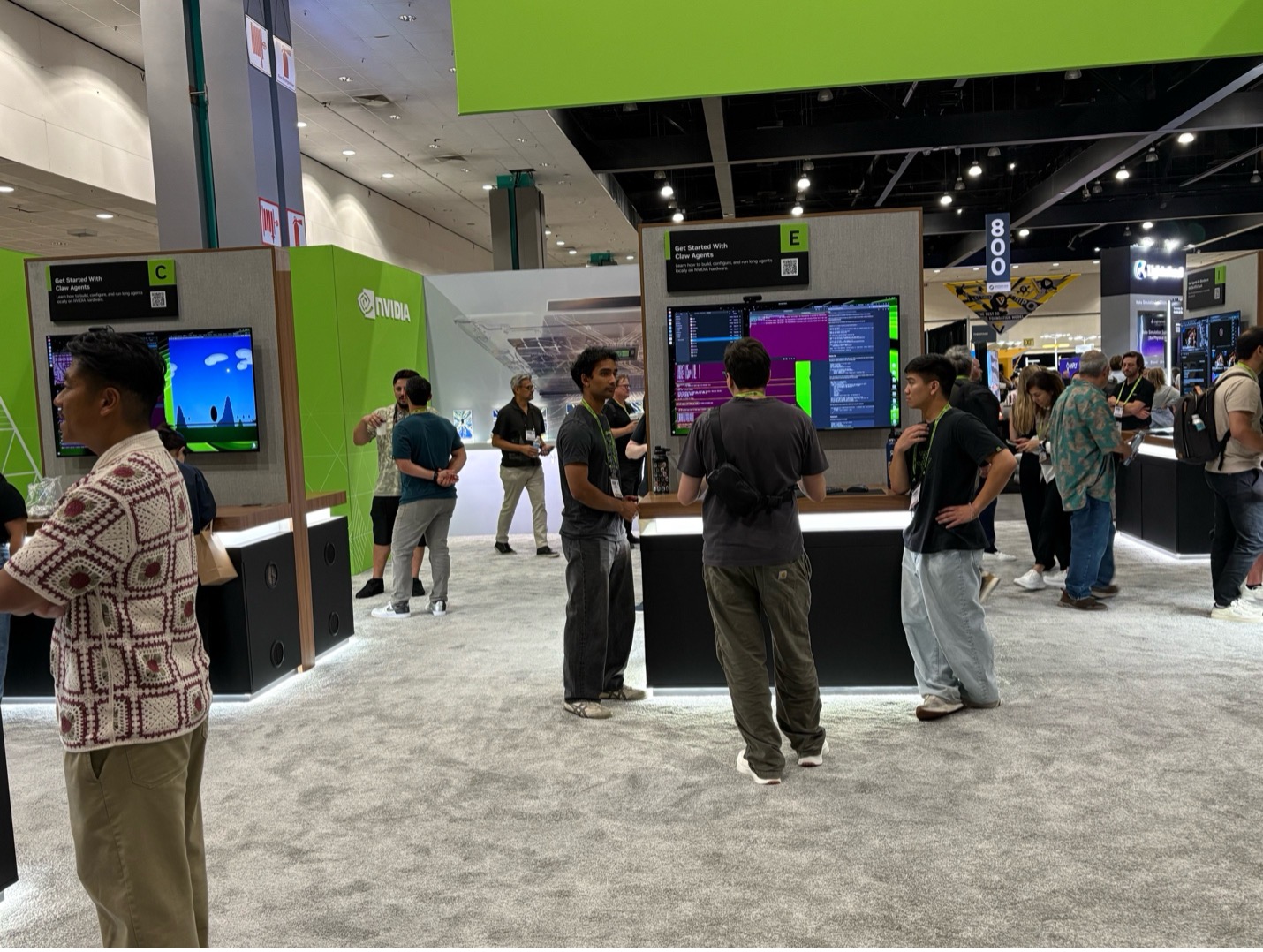
Nvidia shows off its various tech at Siggraph 2026. (Source: JPR)
Nvidia shows off its various tech at Siggraph 2026. (Source: JPR)