
Perplexity has expanded Portable Computer, the local version of its Computer agent platform, to Windows PCs powered by AMD Ryzen AI Max Series processors, including the Ryzen AI Halo developer platform. The package bundles a 27B model, agent orchestrator, scheduler, sandbox, and a sensitive-content classifier. Local inference does not consume Computer credits, and cloud escalation requires user permission. It is available now to Pro and Max subscribers on systems with at least 24 GB of GPU-accessible memory.
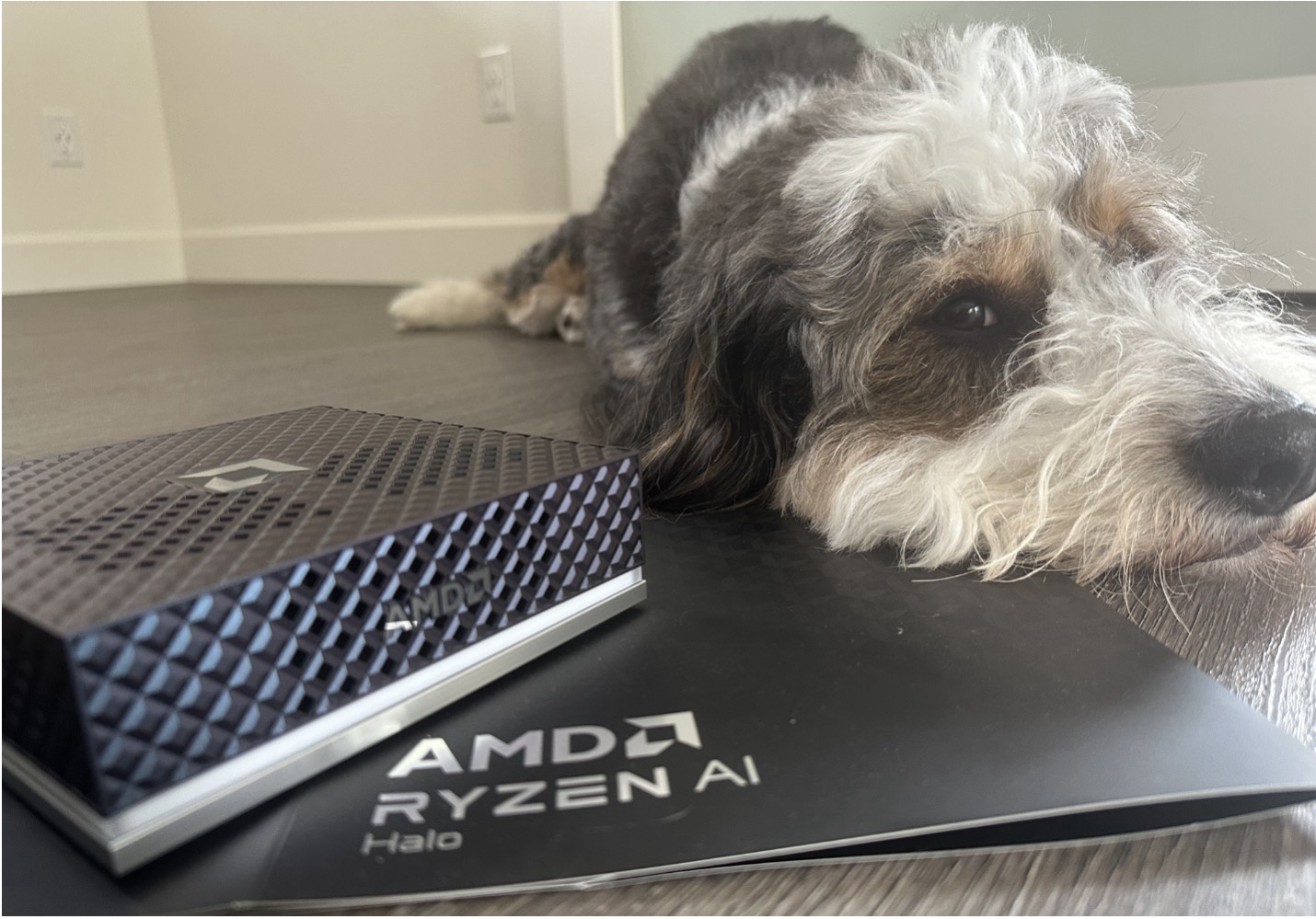
AMD Ryzen AI Halo developer platform. (Source: JPR)
On September 24, 2026, Perplexity announced that Portable Computer, the on-device version of its Computer agent platform, now runs on Windows systems powered by AMD Ryzen AI Max-series processors, including AMD’s Ryzen AI Halo developer platform. AMD published its own announcement the same day. The pitch is straightforward: run the model, the agent, and the tools on your own hardware, keep sensitive files on the device, and stop spending cloud credits on routine inference.
For AMD, the announcement is another chapter in the agentic PC story it has been building. According to the company, it introduced the first AI PCs in 2023, with the first dedicated NPU in an x86 processor, and followed in 2025 with agentic PCs capable of running AI agents locally. AMD said the Perplexity collaboration extends those capabilities into the applications and workflows people use every day.
“We’re entering a new era of computing, where personal AI transforms the PC from a tool into an intelligent partner. We’re creating a new kind of agentic PC that can understand, reason and act alongside us,” said Jack Huynh, senior vice president and general manager of the Computing and Graphics Group at AMD. “Together with Perplexity, we’re redefining what the PC can be in the Personal AI era: personal, powerful, open, and intelligent by design.”
Why the memory matters
Running a capable language model locally is, above all, a memory problem. AMD said Ryzen AI Max processors combine CPU and GPU performance with a large pool of shared memory, which lets local models run alongside everyday applications. Perplexity’s requirement reflects that: a qualifying system needs at least 24 GB of GPU-accessible memory.
That wording matters. On a conventional PC, the memory available to the GPU is fixed by the graphics card. On a Ryzen AI Max system, the GPU draws from the shared pool, so the amount available for a model depends on how the system is configured. That is the architectural property AMD is leaning on here, and it is why a thin laptop or a small desktop can host a 27B-parameter model at all.
In AMD’s framing, the division of labor is clear. The hardware provides the compute and memory, and Perplexity provides the model, agent tools, and controls that put the hardware to work.
One stack instead of a weekend project
Perplexity’s main argument is convenience. Building a local agent today typically means setting up an inference server, connecting an agent framework, and configuring each tool by hand. Portable Computer packages the local model, agent harness, and orchestrator, scheduler, sandbox, and sensitive-content classifier as one system, according to Perplexity.
Two models are available at launch: Qwen 3.8 27B and PPLX 27B, which Perplexity describes as its own post-trained model. Setup happens inside the Perplexity app for Windows. Users download a model in one click from the Local Inference section of the app’s settings, and the inference engine and classifier install alongside it. They then connect their apps and choose which folders Portable Computer is allowed to work in.
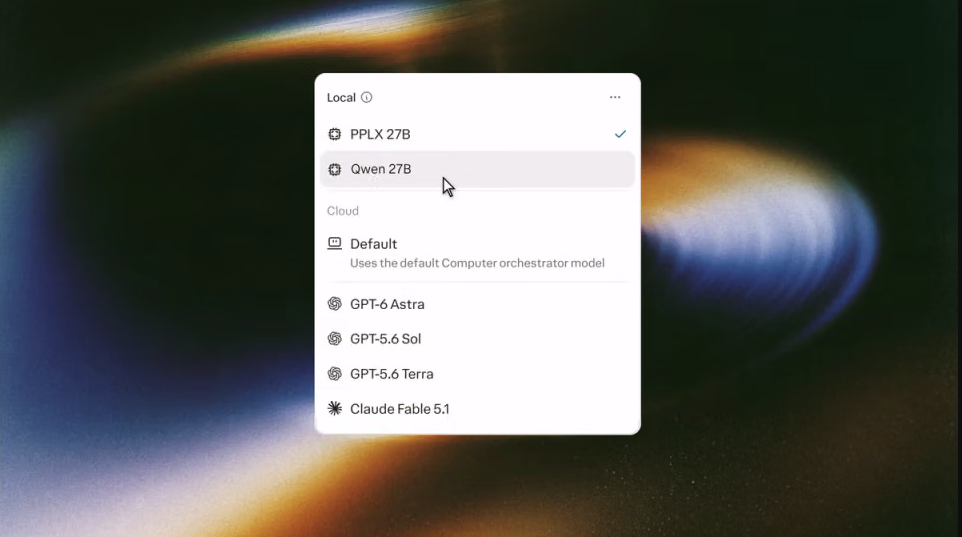
Figure 1. Portable Computer model selector showing local and cloud models. (Source: Perplexity)
Perplexity lists the following requirements:

Portable Computer starts tasks on the local model, but it is not an island. Users can reach cited web results through Perplexity Search and more than 15 frontier models for heavier reasoning. Perplexity’s example is a financial analyst working on a local earnings model who pulls in current market data from the web and uses a frontier model to test how changing interest rates might affect a forecast.
The key control is consent. If a task needs to send information from the device to the cloud, Portable Computer asks for permission before proceeding, according to the company.
Built for recurring work
Beyond one-off requests, Portable Computer can schedule recurring jobs. Its local orchestrator connects to Gmail, Outlook, Slack, and GitHub, and local Model Context Protocol (MCP) servers let it work with supported applications installed on the same PC.
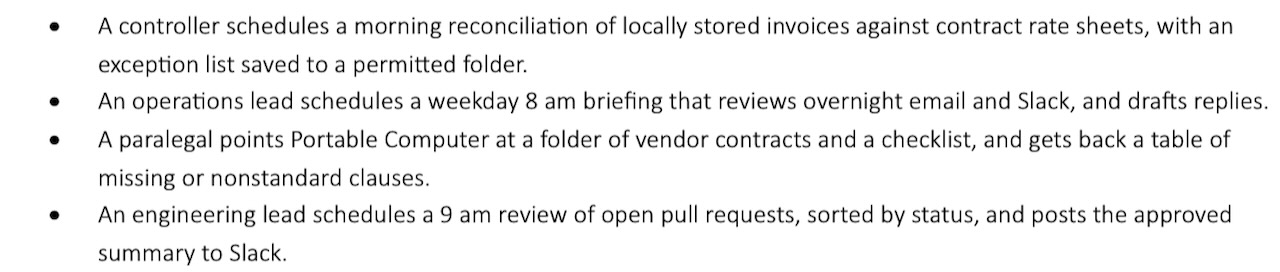
Perplexity offered four scenarios:
Because recurring jobs run on the local model, each run does not add to Computer credit spend. There is a practical caveat, though: Perplexity said scheduled tasks run only while the app is open and the PC is awake. An agent meant to work unattended still needs a machine that stays on and awake.
An agent that writes and executes code needs boundaries, and Perplexity described several. Code and tools run inside an isolated on-device sandbox, with read and write access limited to folders the user permits. Connected apps are reachable only through connectors the user has configured.
The on-device classifier scans content for sensitive details, such as names, account numbers, and credentials, before anything leaves the PC. If it flags something, the user can share it anyway, keep that step on the local model, or stop the task. For organizations, administrators on managed accounts decide whether local inference is allowed, so IT can enable it for the teams that need it.
Perplexity’s target list of sensitive material is telling: deal documents, patient records, unreleased code, and payroll exports. Those are exactly the files that compliance teams do not want in a public cloud, and they are the core of the company’s case for local agents.
Portable Computer on AMD Ryzen AI Max-series processors and the Ryzen AI Halo developer platform are available now to Perplexity Pro and Max subscribers on individual and enterprise plans through the Perplexity app for Windows. Neither announcement from AMD or Perplexity included performance figures, such as token throughput or task completion times, for Ryzen AI Max systems.
What do we think?
At JPR, we are big believers in local AI, not only for the lower total cost of ownership and the privacy it provides, but also for the control and consistent performance it offers. With Portable Computer, the model, your files, and your prompts stay on your machine, and you decide what leaves it, when the cloud gets involved, and when cloud usage costs begin.
Hybrid AI, with local processing for routine and sensitive work and the cloud for heavier reasoning and current information, is where the industry is heading, and this announcement is another meaningful step in that direction. It also matters for a simpler reason: One month after Portable Computer launched on Nvidia hardware, it now runs on AMD as well. Local agents should not be tied to a single silicon vendor, and more hardware choice is good news for users.
AMD brings a different architectural argument to the table. The 24 GB requirement is the same minimum on every platform, but on a Ryzen AI Max system, the GPU draws from a shared memory pool, so the amount available for models scales with the system’s configuration. The HP ZBook Ultra G3a 16, for example, offers up to 192 GB of unified memory with up to 160 GB allocable to graphics, on a mobile workstation. HP dedicated a section of its launch to Perplexity: The ZBook Ultra G3a comes with Perplexity Computer preloaded, and Portable Computer’s MCP connector to Autodesk Revit lets customers use on-device AI alongside their project data. HP expects the system to be available in October 2026. That is far more headroom than a 27B model needs, which means the hardware already offers room for multi-agent workflows and sizable context windows.
The audience with qualifying hardware is still limited, and the current models top out at 27B parameters. We encourage AMD and Perplexity to keep pushing toward larger, more capable models that can run locally, since AMD’s unified memory platforms are well-positioned to host them.
We also commend both companies for prioritizing installation simplicity. A one-click model download, with the inference engine and classifier installed alongside it, opens this technology to a far larger group of power users across industries who are experts in their own fields but not in AI or software.
AMD’s strategy of partnering with software developers like Perplexity and PC OEMs like HP creates a perfect cycle where the winner is the end user.
JPR Labs has an AMD Ryzen AI Halo mini PC, and we plan to test Portable Computer on this platform as well. Stay tuned for follow-up coverage of the installation, download, and hands-on experience running it.
—The Workstation Cavalry
AND IF YOU LIKED WHAT YOU READ HERE, DON’T BE STINGY, SHARE IT WITH YOUR FRIENDS.
Disclaimer: This article is not financial advice. The content is for informational purposes only. The author may own shares in companies mentioned, and readers should not consider this article a recommendation to buy, sell, or hold any assets.