
China’s customs authority has banned the Nvidia GeForce RTX 5090 D v2—a GPU designed exclusively for the Chinese market with reduced memory and compute—from entering the country. The move caught Nvidia off guard and left Chinese board manufacturers without answers. For CIOs and IT decision-makers tracking GPU supply chains and AI hardware access in China, this signals a new and unpredictable layer of trade friction originating from Beijing, not Washington.
A self-imposed blockade
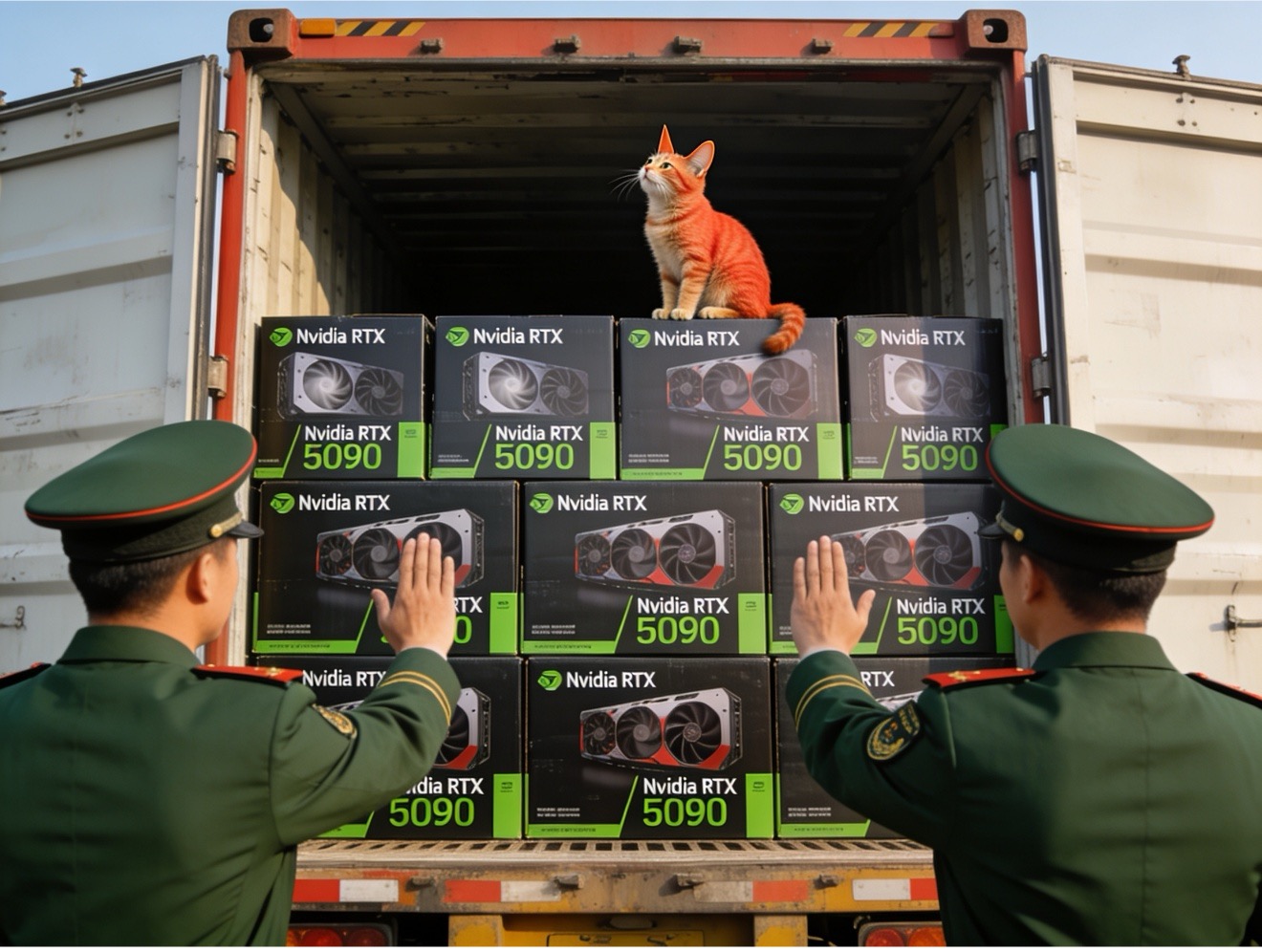
Chinese customs authorities notified logistics companies and graphics card manufacturers in May 2026 that the Nvidia GeForce RTX 5090 D v2 will not receive import approval. The ban applies exclusively to this SKU. Nvidia did not receive advance notice. The RTX 5090 D v2 is a China-specific product—Nvidia designed it to comply with US export controls by reducing its video memory from 32 GB to 24 GB and narrowing the memory bus. Those hardware constraints make the card unsuitable for serious AI training or inference workloads. Because Nvidia built it solely for the Chinese market, it has no legal sales channel anywhere else.
Chinese board manufacturers confirmed to HKEPC that they received customs notices but currently have no explanation for the decision. The ban came shortly after US-China trade talks concluded and after President Trump met with Nvidia CEO Jensen Huang—meetings that industry observers expected to ease GPU-related tensions. The US recently authorized shipments of the H200 AI accelerator to China, making Beijing’s move in the opposite direction more difficult to interpret through a straightforward trade-friction lens.
Nvidia built the RTX 5090 D v2 specifically to satisfy Chinese market rules—then China banned it anyway.
What the ban actually blocks
The RTX 5090 D v2’s hardware profile tells the story directly. Nvidia locked its AI compute throughput in firmware and reduced VRAM to 24 GB—specifically to prevent the card from functioning as an AI accelerator at scale. Chinese board manufacturers note that banning a GPU with locked compute does nothing to strengthen domestic AI chip development; the card posed no competitive threat to Chinese AI silicon vendors.
Industry analysts speculate that Beijing viewed the product as a deliberate downgrade—a second-tier SKU sold to Chinese consumers at flagship pricing. That interpretation frames the ban as a consumer protection or national-dignity signal rather than a strategic technology decision. With the card now blocked, Chinese gaming consumers at the high end will redirect purchases toward the RTX 5080, which remains available. The RTX 5090 D v2’s China exclusivity means no gray-market redirect to other regions is possible through legal channels, though JD.com previously reported illegal sales of full-spec RTX 5090 cards at ¥91,999 (US $578)—a figure that signals active black-market demand for unrestricted Nvidia hardware.
The domestic chip context
Chinese GPU and AI chip vendors—including Moore Threads, Biren Technology, and Cambricon—continue to develop domestic alternatives, but their current products trail Nvidia’s latest generation on raw compute, memory bandwidth, and software ecosystem maturity. The ban on the RTX 5090 D v2 does not accelerate domestic chip adoption; it removes a product that was already intentionally limited. Chinese consumers who need discrete GPU compute for gaming or creative workloads now have a narrower set of options at the top of the market, and Chinese AI developers working on large-scale training workloads were never the RTX 5090 D v2’s intended customer anyway.
HKEPC, which first reported the ban, confirmed it is continuing to verify details across multiple sources. The situation remains fluid, and Nvidia has not issued a public statement on the import rejection as of publication.
What do we think?
The RTX 5090 D v2 ban is strategically incoherent on its face—China blocked a GPU that Nvidia already neutralized as an AI-compute platform. For CIOs managing procurement in China or sourcing from Chinese supply chains, the more significant signal is procedural: Beijing now acts unilaterally on GPU import approvals with no advance notice and no stated rationale. That unpredictability is a supply chain risk regardless of which specific SKU is affected next.
This ban may mark an inflection point in how GPU hardware policy operates globally. For years, the dominant framework placed the US as the actor restricting outbound chip exports to China. Beijing’s move inverts that dynamic—China now restricts inbound hardware on its own terms, for reasons that are opaque even to the manufacturer. If that pattern holds, the inflection point is the moment GPU supply chains stopped being shaped by one government’s export rules and started being shaped by two governments’ independent and potentially contradictory import and export controls simultaneously.
LIKE WHAT YOU’RE READING? TELL YOUR FRIENDS; WE DO THIS EVERY DAY, ALL DAY.