
SK Hynix turned a long HBM investment cycle into a central position in AI infrastructure. The company built deep ties with Nvidia, aligned with TSMC, and moved memory out of commodity pricing patterns. Its HBM share, operating margin, and product roadmap now reflect a custom-silicon role tied to AI accelerators, robotics, client AI systems, and autonomous fabs. For silicon teams, SK Hynix now shapes platform design as much as it supplies memory capacity.
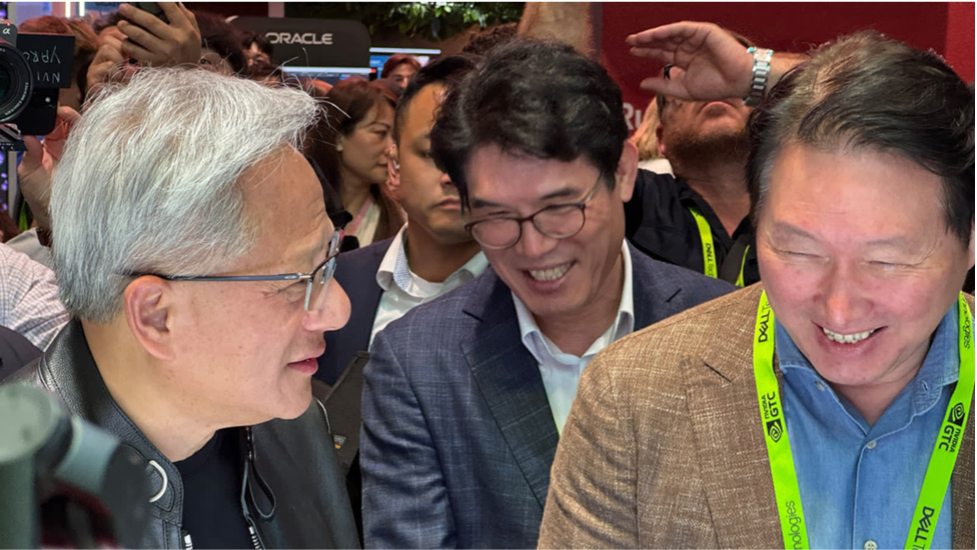
Nvidia’s Jensen Huang (left) and SK Group Chairman Chey Tae-won (right). (Source: SK Hynix)
SK Hynix has changed its role in the semiconductor market by treating HBM as a custom platform product. The company spent years investing in stacked DRAM technology, then matched that work to Nvidia’s AI accelerator roadmap as generative AI changed data center requirements. That decision moved SK Hynix away from conventional DRAM cycles and into a tighter engineering relationship with the company driving much of the AI factory build-out.
The financial results show the scale of that shift. SK Hynix moved from a 9 trillion won (~US $6.7 billion) net loss in 2023 to a reported Q1 2025 net profit of 40.35 trillion won, or ~US $26.7 billion, with a 72% operating margin. HBM drove much of that performance. Counterpoint Research placed SK Hynix at 57% global HBM share in Q4 2024, ahead of Samsung Electronics at 22%.
That outcome began before the current AI cycle. SK Group acquired Hynix Semiconductor in 2012 and inherited a memory team with early expertise in stacked DRAM. SK Hynix completed the first HBM device in 2013, years before large AI models created sustained demand for high-bandwidth memory. SK Group Chairman Chey Tae-won backed a long investment horizon and pushed the company through a difficult acquisition and turnaround.
Nvidia gave that work a defining market. Its AI GPUs need high-capacity, high-bandwidth memory to feed model training, large inference clusters, and AI factory workloads. Each new GPU generation raised bandwidth and capacity requirements. SK Hynix moved deeper into Nvidia’s development cycle, and Nvidia gained a memory partner that could support aggressive platform schedules.
The relationship now extends beyond component supply. Nvidia and SK Hynix announced a multiyear technology partnership that reaches across Vera Rubin AI supercomputers, Vera CPUs, RTX Spark-powered PCs, and Jetson Thor robotic computing platforms. SK Hynix will co-develop next-generation memory for these platforms, making HBM and related memory technologies part of Nvidia’s broader system roadmap.
TSMC adds a third side to the structure. SK Hynix formalized a technical alliance with TSMC in 2024, with SK Hynix’s substrate technology contributing to future HBM manufacturing. Taller HBM stacks create yield, packaging, and substrate challenges. TSMC supplies advanced logic manufacturing and packaging expertise, Nvidia supplies accelerator demand and platform direction, and SK Hynix supplies the memory technology that connects capacity with compute.
This triangular structure gives AI infrastructure planners a new supply-chain model. HBM no longer behaves like a spot-market commodity for leading AI platforms. It moves through long-cycle co-engineering agreements, early architecture alignment, and capacity commitments. SK Hynix CFO Kim Woo-hyun has said customers and suppliers now emphasize long-term supply and demand visibility, which lowers the chance of a repeat oversupply cycle. Chey has projected semiconductor tightness through 2030 and committed 103 trillion won (nearly US $77 billion) in chip investment from 2024 through 2028.
The Nvidia partnership also moves into semiconductor design and manufacturing. SK Hynix plans to use Nvidia CUDA-X libraries and PhysicsNeMo to accelerate TCAD, computational lithography, and engineering simulations. These tools can help engineers shorten simulation loops and improve process development workflows across advanced memory and packaging.
Factory automation adds another layer. SK Hynix plans to build fab digital twins using Nvidia Omniverse, OpenUSD, Metropolis, and cuOpt. These systems create 3D models of cleanrooms, equipment flows, and production constraints. Engineers can test line changes virtually, optimize routing, and coordinate autonomous mobile robots through GPU-accelerated planning.
The roadmap also reaches client and physical AI. RTX Spark-powered PCs bring the memory relationship into personal AI systems. Jetson Thor connects SK Hynix to robotics platforms that need local inference, sensor processing, and real-time control. Vera CPUs and Vera Rubin systems extend the partnership across AI compute fabrics that combine CPU, GPU, memory, networking, and software.

Table 1. SK Hynix’s expanding partnership with Nvidia.
SK Hynix has also gained cultural momentum in South Korea. University students ranked the company ahead of Samsung as an employer of choice in a 2025 poll. That shift reflects the new status of memory engineering in the AI era and the appeal of working inside a high-value technology cycle.
SK Hynix now sits at the intersection of memory, AI platforms, and semiconductor manufacturing automation. Its Nvidia partnership turns HBM into a platform layer tied to system architecture, software tools, and fab operations. For silicon teams, that means memory choices now shape performance, roadmap access, and supply risk. For CIOs building AI factories, it means leading-edge accelerator plans increasingly depend on engineered memory partnerships.
What do we think?
SK Hynix shows how a memory company can gain platform leverage through specialization. The company invested early, aligned tightly with Nvidia, and built HBM into a custom infrastructure product. The margin profile reflects engineering position, not only market timing. Silicon teams should treat HBM access, supplier alignment, and memory roadmap visibility as core AI platform planning variables.
The Nvidia and SK Hynix agreement signals an inflection point in AI infrastructure. Memory no longer sits at the edge of platform planning; it defines system capability, supply access, and product timing. This inflection point also reaches manufacturing, where AI tools now help design chips, simulate physics, and automate fabs. As memory suppliers, logic foundries, and GPU vendors coordinate roadmaps, AI hardware shifts toward engineered ecosystems rather than interchangeable component markets.
South Korea now anchors the AI memory supply chain. Samsung and SK Hynix dominate HBM, the memory technology feeding Nvidia’s AI accelerators and large-scale AI infrastructure. The AI build-out has pushed advanced memory from cyclical component status into a strategic resource tied to data center expansion, generative AI services, and national technology policy. Investors have responded by driving both companies toward trillion-dollar valuations and giving HBM leaders a large share of Korea’s equity market weight. That strength also brings risk. Retail leverage has grown alongside the rally, raising the chance that a market correction could amplify volatility across Korean equities. Even so, the central force remains structural: AI systems need more bandwidth, more capacity, and closer memory integration. Korea’s memory suppliers now shape the economics and timing of global AI factory deployment.
Epilog
SK Hynix, Samsung, and Micron now define the HBM supply race. Each company has a different path into AI infrastructure, and those differences matter more as memory becomes a platform constraint for Nvidia, hyperscalers, and custom ASIC vendors.

Table 2. Comparison of HBM memory supplier strategies.
SK Hynix leads because it treated HBM as a strategic product early. The company aligned engineering roadmaps with Nvidia, optimized memory for AI accelerators, integrated with TSMC’s packaging ecosystem, and secured long-term supply commitments. That strategy placed SK Hynix inside the Nvidia, SK Hynix, and TSMC AI infrastructure triangle. Its position now extends beyond HBM supply into Vera Rubin systems, Vera CPUs, RTX Spark PCs, Jetson Thor robotics, digital twins, semiconductor design workflows, and autonomous fabs.
Samsung brings scale. The company controls DRAM, foundry, and packaging assets, giving it a broad manufacturing base for HBM4 and future stacks. Samsung faced HBM3E qualification delays, thermal issues, and slower Nvidia adoption, then shifted attention toward HBM4, advanced bonding, and turnkey production. Its challenge centers on customer momentum. Once qualification hurdles clear, Samsung can expand output quickly and use its vertical integration to support customers seeking memory, logic, and packaging from one supplier.
Micron has built a technology-led and geography-led position. It emphasizes power efficiency, bandwidth per pin, yield, advanced packaging, and US-based supply. Micron entered Nvidia systems later than SK Hynix, yet it gained credibility as a second source for hyperscalers and custom ASIC programs. Its US fab strategy also gives cloud customers a supply-chain option outside Korea, which matters as AI infrastructure planners reduce geographic and vendor concentration.
The strategic divide comes down to role. Samsung still behaves mainly as a manufacturing-scale memory supplier. Micron acts as a technology and secure-supply alternative. SK Hynix increasingly operates as an AI infrastructure partner. That distinction explains Nvidia’s deeper multiyear agreement with SK Hynix and the broader scope of the relationship.
HBM shortages will keep pressure on the AI supply chain. Nvidia controls the accelerator roadmap, TSMC controls much of the advanced logic and packaging path, and SK Hynix controls the largest HBM share. Samsung and Micron will gain ground, but memory now shapes AI deployment capacity directly. HBM has moved from commodity DRAM economics into strategic infrastructure planning.
YOU LIKE THIS KIND OF STUFF? WE HAVE LOTS MORE. TELL YOUR FRIENDS, WE LOVE MEETING NEW PEOPLE.