
Syntiant has filed for a Nasdaq IPO under the ticker SYTN, giving investors another edge AI story to examine. The Irvine company sells low-power processors, sensors, software, and models for devices that need local inference. Its filing shows real revenue after the Knowles consumer MEMS microphone acquisition, and it also shows losses, debt, founder control, and heavy dependence on the acquired sensor business. For ISVs, silicon teams, and CIOs, Syntiant raises the right edge AI questions now, at scale today.

Syntiant has filed for an IPO and wants public investors to buy into a version of AI that lives close to the sensor, not inside a cloud data center. The Irvine, California, company plans to list Class A common stock on the Nasdaq Global Market under the ticker SYTN, with Citigroup, BofA Securities, UBS Investment Bank, Needham, Stifel, Cantor, and KeyBanc among the underwriters.
The company calls its market physical AI. That phrase can sound inflated, and Syntiant gives it a practical definition: on-device sensing and neural inference that let devices perceive, process, and respond to real-world inputs. The company sells neural decision processors, sensors, optimized AI models, and software tools that run locally at the point of interaction, with the cloud used selectively for training, orchestration, and updates.
That distinction matters. Edge AI does not need another data center accelerator story. It needs devices that can hear, see, classify, respond, and stay within tight limits on power, latency, size, and cost. Earbuds, wearables, smart speakers, automobiles, cameras, industrial systems, security devices, healthcare devices, and retail endpoints do not have the power budget or thermal headroom of a server rack. Syntiant’s pitch starts there.
Syntiant began in 2017 and built its reputation around ultra-low-power AI processors for always-on inference. The company then made a larger move in December 2024 when it bought Knowles Corporation’s consumer MEMS microphone business for $114.4 million, adding manufacturing facilities in China and Malaysia, and about 1,200 employees. That deal changed the company’s scale and also changed the way investors should read the numbers.
The SEC Form S-1 shows why. Syntiant reported $64.5 million in revenue for the three months ended March 31, 2026, down from $66.6 million in the year-earlier period. It reported a net loss of $20.9 million for the March 2026 quarter and a net loss attributable to common stockholders of $26.2 million after cumulative undeclared dividends. That difference explains why some summaries use different loss figures.
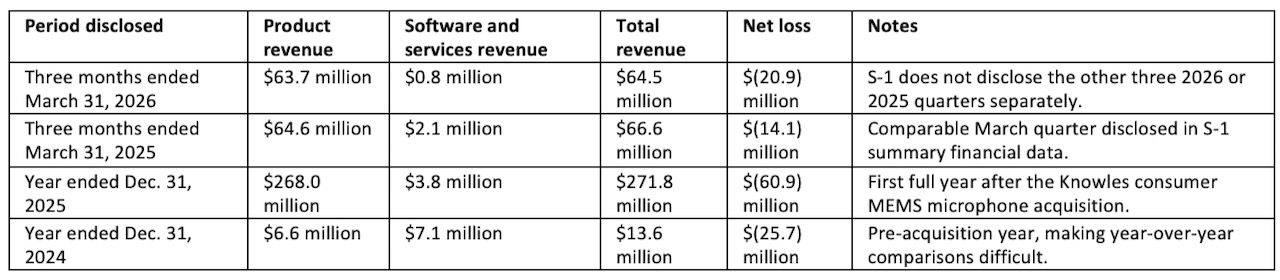
Table 1. Syntiant’s financial results for the last three quarters.
The revenue line has grown because Syntiant bought a sensor business, not because its original AI processor business suddenly scaled on its own. Syntiant says the acquired sensors business produced $263.9 million, or 97% of total 2025 revenue, and $62.0 million, or 96% of total revenue in the March 2026 quarter. That makes the IPO a combined sensor, processor, software, and model story.
The strategic logic still makes sense. Syntiant says nearly every NDP deployment sat next to a microphone, which led the company toward Knowles’ consumer MEMS microphone business. A microphone plus a low-power neural processor plus tuned models can reduce integration work for always-on voice and audio applications. For device OEMs, fewer integration seams can matter more than a peak TOPS number.
Syntiant also gives the market a useful edge AI test case. The company says its AI technology runs in tens of millions of devices across consumer electronics, automotive, security, healthcare, defense, and retail, and it shipped more than 1 billion sensors in 2025. That puts Syntiant closer to volume hardware reality than many AI chip companies that sell a roadmap.
The filing also reminds buyers and investors that edge AI remains a hard business. Gross profit reached $10.6 million on $64.5 million in March-quarter revenue, and operating expenses reached $22.3 million in the same period. The company also had $50.0 million of senior secured term loans and $6.0 million of secured subordinated loans from Knowles outstanding as of March 31, 2026.
Control also stays with the founders. The offering creates Class A shares with one vote per share and Class B shares with 10 votes per share, and the founders and related trusts will hold the Class B shares after the offering. Public investors, therefore, get exposure to the edge AI platform, not equal control over its direction.
Intel Capital, Microsoft Global Finance, and Knowles appear as important backers or stockholders in the filing, giving Syntiant strategic credibility across semiconductors, platforms, and sensors. Syntiant also raised Series D-1 preferred financing between December 2024 and March 2026, including purchases by Intel Capital and Microsoft Global Finance.
For ISVs, Syntiant matters because the company sells more than a chip. Edge AI needs models, tools, reference flows, and deployment software that let product teams ship features without becoming silicon experts. For silicon teams, Syntiant shows a familiar direction: bring sensors and AI processors closer together, reduce data movement, tune the model stack to the hardware, and make inference live inside the device.
CIOs should read the IPO through a deployment lens. On-device AI can reduce cloud traffic, improve response time, keep some data local, and support devices that cannot depend on a stable network. Those benefits matter in healthcare, retail, factories, automobiles, security systems, and consumer endpoints. Procurement teams still need hard evidence around reliability, model update paths, data governance, support, and lifetime cost.
Syntiant enters the public-market process at a useful moment. Investor appetite for AI remains high, and the market has started to look beyond GPUs toward the sensor edge. Reuters described the filing as part of a wider run of AI-related IPO activity in 2026. The harder question involves whether investors will value edge AI systems revenue the same way they value data center AI growth.
Syntiant’s IPO filing puts an edge-AI platform under public scrutiny. The company has real products, sensor volume, strategic backers, and a clearer system story after the Knowles acquisition. It also has losses, debt, acquisition integration risk, founder voting control, and a revenue base now tied heavily to sensors. The opportunity sits in the same place as the risk: Syntiant must prove that ultra-low-power inference, sensors, software, and models can become a durable public-company business.
What do we think?
Syntiant has a credible edge-AI story because it links sensors, processors, models, and software in real devices. The Knowles acquisition gave it revenue scale and manufacturing reach, and also made the business harder to read. Investors should separate sensor volume from AI processor pull-through and watch margins, debt, customer concentration, and attach rates after the IPO closely over time.
Syntiant’s IPO could mark an inflection point for edge AI if public investors accept that AI value will not live only in cloud GPUs. The company’s pitch puts intelligence at microphones, sensors, wearables, vehicles, and industrial endpoints. That moves the debate from model size to always-on interaction, latency, power, and local response. The inflection point arrives when OEMs buy sensor-plus-inference platforms as standard building blocks for physical AI products and ship them across mainstream device categories in volume, not demos.
WHAT DO YOU THINK? LIKE THIS STORY? TELL YOUR FRIENDS, TELL US.