
Ato is a screen-free, voice-first AI companion built for seniors. We purchased a unit independently, not as part of a sponsored review, and tested it for one month with an 86-year-old Bilingual family member living overseas. This piece covers what Ato is, what it does well, where it could get better, and what a newly announced version coming in December means for the category.
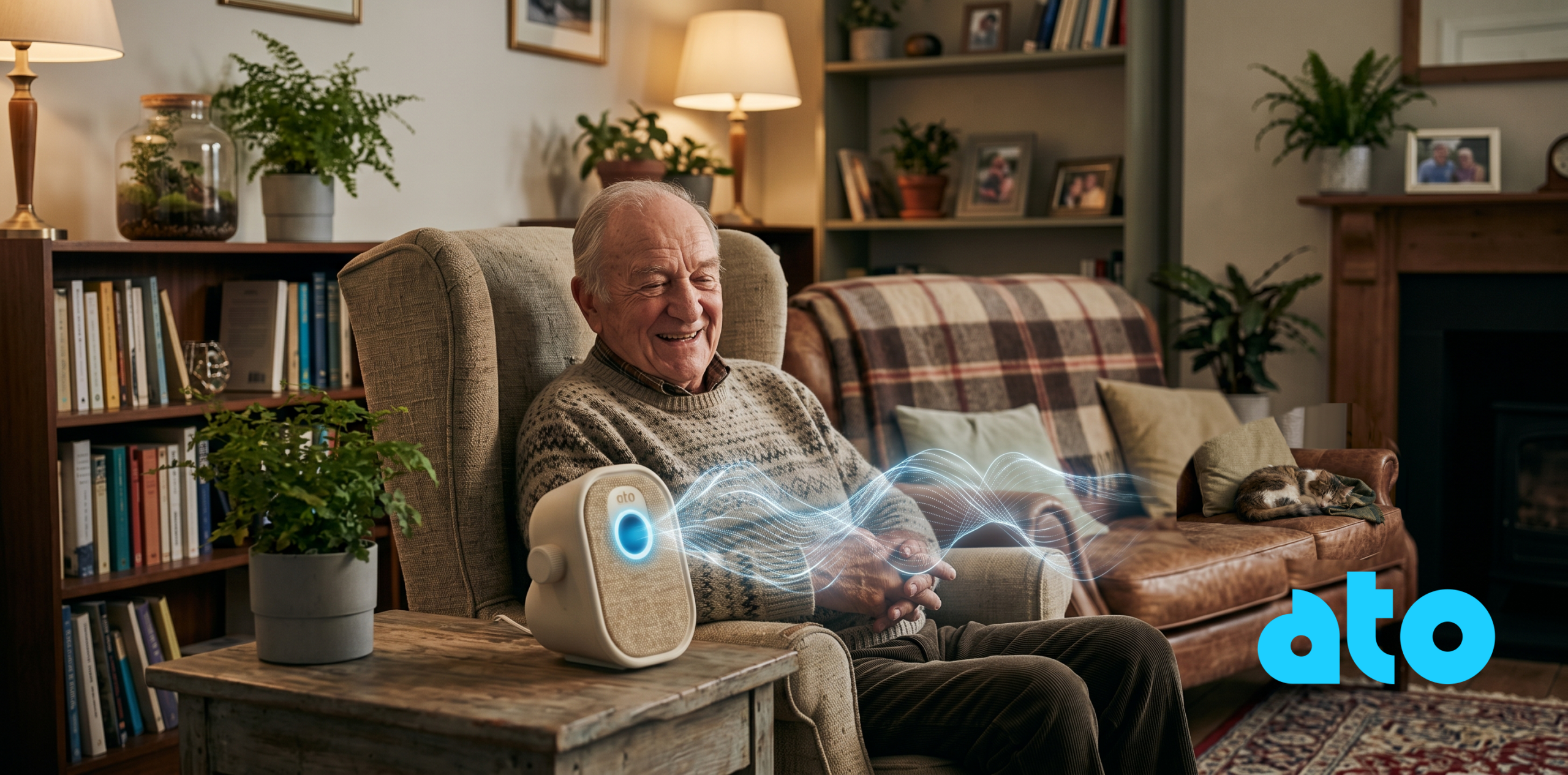
Illustration of voice-first AI companion Ato interacting with elderly person. (Source: JPR)
It doesn’t matter who we are, what we have done, or how successful we are in life, one thing is for certain: If we are lucky, we will be old someday, and that comes with challenges. We call our parents and grandparents often, but not all the time, and technology for seniors is something I have explored for the last two decades. I started with a notebook my parents didn’t know how to use, so I’d remotely connect to it and show them pictures and websites; then came a Skype phone from Philips, which used to compete with the original iPhone—not the Apple product, but rather a Cisco- Linksys VoIP phone. Then AppleTV to watch family pics on Flickr and other services, and finally years of Android tablets that I would access remotely with TeamViewer, since Android is a lot friendlier for this than Apple iPads. All these devices imply a learning curve and integrating them into their daily life, which is not trivial. So, when I saw a voice-first, AI-powered device with a single button and a volume dial, I was intrigued, and I pulled up my credit card and started my journey.
Ato is a screen-free AI care companion for seniors, made by Eighteen Labs, Inc., a company based in San Francisco. The device is voice-first by design; there is no app or screen for the elderly user to learn—the company’s pitch is simply to plug it in and talk.
“We believe one of the most important things an older adult can have is a strong connection to the people they love. Families are often spread across cities and countries, and most technology makes staying close harder than it should be: smaller screens, deeper menus, and more apps to learn. When we saw what the first Ato changed in our own family, and how many others were looking for the same thing, we left everything else behind to build it. We want Ato to help millions of families share more everyday moments, even when they live far apart, and help older adults live with more connection, curiosity, and independence.”
— Juan Cereigido and Gaspi Habif, Ato co-founders and CEO and CTO, respectively
The new Ato
While JPR was testing the current device, Eighteen Labs announced a new version of Ato, set to ship in December 2026. Starting September 2, the company is offering the new unit for $99 for the first 24 hours of its pre-order window, with additional discounts continuing over the following days as the offer moves through subsequent pricing batches. The new Ato looks and feels like a high-end, polished product, elegant and designed to blend into a warm, cozy environment. This is a substantial improvement from the early model, which looked and felt like a 100% functional proof of concept. The fact that the functional changes are so small speaks to the level of maturity of the first commercial version, now produced to scale with the new Ato.
An amazing gesture from the Ato team is that, according to their website, the company offers to upgrade existing users who have the monthly subscription, to the new Ato hardware when it ships in December—you don’t see this level of customer care very often.
The need for privacy and trust
For a device that listens to a senior parent’s most personal stories and one that a family trusts with details about their loved one’s health, routines, and daily life, security credentials matter as much as the conversation itself. Ato is built by a US company, not an anonymous overseas operation selling through a storefront. It’s SOC 2 Type I- and Type II-compliant, HIPAA-compliant, and ISO 27001-certified, a combination that signals the company has been independently audited for how it handles sensitive data, both at a point in time and over a sustained period. For families considering handing over a parent’s biography, family relationships, and daily conversations to an AI system, that layer of verification is not a footnote. It’s a prerequisite for trust.
Checkout was straightforward. We personally reached out to the Ato team ahead of an overseas trip, and the company went above and beyond to expedite the shipping so the device would arrive in time for it to be set up and tested during that visit, ensuring the family member could experience it firsthand rather than waiting for a future trip. For some, this might be a small detail, but for me, the fact that I was exchanging emails with the company co-founder and his team, to help me help my Mom, illustrated the level of commitment and mission-driven attitude of the founders that made this company possible.
Setting up Ato and using it
The unit arrived well packed with everything I needed to get started: the device itself, a manual, and a charger. One detail worth flagging for anyone setting this up for a relative: Wi-Fi pairing needs to happen at the device’s final location. Ato creates its own hotspot to receive home Wi-Fi credentials, so even if you could pre-configure it somewhere else and then moved it to the senior’s home and update the settings, it’s just easier to set it up at its final location.
Building the elder’s profile works best through organic storytelling, ideally during a family visit or reunion, since Ato remembers names, relationships, birthdays, and anecdotes well, once they come up naturally in conversation. Our approach was more direct: reading a prepared, multi-page biography document aloud to Ato. More details about this experience later in this review.
The companion app, used by family members, is entirely separate from the elder’s voice-only experience. A family member sends a text message through the app, Ato reads it aloud to the elder, and the elder’s spoken response is summarized by Ato and sent back to the family member as a text. It works great, and the family member gets a delivery confirmation.
Over a month of near-daily use, one feature stood out above the rest: Ato handles real-time bilingual switching seamlessly. My mother speaks both Portuguese and Spanish, and the device detects and switches languages mid-conversation, handling regional accent nuance well in the process. The default language is configured at setup, but beyond that, Ato switches dynamically during use without any setup. It’s quite impressive. You can also configure country-specific accents, a feature that makes the device feel way more familiar, especially on a language as geographically dispersed as Spanish.
Ato can also search the web, researching topics to answer questions and add to the conversation, even read back the lyrics to Brazilian lullabies from my mom’s childhood. It’s worth clarifying that the device cannot sing, it only reads the lyrics aloud, but it can do the same with poems, Bible passages, and book excerpts on request. Among many other features (and more being developed), Ato can play brain games, check sports results, and play radio stations.
Ato can be configured to be more or less proactive in initiating conversation during the day. Each senior has a different level of tolerance and desire to talk, so Ato is always there for the person, and the family can set how talkative the device is from the family companion app.
Beyond specific features, the broader user experience holds up well for an elderly user. Ato is patient. It gives users time to think, does not rush a response, and is forgiving of mispronunciation, and pauses in a way that matters a great deal for this audience. It’s as kind as the kindest human you know.
On interaction design, Ato is activated with a simple “hey Ato” wake phrase or, for example, “escucha Ato” in Spanish, with a single physical button available as a fallback for anyone who finds voice activation inconvenient.
The main gap we ran into involves distant family. Once a family member is not physically near the device, there is currently no way for them to keep contributing stories or details to the elder’s profile remotely. The companion app has no document upload or form-based input for this purpose today.
Even the approach we used locally to read the short biography we wrote as a family was a challenge. The device is trained for conversation, so it kept interrupting throughout, a friction point that started as frustration and quicky turned into a funny family moment. We think the device could definitely use a way for the family to train the senior profile, whether it is the capability to upload a document or record an audio recording from the family companion app. This would give family members who live far away an opportunity to contribute anecdotes and be part of the process. After we created an initial profile, Ato used the stories that came out of it later as conversation starters and follow-up questions to keep the senior engaged.
Ato costs $179, down from $200. A $29 monthly subscription unlocks the full AI feature set, though a limited free tier exists without it. Given how dependent the experience is on AI, particularly the conversational and research features, the subscription is a reasonable ask. The value of the device also increases once the whole family, tech-savvy or not, is onboarded to the companion app; JPR found that process easy to complete.
For more information, visit http://heyato.ai/.
What do we think?
In a landscape saturated with headlines about ever-larger models, development features, and benchmark scores, it’s refreshing to see AI applied simply and directly to something that actually helps humanity. Ato is a clear example of that. The ramp-up for both the elderly person and the wider family has been remarkably smooth, and that ease of adoption, more than any specification, is what makes this product stand out. This publication is optimistic about where Ato is headed, and hopes to see it keep developing and helping families stay connected around the world.
– The Workstation Cavalry
AND IF YOU LIKED WHAT YOU READ HERE, DON’T BE STINGY, SHARE IT WITH YOUR FRIENDS.