
Intel has introduced a Robotics AI Suite as part of its Open Edge Platform—positioned as an SDK collection and reference apps to speed up robot perception, navigation, and control at the edge. It lands alongside Intel’s previously announced Edge AI Suites (retail, manufacturing, metro) and the Open Edge Platform, and is being advanced with a broad set of ecosystem partners.
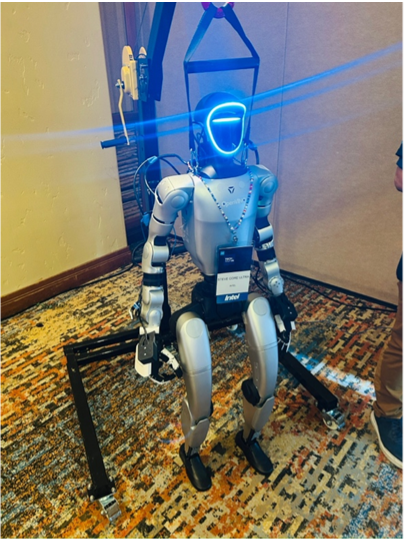
Intel Tech Tour 2025. (Source: JPR)
Intel’s Robotics AI Suite arrives (currently in preview) as another industry-specific “Suite” in its Open Edge Platform. The suite bundles ROS 2-centric ingredients, OpenVINO-optimized models, navigation and SLAM tutorials, humanoid imitation learning pipelines, benchmarking tools, and reference apps (e.g., wandering, object detection, segmentation, floor segmentation) intended to help teams get from dev kits to pilots faster on Intel CPUs, GPUs, and NPUs. (JPR counts AIPs, or AI processors, used in ambulatory robots as part of vehicles in its AIP report.)
This AI Suite sits alongside Intel’s broader edge effort—Edge AI Suites and the Open Edge Platform unveiled in March—which focuses on repeatable blueprints, containerized deployment, and manageability. Intel is backing that with a long partner list across OEMs, ISVs, and integrators (Cisco, Lenovo, Red Hat, Wind River, Supermicro, Canonical, Advantech, Asus IoT, OnLogic, Nexcom, Aaeon, Adlink, Deloitte, and more).
“AI at the edge is more than a technical shift—it’s where intelligence meets the physical world,” said Matthew Formica, senior director, edge product marketing at Intel.
What do we think?
This is inevitable. The center of gravity for AI is tilting toward physical AI, and every silicon vendor is publishing a stack. Still, Intel’s Robotics AI Suite is an actual suite (code, docs, reference apps, manageability), not just a “we’re looking at robotics” slide. We know this because we got a demo of it at Intel Tech Tour 2025 in Phoenix.
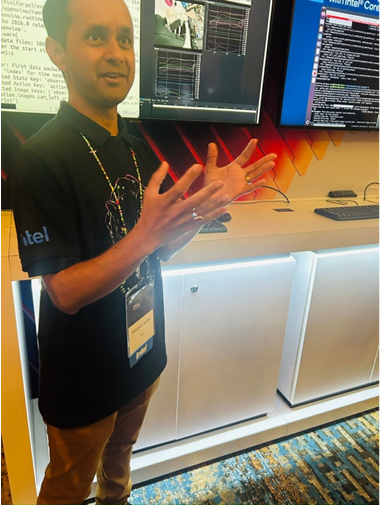
Intel robotics software development demo at Intel Tech Tour 2025. (Source: JPR)
The company’s earlier Edge AI Suites and Open Edge Platform provide the scaffolding (blueprints, remote deployment, and OpenVINO-based optimizations) that robotics teams need to scale beyond a demo cart.
However, Intel is among a pack of other contenders:
• Nvidia has set the pace on physical AI with Isaac and GR00T/cloud-to-robot platforms, pulling the ecosystem toward standardized models, simulation, and data pipelines. Intel needed a clearer robotics lane; its Edge AI Suite is that.
• Qualcomm has been in the game for years with RB5/RB6 platforms and is pushing on-device AI aggressively across mobile and auto—giving it strong credentials for power- and cost-sensitive robotics.
• MediaTek is leaning into edge AI (Genio) and showcased robot demos this year; expect more ROS-friendly SKUs.
• AMD is scaling data center AI fast; the open question is how quickly it will translate that momentum into a cohesive edge/robotics developer offer beyond CPU+GPU parts, possibly with FPGAs.
• MIPS (now under GlobalFoundries) is explicitly chasing physical AI with real-time, safety-critical RISC-V—relevant for motor control and robotics subsystems that care about deterministic behavior.
For Intel, success will hinge on whether Robotics AI Suite becomes enough of a low-friction path for ISVs and SIs to ship—and update—robots in the field: turnkey images, reproducible pipelines, clear hardware SKUs, and strong life cycle tooling. If Intel can turn the current preview into a stable, versioned release with robust samples (autonomous mobile robots, manipulators, humanoid imitation learning) and keep partner momentum, it will have a credible alternative to Nvidia’s Isaac path—particularly for customers standardizing on x86 plus integrated NPUs and who prefer open, cloud-like edge ops.
Intel now has to earn deployments.
WHAT DO YOU THINK? LIKE THIS STORY? TELL YOUR FRIENDS, TELL US.