
VESA has released Version 1.1 of its DisplayPort Automotive Extension, adding an executable emulator and expanded safety and security mechanisms aimed at safety-critical in-vehicle displays. The update is designed to let automakers and Tier-1 suppliers adopt DisplayPort in automotive systems without changing the underlying physical interface, while meeting stringent functional safety and cybersecurity requirements.
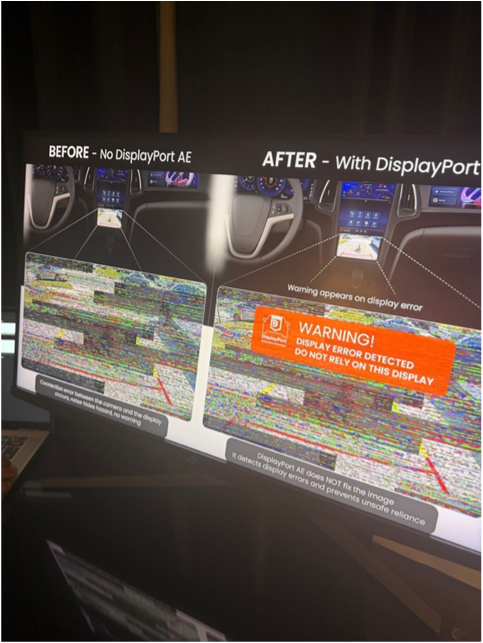
DisplayPort Automotive Extension v1.1 display safety in action. (Source: JPR)
The Video Electronics Standards Association (VESA) has released DisplayPort Automotive Extension (DP AE) v1.1, a specification update that brings functional safety and security capabilities directly into the DisplayPort protocol stack for automotive applications.
Rather than redefining the physical layer, DP AE v1.1 is implemented as a thin extension layer on top of existing DisplayPort and Embedded DisplayPort, allowing OEMs and suppliers to reuse established technology while addressing automotive-grade requirements.
James Goel, who leads VESA’s DisplayPort Automotive Extension work, framed the problem succinctly: “As cars get more intelligent, they’re going to have more screens in the car, and they want to trust those screens more. The few displays you have, have to be very high functional safety.”
From paper specification to executable model
The most significant addition in v1.1 is a fully executable software emulator, delivered as a normative part of the specification. Unlike traditional reference models, this emulator allows developers to simulate and validate safety and security behavior before hardware is built.
“For the very first time, VESA built an entire software emulator model,” Goel said. “Automotive makers can see every transaction and how safety and security are enforced, end to end.”
The emulator enables validation of frame integrity, authentication, and tamper detection, reducing ambiguity and helping OEMs and silicon vendors catch issues earlier in the design cycle.
Functional safety and security by design
DP AE v1.1 defines multiple cumulative profiles, scaling from functional safety only to full safety and security coverage. At the highest level, the extension is designed to support ASIL-D, the most stringent classification under ISO 26262.
Goel emphasized that the protocol is intended to detect subtle failures as well as obvious ones: “If you drop a frame, you’re detected. If you duplicate a frame, you’re detected. Even a single bit error can trigger detection.”
A key feature is support for up to 16 regions of interest (ROIs) within a display stream, allowing critical UI elements such as speedometers, gear indicators, or warning symbols, to receive enhanced protection.
“We worked with automotive OEMs who told us most of the time it’s four or five regions that really matter,” Goel explained. “Sixteen gives margin without unnecessary complexity.”
Security mechanisms run alongside functional safety, with protections against tampering, man-in-the-middle attacks, and unauthorized display substitution.
“What you don’t want is hackers blanking a display or changing what the driver sees. That’s exactly what this protocol is designed to prevent,” Goel said.
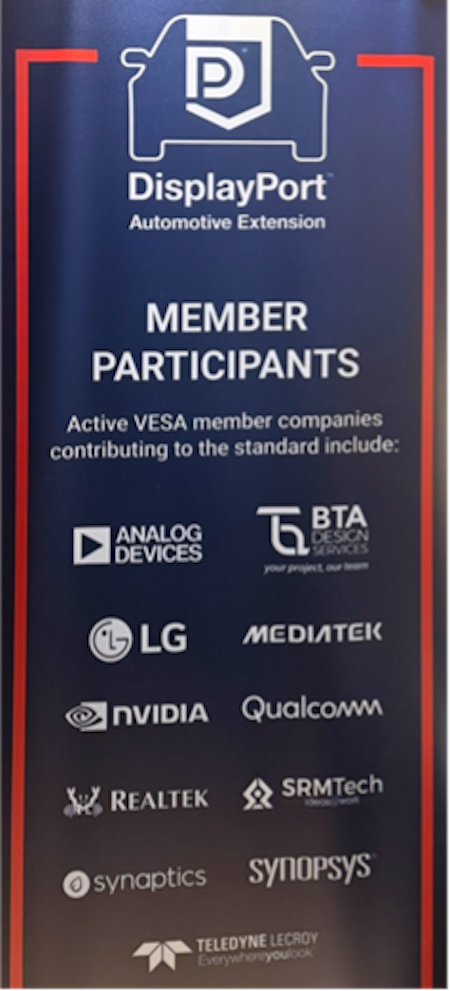
Figure 1. DisplayPort Automotive Extension member participants. (Source: JPR)
Built for automotive conservatism
DP AE v1.1 is designed to fit into existing automotive display architectures and emerging serialized links, without forcing OEMs to abandon DisplayPort or adopt proprietary alternatives.
“This is a thin layer that sits on top of existing DisplayPort,” Goel said. “Automotive is conservative for good reasons, and this lets manufacturers add safety and security without reinventing the display stack.”
VESA is also preparing a logo certification and compliance test program, with test equipment from Teledyne LeCroy demonstrated publicly to us at CES.
“This isn’t just a light specification,” Goel added. “There’s a full compliance test system behind it, and that’s critical for automotive adoption.”
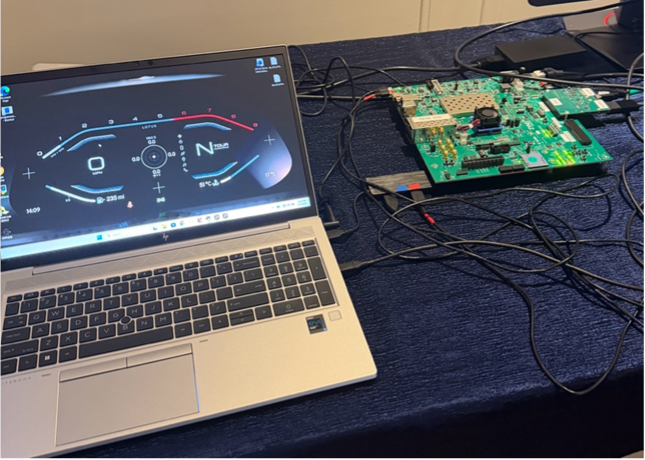
Figure 2. DP AE v1.1 development board from Teledyne LeCroy. (Source: JPR)
What do we think?
As vehicles become increasingly software-defined, displays are no longer passive endpoints; they are integral to safety, security, and user trust. With DP AE v1.1, VESA is positioning DisplayPort as a credible, standards-based solution for safety-critical automotive displays.
The combination of an executable emulator, defined safety profiles, and alignment with global functional safety and cybersecurity standards signals a long-term commitment.
Whether DP AE becomes a default automotive choice will depend on ecosystem uptake, but the message from VESA is clear: In modern vehicles, display technology must be trusted as much as it is fast.
YOU LIKE THIS KIND OF STUFF? WE HAVE LOTS MORE. TELL YOUR FRIENDS, WE LOVE MEETING NEW PEOPLE.