
AI processor start-ups raised an average $190 million each—enough to hire elite engineers and build compelling designs. But capital doesn’t reserve fab capacity. TSMC, Samsung, GlobalFoundries, Intel Foundry, and even SMIC run at capacity, serving long-term hyperscaler contracts. Memory fabs compound the problem, switching production lines from DDR to HBM. The supply chain has become the primary constraint on AI processor commercialization—not design quality, not customer demand, not funding.
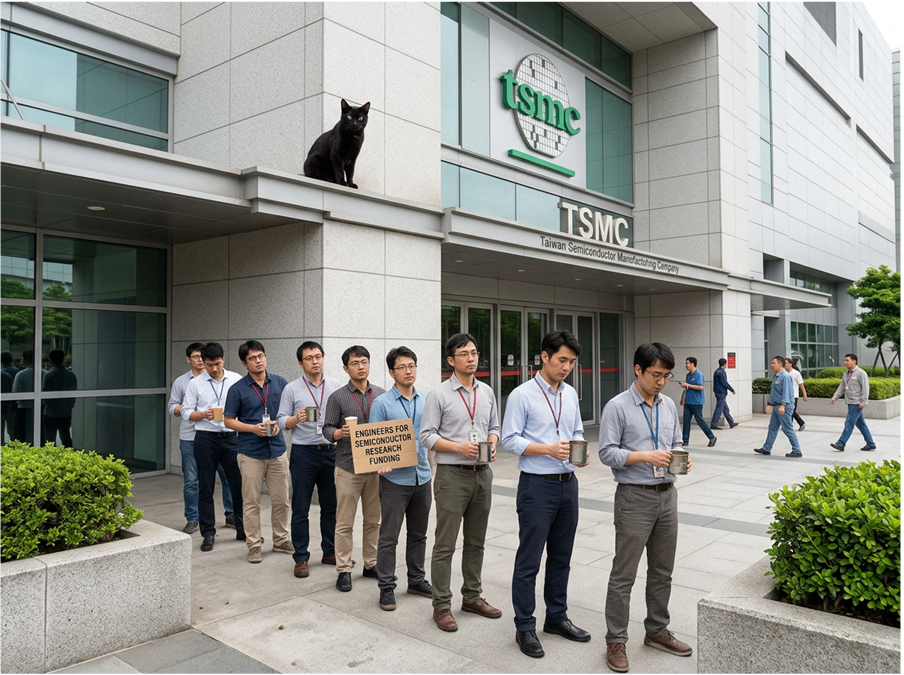
Can you spare some chips, sir?
Hyperscalers are not the only AI companies jockeying for fab production. Start-ups are being constrained by memory availability and fab access for their AI processors, and also by CPU availability. The supply chain becomes more critical to success than the design and the product. The AI processor start-ups have been phenomenally successful in raising capital, averaging $190 million, giving them a fighting chance to attract talented engineers and programmers. But on the manufacturing side, constraints are tighter. The fabs and fabricators have become the bottleneck to the industry’s growth, not customer demand, not clever and powerful designs, but nuts and bolts and blobs of silicon.
The major fabs with leading-edge process nodes like TSMC, Samsung, Intel, and GlobalFoundries are running at capacity and servicing their big, long-term customers. And even SMIC’s N+2 fab has a big backlog
TSMC (Taiwan and Arizona) runs at capacity servicing Amazon, Apple, Nvidia, AMD, Qualcomm, Broadcom, MediaTek, Google, Cerebras, SambaNova, Hailo, Tenstorrent, SiMa.ai, Axelera AI, Kneron, EdgeCortix, FuriosaAI, Innatera, Polyn Technology, Aspinity, EnCharge AI, and most edge-AI start-ups.
Samsung Foundry (Korea and Taylor, Texas) services Meta MTIA, AMD next-gen data-center GPUs, Qualcomm select Snapdragon lines, Tesla AI6 FSD, FuriosaAI, Rebellions, HyperAccel, Mobilint, and ByteDance. Intel Foundry supports its own Gaudi and CPU AI tiles as an IDM, plus select automotive and industrial inference customers.
GlobalFoundries handles mature-node IoT and edge AI for NXP, STMicroelectronics, Nordic Semiconductor, GreenWaves Technologies, XMOS, and automotive/industrial inference programs.
SMIC and HuaHong absorb China’s domestic AI chip producers—Biren, Cambricon, Enflame, Iluvatar CoreX, Moore Threads, MetaX, Moffett AI, Denglin, Vastai Tech, Black Sesame, Horizon Robotics, Unisoc, and Zhaoxin—but SMIC’s most advanced N+2 node sits roughly two to three process generations behind TSMC’s volume 3 nm and ramping 2 nm.
Logic is only half the constraint. Memory fabs run at equivalent capacity and redirect production lines from DDR to HBM, compressing DDR supply and hitting consumer markets—PCs, TVs, smartphones—as collateral damage. TAM for AI processors stays high. But SOM execution now depends on fab access, long-term purchase contracts, and memory allocation—advantages that belong almost exclusively to hyperscalers.
What do we think?
Start-up AI chip companies face a structural disadvantage that capital alone cannot fix. Hyperscalers hold multi-year fab contracts, priority CoWoS allocations, and HBM supply agreements. Start-ups get whatever capacity remains. The best chip design in the market delivers zero revenue without a wafer start. The competitive moat in AI silicon has shifted from architecture to supply chain—and most start-ups are on the wrong side of it.
The AI processor market has reached an inflection point that inverts conventional start-up logic. Historically, raising capital and recruiting engineers determined which companies won. Today, fab allocation and memory supply agreements determine who ships. TSMC, Samsung, and SMIC have become the de facto gatekeepers of AI hardware commercialization. Start-ups that cannot secure long-term wafer contracts before tape-out will find themselves technically competitive but commercially stranded. The constraint is not innovation—it is silicon, substrate, and HBM—and hyperscalers have locked up most of it. We have a separate bulletin on that.
If you’re involved in or following the AI processor market, you’ve come to the right place. We have an in-depth database on all 133 active AI processor suppliers (as well as the 25 acquired ones). We can tell you how much each company has shipped, where its chips are made and at which node, which market segments it serves, how much money it has raised and from whom, and who its management is. Drop me a note if interested at [email protected].
LIKE WHAT YOU SAW HERE? SHARE THE EXPERIENCE, TELL YOUR FRIENDS.