
What began as an in-house animation tool in 1994 has grown into a widely used 3D creation platform for beginners and experts alike. Free and open source since 2002, Blender today counts Netflix, Epic Games, Nvidia, Apple, and Adobe among its development-fund supporters. New CEO Francesco Siddi recently toured the US, gathering user feedback on Blender 5.0, with three major releases planned for 2026. He’ll be revealing new projects and directions at BCON North America, April 13–14 in Austin, Texas.
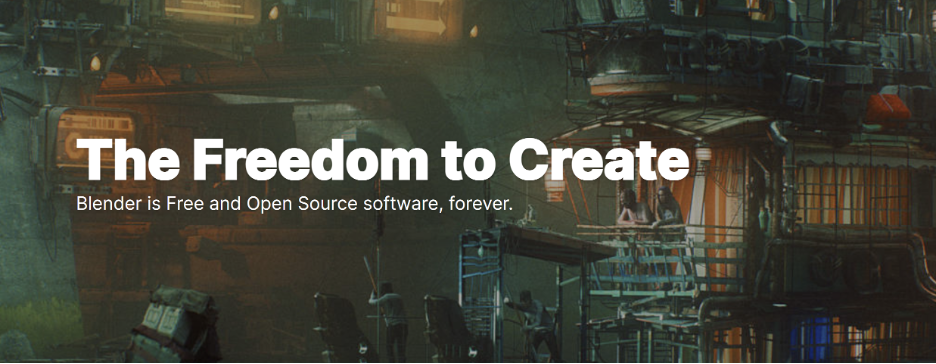
(Source: Blender)
Blender is beloved. Early in its development, Blender was designed to put creative tools in the hands of everyone who wants to tell stories using computer graphics, from cartoons to photorealism. It began as the obsession of software developer Ton Roosendaal, who founded NeoGeo as an animation company. His content creation tool, Blender, was introduced in 1994, and according to the Blender page, it was actually a collection of tools, including a ray tracer for the Amiga. The idea was to develop the ability to handle changes from demanding clients in-house and as needed. Blender was born to be adaptable and configurable. Arguably, Blender was also born to be free. After NeoGeo, Roosendaal and partner Frank van Beek founded Not a Number (NaN) in 1988 to develop and sell Blender. They gave away the Blender core program under a freemium license and sold keys to unlock advanced features.
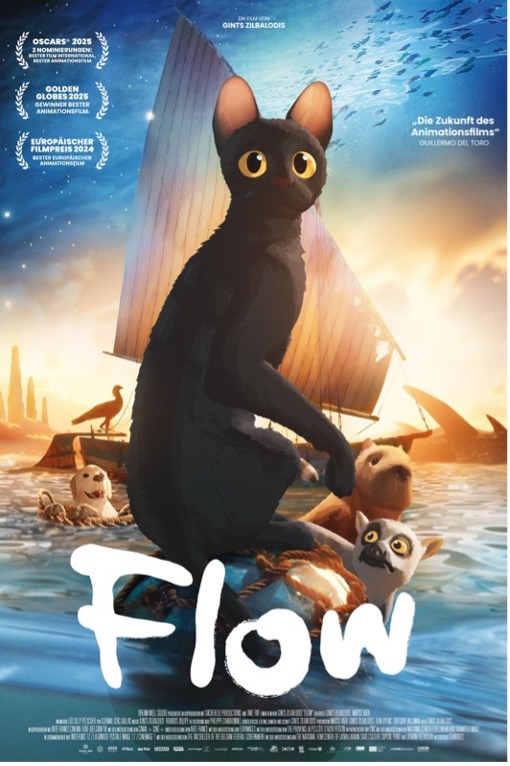
By 2002, Blender was distributed under the GNU General Public License with the promise that the source code would be free forever. The gates were opened to hobbyists, tinkerers, artists, and 3D enthusiasts. There were hiccups along the way, and they’re described on Blender’s site, but what’s important is that the number of people who download Blender and work with it regularly continues to grow. Blender also has found its way into a number of applications including game development, and independent film and animation production. Blender’s Cycles path tracer has found its way into architectural rendering and product visualization. Perhaps the strongest case for Blender as a professional tool comes from the success of the movie Flow by Gints Zilbalodis, which won an Academy Award for Best Animated Feature in 2025.
Blender was able to make truly significant progress when the organization joined the Khronos Group in 2020. Khronos is a non-profit, member-funded consortium to create royalty-free API standards for 3D graphics, augmented and virtual reality (XR), parallel computing, machine learning, and vision processing. By becoming a member, Blender gained inside access and a way into the development of graphics open standards including OpenCL, OpenXR, and Vulkan. For instance, Blender has extended its VR capabilities through support of Khronos’ OpenXR. It can offer an easier path to hardware acceleration via OpenCL. (Hardware GPU acceleration is further extended via Blender’s adoption of CUDA and OptiX technologies.)
Additionally, Blender adopted Khronos PBR (physically based rendering) Neutral tone mapper in 2024 and glTF, which opens up access to online product marketing with standard approaches to PBR. These are standardized tools open to retailers, artists, and marketers, who are all able to work with the same content to publish online.
Blender has become a multifaceted collective with multiple paths for self-funding, including donations from individuals and from companies. Blender’s ongoing development is supported through the development fund. Top-tier donating companies include Netflix Animation Studios, Epic Games, Nvidia, AMD, Meta, Microsoft, Apple, AWS, and Intel, and there are many more, such as rendering company Chaos, tablet maker Wacom, Dell, and Adobe. Membership is a two-way street—members get targeted development help to optimize the software to support their tools.
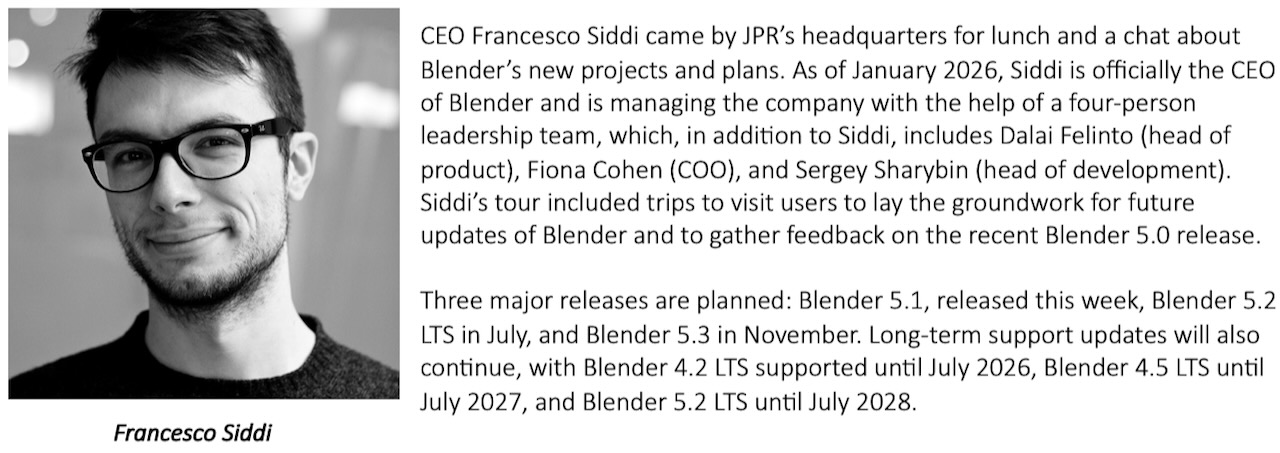
Siddi plans to grow and expand the foundation with some ideas he’s planning to reveal at the upcoming BCON, a huge gathering of Blender users. This year it’s taking place April 13-14 in Austin, Texas, at Inn Cahoots on 6th Street. This will be only the second time BCON has been held in the US, the first being two years ago in Los Angeles. The Blender management team promises to bring the same raucous enthusiasm of the original Amsterdam conferences, with a focus on real-world workflows, creative growth, and the exchange of skills that’s only possible when people can get together and share their ideas and techniques. Early bird tickets are available for $299, a 25% discount off the regular price of $399.
For those who can’t make it to Austin, BCON26, the flagship event, is scheduled for September 23–25, 2026, at Felix Meritis in Amsterdam.
(Source: Blender)
LIKE WHAT YOU’RE READING? TELL YOUR FRIENDS; WE DO THIS EVERY DAY, ALL DAY.