
AIStorm is a Houston semiconductor company doing something architecturally unusual: computing neural network inference directly in the image sensor, before the data ever gets digitized. Their charge-domain analog AI eliminates the ADC conversion step entirely, which cuts power, cost, and latency simultaneously. The Cheetah HS—capable of 260,000 frames per second with on-chip AI shipped in August 2025 and is available on DigiKey. Small company, interesting technology, real products shipping. Worth watching.
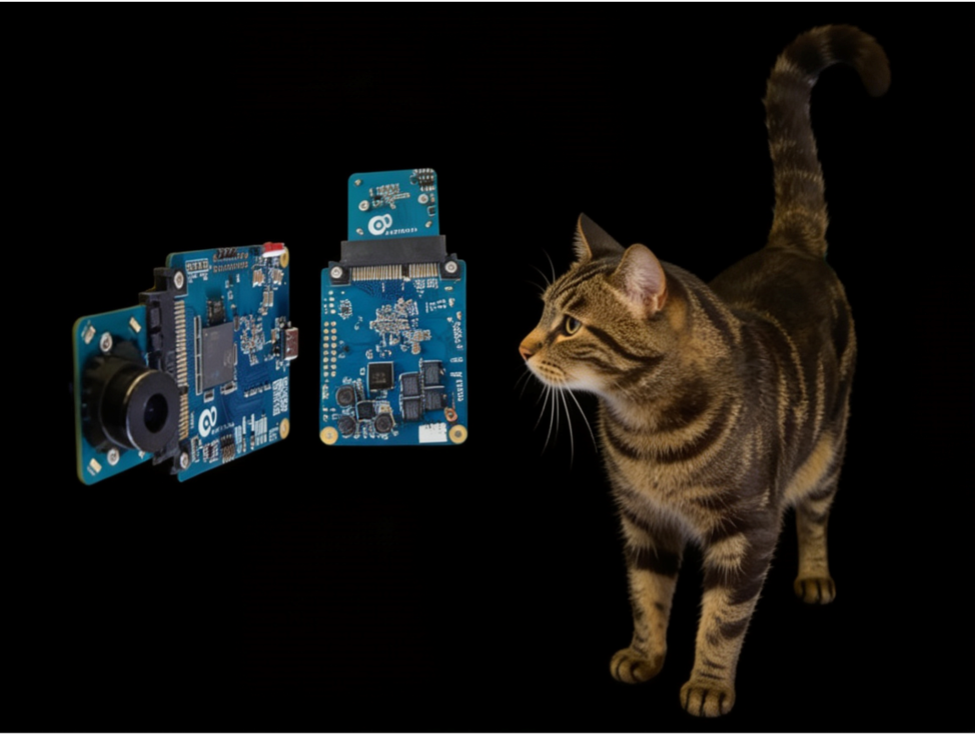
Shadow inspecting the boards.
David Schie, a former executive at Maxim, Micrel, and Semtech, cofounded AIStorm in 2018 with Robert Barker, Andreas Sibrai, and Cesar Matias—veterans of WSI, Toshiba, and Arm. Schie’s background in analog design and his founding of Linear Dimensions Semiconductor laid the groundwork for AIStorm’s core technology. The company is headquartered in Houston, Texas. Estimated employees run 25–100; estimated annual revenue is $100K–$5M. CFO is Robert Barker, one of the cofounders.
AIStorm has raised $29.2 million over two rounds: a $13.2 million Series A in February 2019 and a $16 million Series B in December 2020. The Series B was oversubscribed. Investors include AsusTek, Egis Technology, Knowles Corporation, Meyer Corporation, and Senvest Management. AIStorm’s backers now total more than 40 investors—and as the company notes, many of them are also customers. That’s an unusual but coherent funding model: the people writing checks have a direct interest in seeing the chips work.
The architecture
Most AI inference chips follow the same sequence: sensor data comes in analog, gets converted to digital by an ADC, then feeds a digital processor. AIStorm skips the ADC. Their charge-domain architecture converts incoming photons directly to charge, computes the first neural network layer in that analog charge domain, then outputs a pulse stream that downstream networks process. No conversion step. No ADC cost. No ADC power draw. No ADC latency.
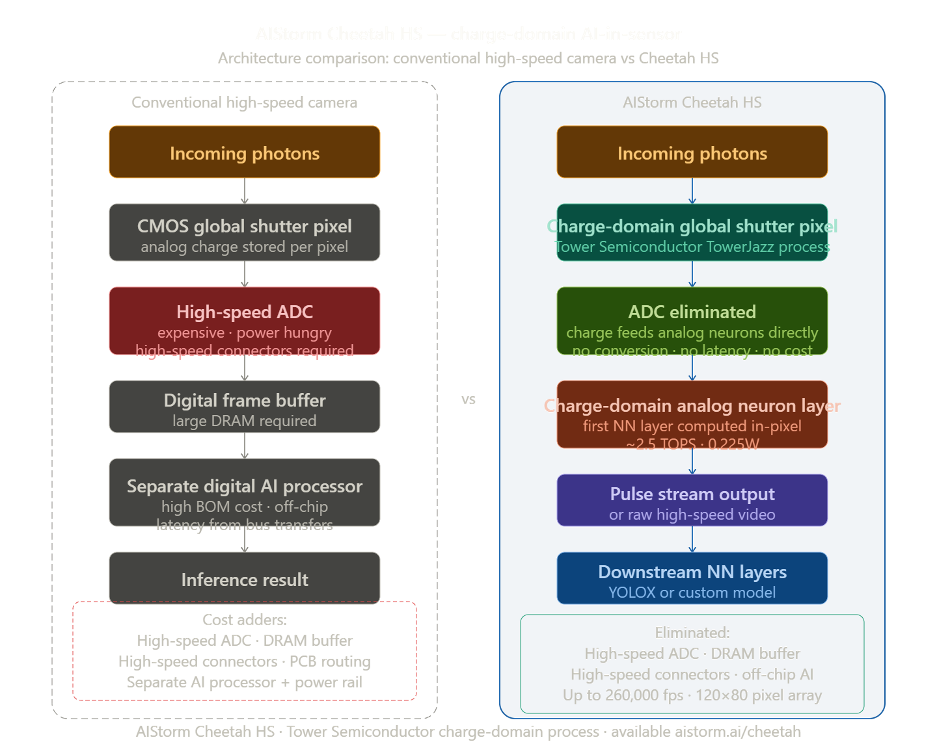
Figure 1. AIStorm’s Cheetah HS block diagram. (Source: JPR)
No official AIStorm block diagram exists publicly—40 patents means they keep the architecture drawings close. The diagram above is constructed from their press releases, the Cheetah HS announcement, and the VentureBeat technical description.
The implication is significant for always-on applications. Digital AI subsystems need a wake-up trigger—something has to convert the analog signal to digital before the AI can decide whether the signal matters. That trigger mechanism generates false positives, burns power, and adds latency. AIStorm’s approach couples directly to the sensor, which means the AI is running continuously at near-zero idle power. There’s nothing to wake up because nothing is sleeping.
The core inference engine delivers approximately 2.5 TOPS at 0.225 W. That number understates the practical advantage—because the architecture bypasses ADC conversion, the effective work done per joule at the system level is substantially better than a digital chip with equivalent TOPS would suggest.
Products
AIStorm has shipped four product families. Mantis targets always-on smart camera applications. Cheetah addresses high-speed imaging. Chameleon handles audio and biometrics. MantisConnect integrates Bluetooth and Wi-Fi for IoT.
The headline product right now is the Cheetah HS, announced August 12, 2025, in partnership with Tower Semiconductor. It’s a 120 × 80-pixel imager that captures up to 260,000 frames per second—2,000 to 4,000 times faster than conventional CMOS sensors—with the first neural network layer computed on-chip in the charge domain before any data leaves the pixel array.
That architecture enables something traditional high-speed cameras can’t match on cost: no expensive high-speed ADC, no high-speed connector, no external processing board for the first inference layer. The system outputs a pulse train that downstream networks process, which dramatically simplifies the BOM and shrinks the overall system footprint.
Applications for Cheetah HS include robotics, drones, PCB inspection, biometric unlock, golf swing analysis, and vibration monitoring. Those aren’t theoretical—the chip is available in chip form and as a complete reference camera system at aistorm.ai/cheetah, and the people-counting solution built on the Cheetah AISC11C shipped in December 2025 and is available on DigiKey.
The people-counting solution is worth noting specifically because it ships with privacy architecture by design. The system outputs anonymized metadata—presence or count—and transmits no image data. That’s not a marketing feature for regulations compliance; it’s a fundamental property of how the 120 × 80 pixel resolution is specified. The images don’t contain individual characteristics at that resolution, which means there’s nothing to extract.
AIStorm has real products shipping through real distribution. Tower Semiconductor is a credible manufacturing partner. Egis, AsusTek, and Knowles are credible customers. The investor-as-customer model means design wins fund the company while simultaneously validating the technology. That’s not a red flag; it’s actually a sensible way to de-risk a novel architecture.

Figure 2. AIStorm dev board. (Source: AIStorm)
What remains unclear: revenue trajectory, production volumes, and whether the company has reached the customer concentration necessary to fund next-generation development without another external round. The $29.2M raised over two rounds ending in 2020 suggests the company has been operating on those funds for five years. Either revenue has been covering operations—which at the $100K–$5M annual estimate seems tight—or there are undisclosed rounds or customer-funded development agreements in the mix. Worth asking.
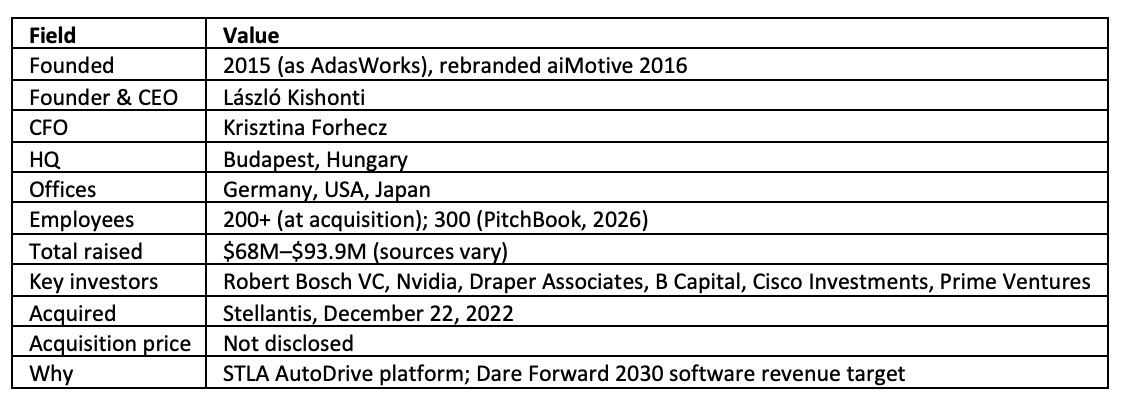
Table 1. AIStorm overview.
AIStorm has been at this since 2018 and has real silicon shipping—that puts them ahead of most charge-domain AI companies, which are still in academic papers or pre-production. The Cheetah HS at 260,000 fps with on-chip AI is a legitimately differentiated product for inspection, robotics, and biometrics. The question is whether the company’s revenue base and capital position support the development pace needed to stay ahead of well-funded digital competitors moving down the power curve. The investor-as-customer model buys time, but it doesn’t buy it indefinitely. Watch for a Series C or a strategic acquirer.
What do we think?
The architecture is real and the products are shipping—that’s a higher bar than most analog CIM companies have cleared. The charge-domain AI-in-sensor approach has a genuine advantage in always-on and ultra-high-speed applications where ADC cost and latency are the binding constraints. The concern is runway. Five years on $29M with sub-$5M annual revenue requires either remarkable capital efficiency or undisclosed customer funding. Worth a serious look from strategic acquirers in imaging and industrial AI.
AIStorm’s Cheetah HS signals an inflection point in sensor AI architecture: the moment compute moved inside the pixel array rather than alongside it. That inflection point reframes the question from “how fast can we digitize and process” to “how much can we infer before we ever digitize.” It’s the same architectural logic that drove cache-coherent memory closer to CPUs—latency and power improve when compute happens where the data already lives. AIStorm is applying that logic to image sensors, and the 260,000 fps Cheetah HS is the proof that it works.
The AIStorm Cheetah is one of the 152 AI processors in our AI Processor Tracking Service, which also lists performance and other specifications for 291 products.
LIKE WHAT YOU SAW HERE? SHARE THE EXPERIENCE, TELL YOUR FRIENDS.