
aiMotive is a Budapest-based automotive AI company that built something the industry actually needed: an NPU IP core designed for production ADAS not benchmarked in a lab, not optimized for press releases. Their aiWare hardware IP delivers up to 256 TOPS per core at 5 nm and pairs with a full ADAS software stack and an SDK that estimates silicon performance within 5% on any desktop PC. Stellantis acquired them in December 2022. aiWare and aiDrive are still licensed externally. László Kishonti is still CEO.
László Kishonti didn’t start in automotive. He built Kishonti Ltd., a graphics benchmarking company that worked with Apple, Nokia, and Google. When the mobile market ran out of headroom, he turned the team toward AI. From 2015, autonomous driving became the target. The company launched as AdasWorks, rebranded to aiMotive in November 2016, and built itself into something unusual—a Hungarian semiconductor IP company that Tier 1 automotive suppliers actually used.
The product portfolio covers four areas. aiDrive is the embedded autonomous driving software stack. aiData handles data management and annotation. aiSim is the simulation environment. aiWare is the NPU hardware acceleration IP—the product that drew Stellantis in. They have offices in Budapest, Hungary, as well as Germany, the US, and Japan and at the time of the acquisition, there were over 200 employees. CFO Krisztina Forhecz came from Magyar Telekom, where she ran investor relations.
The first $2.5M came from Inventure Oy in May 2015. A second round brought $10.5M from Robert Bosch Venture Capital, Draper Associates, and Nvidia. By end of 2022, the total raised was $68M by one measure, $93.9M per PitchBook—which counts 16 investors including B Capital Group, Bosch Ventures, and Cisco Investments. The variance is timing and which pre-acquisition round gets included. Stellantis didn’t disclose the purchase price, so we don’t have that number.
The aiWare architecture
aiWare is IP—not a chip. It licenses to SoC vendors and Tier 1 suppliers that integrate it into their own silicon. The aiMotive name never appears on a shipped part. It shows up inside the customer’s automotive SoC, the same model Arm Ethos and Cadence Tensilica use. That’s the business.
aiWare5 is the current generation. It delivers 256 TOPS per core at 2 GHz on a 5 nm process using standard synthesis libraries and memory compilers. The RTL is fully synthesizable, tiled, with no large buses—which matters for physical implementation at high clock speeds. Scale starts at 1 TOPS for edge sensor nodes and reaches 1,000+ TOPS using multiple cores. That range covers sensor edge processors, domain controllers, and high-performance centralized compute—essentially the full ADAS hardware stack.
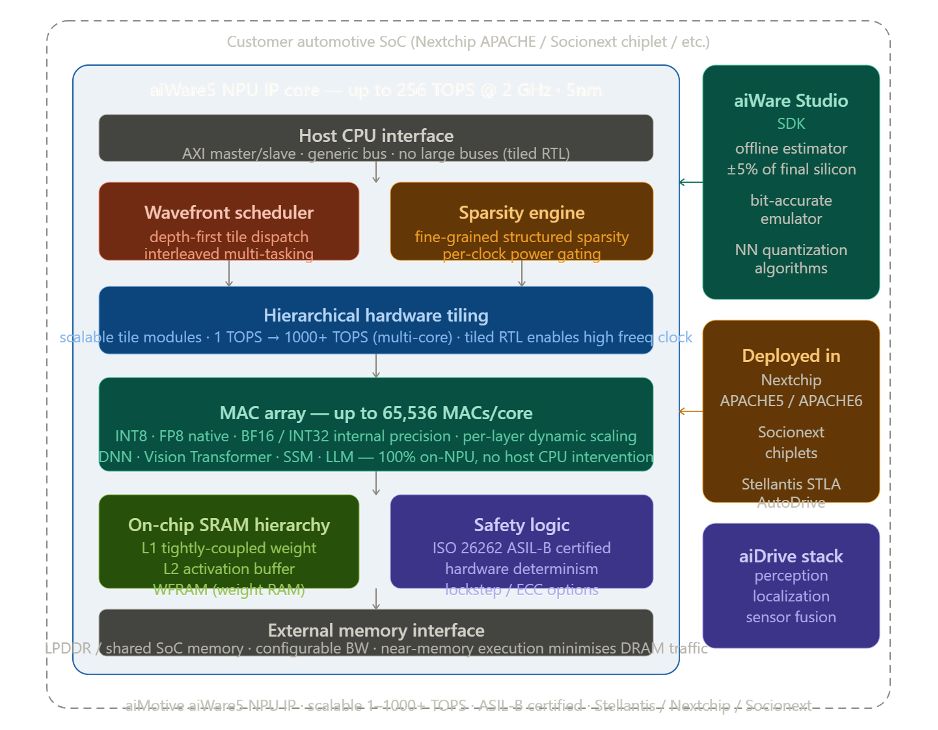
Figure 1. Apache5/Apache6 chip block diagram. (Source: JPR)
Each core supports up to 65,536 MACs at BF16 or INT32 internal accuracy; native INT8 and FP8 execution, with per-layer dynamic scaling. The support function library—activation, pooling, unary, binary, tensor shaping, attention, linear—covers everything needed to run DNN, Vision Transformer, State Space Model, and LLM inference without host CPU intervention. Multi-input, multi-headed network execution runs natively. That’s not a minor feature—production ADAS perception networks process camera, lidar, and radar inputs simultaneously. Most NPU benchmarks don’t test that. Most NPU vendors don’t explicitly support it.
The SDK and simulation stack
The aiWare Studio SDK includes an offline performance estimator that delivers results within 5% of final silicon on any desktop PC. No special hardware. No pre-silicon emulation rig. Just a desktop and the SDK. For automotive programs where schedule pressure is constant and pre-silicon hardware is scarce and expensive, that’s a real capability—not a marketing bullet point.
The GPU-accelerated bit-accurate emulator runs SIL testing without target hardware. Teams use existing cloud or on-premises GPUs instead of building dedicated lab infrastructure. The SDK also ships with quantization algorithms and supports custom quantization strategies for teams whose networks need something tighter than standard approaches.
The whole stack integrates with aiDrive. So buying aiWare isn’t just buying an NPU—it’s buying into a co-designed software-hardware platform where the inference engine and the ADAS software were built to work together. That’s a different proposition from sourcing an NPU and then integrating someone else’s driving stack on top of it.
Why Stellantis bought them
Stellantis announced the acquisition November 17, 2022. It closed December 22, 2022. The stated rationale was to accelerate the STLA AutoDrive platform—Stellantis’ autonomous driving stack underpinning its Dare Forward 2030 strategy, which targets €20 billion in annual software-enabled revenues by decade’s end.
At the time of acquisition, Stellantis had no hands-free driving capability on any of its vehicles. GM had Super Cruise. Ford had BlueCruise. So buying a 200-person team with production-validated ADAS AI IP was faster and probably cheaper than building that capability internally, especially given the schedule pressure Stellantis was under.
Kishonti stays as CEO. aiMotive operates independently within Stellantis, start-up culture intact. And—this is the interesting part—Stellantis kept the external licensing business running. aiData, aiSim, and aiWare continue to sell to other OEMs and Tier 1s outside the Stellantis ecosystem. That’s an unusual move for an acquirer. It means Stellantis wanted the team and the technology platform not exclusivity. Or they wanted the revenue. Probably both.
One correction worth making: The acquirer is Stellantis, not Bosch. Bosch Venture Capital was an investor in an early round. The two facts are sometimes conflated. They shouldn’t be.
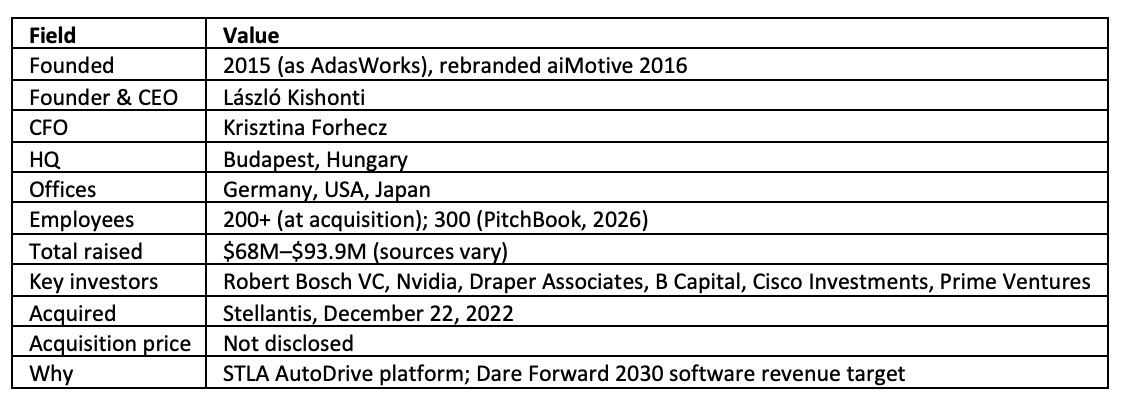
Table 1. aiMotive’s overview.
Stellantis acquiring aiMotive fits a pattern that’s becoming common across the automotive industry: OEMs without in-house AI silicon expertise face a structural problem as ADAS moves to centralized compute platforms. Buying a team that already solved it is faster than building one. aiWare5’s 256 TOPS scalability from sensor edge to central compute, the aiWare Studio simulation infrastructure, and the aiDrive software co-design give Stellantis a development-to-production pipeline that would take years to assemble from separate vendors. And the external licensing continues—so aiMotive’s IP reaches programs beyond Stellantis, which keeps the team technically honest and the IP commercially relevant. That’s a smart structure.
What do we think?
aiMotive built the right thing. Production-validated NPU IP with an SDK that estimates silicon accuracy within 5% before tape-out—that claim either holds up in customer programs or it doesn’t, and the fact that Tier 1s were using it before Stellantis came along suggests it does. The acquisition terms weren’t disclosed, but the fact that Stellantis kept the external licensing business running suggests the IP has enough market value that shutting it down would have been a waste. We think it was a good deal for everyone involved.
The Stellantis-aiMotive acquisition marks an inflection point in automotive AI procurement: the moment OEMs recognized that licensing NPU IP on standard terms creates roadmap dependency they can’t manage for production ADAS programs with five-year development cycles. That inflection point is now driving vertical integration across the industry—OEMs and Tier 1s acquiring AI silicon and software teams outright rather than negotiating IP agreements. aiWare5’s range from 1 TOPS to 1,000+ TOPS confirms that the NPU is no longer a component selection decision. It’s a platform architecture commitment, and OEMs are making it by buying the people who built the platform.
The external licensing continuity confirms, and the product-to-production pipeline that the aiWare Studio + aiDrive combination provides the understanding for the correction of the Bosch misattribution.
The aiMotive Apache is but one of the 152 AI processors in our AI Processor Tracking Service, which also lists performance and other specifications for 291 products.
LIKE WHAT YOU’RE READING? DON’T KEEP IT A SECRET, TELL YOUR FRIENDS AND FAMILY, AND PEOPLE YOU MEET IN COFFEE SHOPS.