
AMD just pushed a significant update to its FSR rendering SDK, and if you develop games or follow GPU technology, this one is worth paying attention to. The FSR Redstone SDK 2.2 brings sharper upscaling, better ray-tracing denoising, and smoother frame generation—all powered by ML running on RDNA 4 hardware. The catch: Several of the headline features require the new RX 9000-series GPUs. Here’s what changed, what it means for developers, and why it matters for the broader AI-in-graphics story.
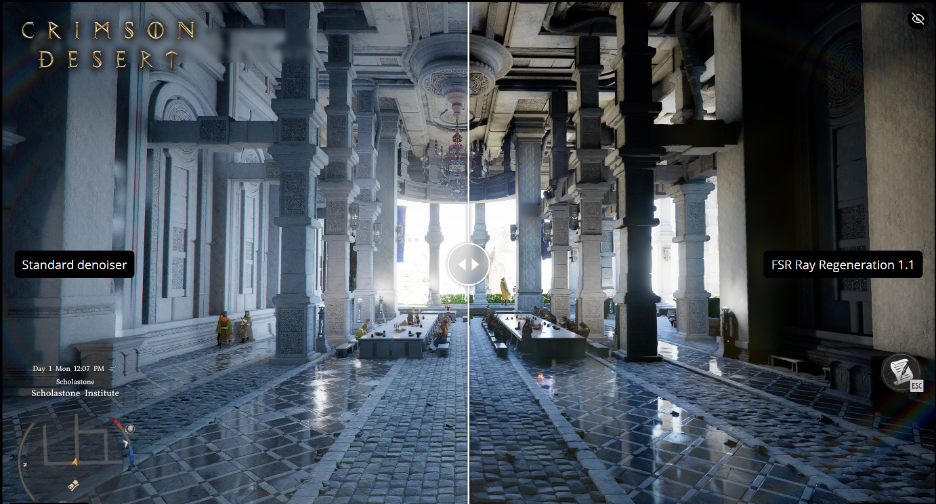
Crimson Desert standard denoiser vs. FSR Ray Regeneration 1.1 (captured with Radeon RX 9070 XT & Ryzen 7 9800X3D—4K cinematic game settings).
AMD released FSR SDK 2.2, the first major update to its Redstone neural rendering platform since the December 2025 launch. The release updates two core ML-powered technologies—FSR Upscaling 4.1 and Ray Regeneration 1.1—and ships Frame Generation 4.0 and Radiance Caching 0.9 as a technical preview alongside the Adrenalin 26.3.1 driver.
FSR Upscaling 4.1 targets the primary weakness of its predecessor: motion artifacts. FSR 4.0 introduced ML-based reconstruction that matched or exceeded native rendering quality at lower cost, but exhibited softening and temporal instability when objects moved across the frame. The 4.1 update revises the inference model, producing sharper detail retention on vegetation, fine textures, and small geometry during motion. Ultra-performance and dynamic resolution scaling modes also improve. Pearl Abyss validated the update in Crimson Desert, the first title to ship with FSR Upscaling 4.1.
Ray Regeneration 1.1 updates AMD’s ML denoiser for ray-traced workloads. The denoiser processes noisy RT output in real time, reconstructing shadow depth, lighting coherence, and scene clarity without increasing rendering cost. Version 1.1 adds memory efficiency improvements and debug view modes alongside quality gains. Crimson Desert is also the launch title for Ray Regeneration 1.1 developers should note that version 1.1 introduces ABI (application binary interface) breaking changes from 1.0, requiring integration updates.
Frame Generation 4.0 inserts ML-interpolated frames between rendered frames, increasing perceived frame rate without additional GPU rendering load. Radiance Caching 0.9—still in technical preview—improves global illumination efficiency by caching radiance data across frames rather than recomputing it per frame.
Hardware constraints apply to the ML-powered features. FSR Upscaling 4.0 and 4.1, Ray Regeneration, and Radiance Caching all require RDNA 4-based RX 9000-series GPUs. Ray Regeneration 1.1 and Radiance Caching additionally require DX12 Shader Model 6.6 via the DirectX 12 Agility SDK 1.4.9 or later. Analytical fallback modes—FSR 3 for upscaling and frame generation—remain available for RDNA 3.5 and earlier hardware, preserving broad compatibility. Vulkan support is absent from SDK 2.2; AMD has not confirmed whether DX12-specific dependencies preclude it from future releases.
AMD has also consolidated branding under the FSR name, retiring the FidelityFX label across the SDK. All upscaling, frame generation, denoising, and illumination technologies now ship under a unified FSR identity, simplifying developer integration and in-game UI labeling.
What do we think?
FSR 4.1’s motion stability fix addresses the most visible gap in the 4.0 launch. Ray Regeneration 1.1, with memory improvements, signals that AMD is treating denoising as a first-class rendering component, not a bolt-on. The RDNA 4 hardware lock on ML features creates a narrow addressable install base today—adoption breadth depends on the RX 9000 series’ market penetration. JPR will track developer integration rates across titles shipping in H2 2026.
FSR Redstone SDK 2.2 marks an inflection point in how GPU vendors ship rendering technology. For two decades, improvements in rendering quality required either faster rasterization or more ray-tracing cores. AMD’s ML-inference pipeline shifts that model—quality now improves through software updates to neural networks running on fixed silicon. The implication is structural: A GPU purchased today can receive material rendering-quality improvements via SDK updates for years, decoupling hardware capability from software advancement in a way the industry has not seen before.
LIKE WHAT YOU’RE READING? TELL YOUR FRIENDS; WE DO THIS EVERY DAY, ALL DAY.