
China’s AI computing buildout is accelerating fast, and Biren Technology is positioning itself at the center of it. As domestic demand for AI inference and training silicon surges—driven by agentic AI adoption, falling inference costs, and government policy—Biren’s full-stack GPU approach gives it a credible shot at capturing meaningful share of a market that Nvidia can no longer fully serve. This is a company worth watching closely, whether you’re tracking China AI infrastructure, competitive GPU architectures, or the geopolitics of semiconductor supply chains.

Biren Technology, founded in Shanghai in 2019, has built China’s most technically complete domestic AI-GPU platform in under six years. Co-founder and CEO Lingjie Xu previously led GPU architecture teams at AMD, and the founding team draws heavily from Nvidia, AMD, Intel, and leading Chinese chip design houses—a deliberate talent aggregation strategy that gave Biren its architectural credibility from Day One. The company currently employs approximately 1,500 people across Shanghai, Beijing, and several regional offices, with the majority of its workforce concentrated in chip architecture, software stack development, and systems engineering.
Biren has raised approximately $900 million across multiple funding rounds. Its investors include Sequoia China, Tencent, Alibaba, IDG Capital, and several state-backed investment funds—a funding consortium that reflects both commercial validation and the strategic importance Beijing assigns to domestic AI silicon independence. The company’s valuation at its most recent round reached approximately $2.6 billion, making it one of the most heavily capitalized domestic Chinese GPU developers. Biren Technology officially listed on the Hong Kong Stock Exchange on the first trading day of 2026. This was a landmark event for the Chinese semiconductor industry.
The company’s product line centers on its GPU architecture, which started as a general-purpose GPU compute design optimized for AI training and inference workloads rather than graphics rendering. The BR100 series established Biren’s initial data center presence. The BR200 series, currently in early commercialization, brings a more competitive cost structure and a refined software stack under the BIRENSUPA platform. The BR300 series, targeting volume shipments from the second half of 2026, carries the product-market fit that Biren’s growth model depends on—better performance per watt, tighter integration with domestic supply chain partners, and an AI software stack increasingly optimized for domestic LLM architectures, including DeepSeek V4.
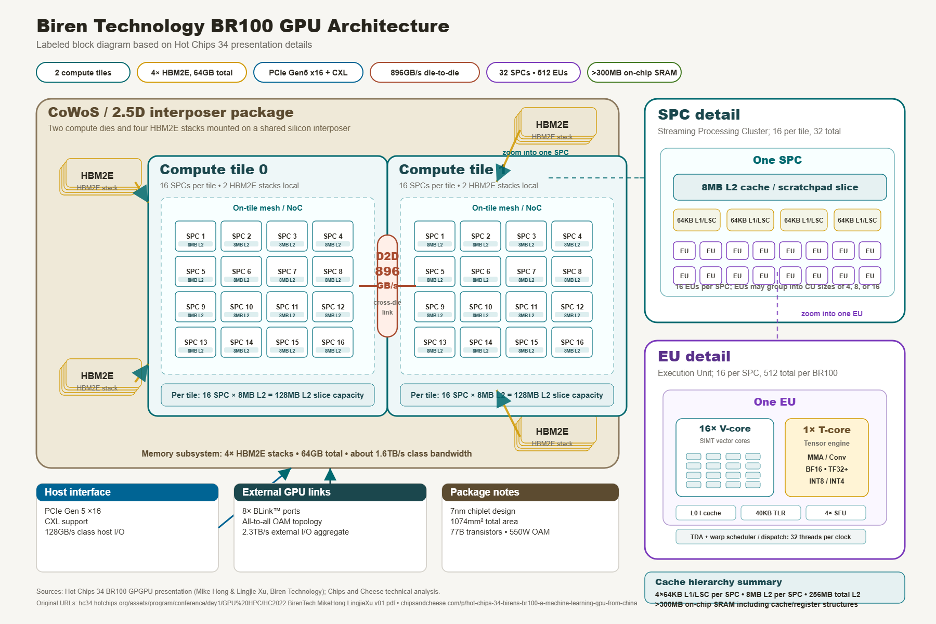
Figure 1. Biren Technology’s BR100 AI GPU.
The demand driver behind Biren’s growth projections is structural, not cyclical. China’s token consumption—the raw measure of AI inference and training compute demand—follows an exponential trajectory. It’s been suggested that China could see a 1,155% CAGR in compute consumption through 2030, driven by agentic AI adoption, declining per-token inference costs that expand addressable use cases, and government-mandated data localization requirements that push enterprise AI workloads onto domestic silicon. Products like OpenClaw and Claude Code equivalents in the Chinese market drive the agentic AI demand surge specifically—multi-step reasoning tasks consume dramatically more tokens per query than single-turn inference, multiplying GPU hours per user session.
Biren’s positioning in this environment rests on two advantages that foreign vendors can’t easily replicate. The first is full-stack domestic integration: Biren delivers chips, systems, high-speed interconnects, networking, and optimized software as a single validated stack, very much like Nvidia does. Enterprise and cloud customers in China increasingly require this integrated delivery model rather than purchasing silicon and assembling their own software environments. The second advantage is supply chain localization—Biren partners exclusively with domestic foundries, packaging facilities, memory suppliers, and board manufacturers. As US export controls progressively restrict advanced chipmaking equipment access, domestic supply chain depth becomes a durable competitive moat rather than a temporary cost disadvantage.
The financial model reflects aggressive but achievable targets given the demand environment. Biren’s GPGPU shipment volume grows from an estimated 13,100 units in 2025 to 106,000 units in 2028—a 101% shipment CAGR. Revenue grows at 137% CAGR over the same period, with profit breakeven projected from 2027 as BR200- and BR300-series margin structures improve on higher volumes. The initiation price target of HK$74.43 (US$9.50) applies a 20× multiple to 2027 estimated revenue—an aggressive but defensible multiple given the growth rate and strategic positioning.
Three risks define the downside case. Supply chain vulnerability remains the most immediate: Domestic foundry yields at advanced nodes trail TSMC, and packaging capacity constraints could delay BR300 volume ramp. R&D execution risk follows—Biren operates at the frontier of what Chinese domestic silicon can achieve, and schedule slippage on BR300 would push breakeven beyond 2027. Geopolitical risk completes the picture: US pressure on third-country vendors supplying Biren, or secondary sanctions targeting its investors, could disrupt the funding and supply ecosystem that the growth model depends on.
What do we think?
Biren represents the most credible domestic Chinese challenge to Nvidia’s data center GPU dominance at this stage of development. Its full-stack approach, domestic supply chain integration, and talent base differentiate it from Chinese GPU start-ups that ship chips without software. The 137 revenue CAGR looks aggressive but aligns with the structural demand trajectory. The critical variable is BR300 execution—if Biren ships at volume in H2 2026 with competitive performance metrics, the growth model holds. If BR300 slips into 2027, the financial case weakens significantly.
Biren’s trajectory marks an inflection point in the global AI silicon landscape—not because one Chinese company is growing fast, but because the structural conditions that made Nvidia’s dominance self-reinforcing are fracturing simultaneously. Export controls accelerate domestic demand. Domestic LLMs optimize specifically for local hardware. Government policy backstops procurement. The inflection point arrives when a domestic GPU vendor ships at scale with a validated software ecosystem—the moment enterprise buyers no longer treat domestic silicon as a fallback option but as the primary procurement choice. Biren’s 2026–2027 BR300 ramp is the test of whether that inflection has arrived.
LIKE WHAT YOU’RE READING? INTRODUCE US TO YOUR FRIENDS AND COLLEAGUES.