
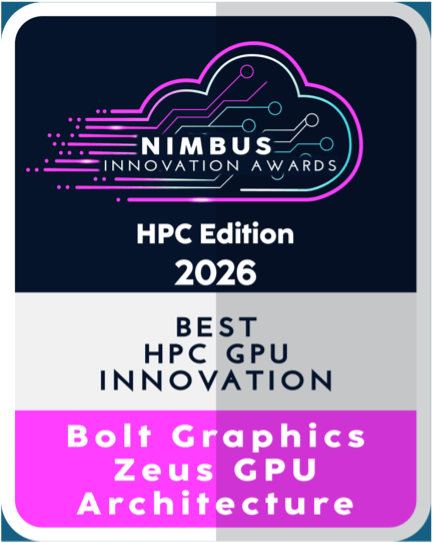
Bolt Graphics has won the Nimbus Innovation Award for Best HPC GPU Innovation, adding external recognition to its still-early Zeus GPU story. The company is positioning Zeus around FP64, large memory capacity, and low power consumption—three attributes that matter in HPC. At ISC, Bolt told us its 12 nm test chip has taped-out and is being brought up, with first products targeted for December 2027 and ramp expected in 2028.
(Source: Nimbus)
Bolt Graphics has won the Nimbus Innovation Award for Best HPC GPU Innovation, a useful validation point for a company trying to enter one of the least forgiving markets in computing.
The award comes after Bolt’s earlier tape-out of its Zeus GPU test chip, a milestone we covered in April. Zeus is not being pitched as another peak-performance monster chasing Nvidia or AMD on their home turf. Instead, Bolt is aiming at a gap in the market: HPC and rendering workloads where cost, power, memory capacity, and FP64 matter more.
In a short statement, Bolt thanked the Nimbus Innovation Awards and said: “FP64, massive memory capacity, and low power consumption are all things we’re proud to bringing to the HPC market in the future.” That is the right shopping list. HPC customers care about double precision. They care about memory capacity. Increasingly, they care very much about power.
At ISC, Bolt told us the Zeus 12 nm test chip has taped-out and is being brought up, with “all signs” pointing positively. The company also reiterated its move toward TSMC 5 nm and said it is targeting first product delivery in December 2027, with ramp in 2028. Bolt also emphasized that rendering remains core to the company’s identity but framed the broader technical problem as “light transport,” with path tracing sitting inside that larger ambition.
The company previously claimed Zeus could reduce compute costs by up to 17× versus incumbent approaches, and claimed a product pipeline of more than $500 million, along with over 14,000 early access members.
What do we think?
The GPU market has spent years optimizing for peak performance, AI momentum, and software lock-in. Bolt is trying to reframe the conversation around cost per useful unit of compute, FP64 availability, memory capacity, and power efficiency. HPC has many workloads that do not map cleanly onto AI-first accelerators, and rendering still has large pools of compute running on CPUs because GPU economics, memory limits, or software friction get in the way. Tape-out de-risks part of the architecture, but bring-up, production economics, and closure on that pipeline will decide Zeus’ success.
LIKE WHAT YOU’RE READING? INTRODUCE US TO YOUR FRIENDS AND COLLEAGUES.